Abstract
Introduction: Professional nurses are trained to provide
direct care; however, in hospital settings, they
delegate tasks to nursing assistants, which can lead to adverse events and patient dissatisfaction.
Objective: To analyze basic and specialized nursing care activities, classifying them
according to the scope of
competence and level of criticality. Materials and Methods: This cross-sectional
observational study was conducted
between June 2021 and January 2022 and included 141 professional nurses and 259 nursing assistants
from a university hospital in Bogotá. A structured questionnaire was used to record the activities
performed by both roles, along with their frequency and execution time. Expert consensus was established
regarding
the set of nursing care activities, their alignment with each role’s scope of practice, and the
classification of critical activities representing a risk when delegated. Descriptive analysis
identified who performed
each activity, along with its frequency and execution time. Bivariate analysis assessed differences
between
the activities performed. Results: A total of 40 basic nursing activities and 17
specialized nursing
activities were identified, of which 18 were classified as critical. Significant differences were
observed between
nursing assistants and professional nurses in the performance and frequency of activities, including
neurological assessment, pain management, and medication monitoring. Discussion: The
delegation of critical
activities to nursing assistants, driven by the multiplicity of administrative and care-related tasks
and by
inadequate staffing of professional nurses, highlights the need to examine the negative consequences for
patients.
Conclusion: At the hospital evaluated, nursing assistants perform activities that,
given the required
level of competence and the risks involved, should be carried out by professional nurses.
Keywords: Delegation, Professional; Nursing Care; Nurse’s Role;
Nursing Assistants; Nurses, Professional
Training.
Resumen
Introducción: El profesional de enfermería, formado para brindar
cuidados directos; en el ámbito hospitalario delega tareas al personal
auxiliar, esto puede generar eventos adversos e insatisfacción en
los pacientes. Objetivo: Analizar actividades de cuidado básico y
especializado realizadas por enfermería, clasificándolas según su
correspondencia y criticidad conforme a la formación. Materiales y
Métodos: Estudio observacional transversal, que entre junio 2021 y
enero 2022 incluyó a 141 profesionales y 259 auxiliares de un hospital
universitario en Bogotá. A través de un cuestionario estructurado,
se registraron las actividades realizadas por ambos roles, así como
la frecuencia y tiempo de ejecución, se establecieron consensos
de expertas, sobre el conjunto de actividades asistenciales, la
correspondencia según el rol y clasificación de actividades críticas
que representan un riesgo al ser delegadas. El análisis descriptivo
identificó quién realizó la actividad, la frecuencia y el tiempo de
ejecución. El bivariado, evaluó diferencias entre las actividades
ejecutadas. Resultados: Se identificaron 40 actividades de cuidado
básico y 17 de especializado, de ellas 18 se consideraron críticas.
Hubo diferencias significativas entre auxiliares y profesionales en la
ejecución y frecuencia de actividades como valoración neurológica,
manejo del dolor y monitoreo farmacológico. Discusión: Delegar
actividades críticas al personal auxiliar por la multiplicidad de
tareas y la escasa contratación de profesionales conduce a examinar
circunstancias negativas para los pacientes. Conclusión: En el
hospital evaluado, el personal auxiliar realiza actividades que por su
nivel de formación y por el riesgo que suponen corresponderían, al
profesional de enfermería.
Palabras Clave: Delegación Profesional; Cuidado de Enfermería; Rol
de la Enfermera; Auxiliares de Enfermería; Enfermeras, Capacitación
Profesional.
Resumo
Introdução: Os profissionais de enfermagem são treinados
para prestar cuidados diretos; eles delegam
tarefas à equipe auxiliar no ambiente hospitalar. Isso pode levar a eventos adversos e insatisfação do
paciente.
Objetivo: Analisar as atividades de cuidado básico e especializado realizadas por
enfermeiros,
classificando-as
de acordo com sua relevância e criticidade com base em sua formação. Materiais e
Métodos: Foi realizado
um estudo observacional transversal entre junho de 2021 e janeiro de 2022, incluindo 141 enfermeiros e
259
auxiliares de enfermagem de um hospital universitário em Bogotá. Um questionário estruturado foi
utilizado
para registrar as atividades realizadas por ambos os grupos, bem como sua frequência e tempo de
execução. O
consenso entre especialistas foi estabelecido em relação ao conjunto de atividades de cuidado, sua
relevância
para cada grupo e a classificação das atividades críticas que representam um risco quando delegadas. A
análise
descritiva identificou quem realizou cada atividade, sua frequência e tempo de execução. A análise
bivariada
avaliou as diferenças entre as atividades realizadas. Resultados: Foram identificadas
40 atividades de
cuidado
básico e 17 atividades de cuidado especializado; Dezoito dessas atividades foram consideradas críticas.
Foram encontradas diferenças significativas entre auxiliares de enfermagem e profissionais de enfermagem
na execução e frequência de atividades como avaliação neurológica, manejo da dor e monitoramento
farmacológico. Discussão: Delegar atividades críticas a auxiliares de enfermagem devido
à multiplicidade
de tarefas e à contratação limitada de profissionais de enfermagem leva a consequências negativas para
os
pacientes. Conclusão: No hospital avaliado, os auxiliares de enfermagem realizam
atividades que, dado
seu
nível de formação e os riscos envolvidos, deveriam ser executadas por profissionais de enfermagem.
Palavras-Chave: Delegação Vertical de Responsabilidades
Profissionais; Cuidados de Enfermagen; Papel
do Profissional de Enfermagem; Assistentes de Enfermagem; Enfermeiras; Capacitação Profissional.
Introducción
In hospital settings, direct care provided by professional nurses is essential
for achieving better health
outcomes1; showever,
the nursing workforce is currently insufficient to meet care demands2.
This situation leads to the delegation of professional nursing activities to nursing
assistants3.
These
practices should be examined more thoroughly to determine which activities can or cannot be
delegated, considering education and competencies, in order to ensure care quality and
safety4,5. Task, circumstance,
person, directions and communication, and supervision and evaluation are the
five principles of appropriate delegation6; however, inadequate delegation may lead to
adverse
events, delays in care, and patient dissatisfaction7, 8.
In the United States and Canada, nursing delegation is regulated by national
guidelines9,
10
that
distinguish three categories of healthcare personnel: Registered nurses (RN), professional
nurses with 4
years of university education focused on clinical reasoning, planning, supervision and
administration11;
licensed practical nurses/licensed vocational nurses (LPN/LVN), who complete 12- to 18-month
technical education programs in the United States11, and 2- to 3- year postsecondary technical
education
programs in Canada12;
and are oriented toward basic and intermediate patient care, with more specific
competencies than nursing assistants and partial autonomy, as they work under RN
supervision11.
Finally, unlicensed assistive personnel or healthcare assistants (UAP and HCA), whose education
ranges
from a few weeks to 6 months and is not formally regulated in Canada, are focused on basic
patient
care and always work under RN supervision. In these countries, the registered nurse (RN) remains
responsible for the delegated tasks, which are delegated only when the delegatee demonstrates
competence and the tasks involve low clinical risk10, 11.
In Brazil, the Conselho Federal de Enfermagem (COFEN)13 establishes three
categories of nursing
personnel: nurses, with 4-5 years of university education focused on comprehensive care,
planning,
and supervision; nursing technicians, with 2 years of postsecondary technical education focused
on
intermediate care and specific procedures under nurse supervision; and nursing assistants, with
one
year of secondary-level education oriented toward basic patient care13. In Colombia, the
nursing
education and service delivery model is binary—that is, professional nurses and nursing
assistants—
and there is no formally validated national system of delegable responsibilities14-16. Other countries
have their own defined models of practice and task delegation9, 10.
In Colombia, undergraduate nursing education lasts between 4 and 5 years, and its scope of
practice
includes basic and specialized nursing care grounded in a comprehensive view of the care
recipient15,
autonomy14 and the
promotion of human development16, 17. Nursing assistants complete 1 to 2 years
of secondary-level technical education focused on basic comprehensive patient care18 and perform
their duties under the direct supervision of healthcare professionals19,20. Therefore,
professional
nurses may delegate activities to nursing assistants when, based on an assessment of factors
such as
time, setting, and person, delegation is considered appropriate14,21.
Given the lack of formal mechanisms for delegation, it is concerning that nursing
assistants in
Colombia assume responsibilities beyond their competence22,23.
Furthermore, few studies have
examined in depth the role of nursing personnel, the largest workforce in the healthcare
sector16. In
tertiary care hospitals, the distribution of nursing personnel varies by service type, whether
basic or
specialized24.
Professional nurses devote time to administrative tasks25,26 and delegate direct patient
care, increasing the probability of adverse events and diminishing the visibility of their work
within
the healthcare system and society at large16,27.
Basic nursing care focuses on meeting patients’ basic daily needs, such as hygiene, feeding,
mobility,
and repositioning, and falls within the scope of practice of nursing assistants. In contrast,
specialized
nursing care involves more complex activities requiring clinical judgment and advanced
education,
such as vascular access procedures, catheterization, wound care, and medication administration,
which fall within the scope of practice of professional nurses28,29. Direct care provided by professional
nurses promotes interpersonal relationships and enhances communication within the therapeutic
process. These practices are based on nursing models and on the Nursing Interventions
Classification
(NIC)30.
This study analyzed basic and specialized nursing activities performed by nursing assistants
that fall
outside their scope of practice. To address this issue, the guiding research question was as
follows:
Which activities performed by nursing assistants in a university hospital in Bogotá fall outside
their
scope of practice, given their competence level? Addressing this question represents an initial
step
toward organizing the distribution of role-specific activities and may positively affect
humanized
patient care, healthcare team functioning, and nursing documentation.
Materials and Methods
A cross-sectional observational study was conducted. Participants included nursing assistants
with 18 months of vocational education and a technical qualification as a nursing assistant, as
well
as professional nurses with four to five years of university education and a formal nursing
degree.
Both groups provided patient care during morning, afternoon, full-day, or night shifts at two
sites of
a tertiary care university hospital located in Bogotá, Colombia. The nursing population at the
study
hospital consisted of 740 nursing assistants and 276 professional nurses. The inclusion
criterion was
active involvement in direct patient care. The sample size calculation was based on the
hospital’s total
nursing staff population, and the different hospital services were weighted by the number of
nursing
assistants and professional nurses assigned to each. A prevalence of role-specific activities
based on
uncertainty (p)31
was used, employing the statistical software Epi Info, version 7.2.2.6. Finally, a random
sample of 161 professional nurses and 253 nursing assistants was determined to estimate a
population
event proportion of 50% at the 95% confidence level and 80% statistical power.
Data collection
During meetings with nursing staff, the nursing department provided the research team with time
to
invite all personnel to participate in the study. Participant enrollment was consecutive until
the target
sample size was reached. Data were collected between June 2021 and January 2022 using a
selfadministered
survey or a survey administered by trained research assistants. Surveys were completed
at the end of the shift to facilitate recall and took an average of 25 minutes.
Measurements
Based on the Nursing Interventions Classification (NIC)30 and the protocols of the institution where
the
study was conducted, the researchers developed a questionnaire to assess the activities
performed
during each shift. The instrument collected sociodemographic information, such as age, sex, and
education; occupational variables, including shift, service, role performed, clinical
experience, and
length of employment at the institution; and variables related to the research topic, including
the
activity performed, its frequency, and the time required for its completion.
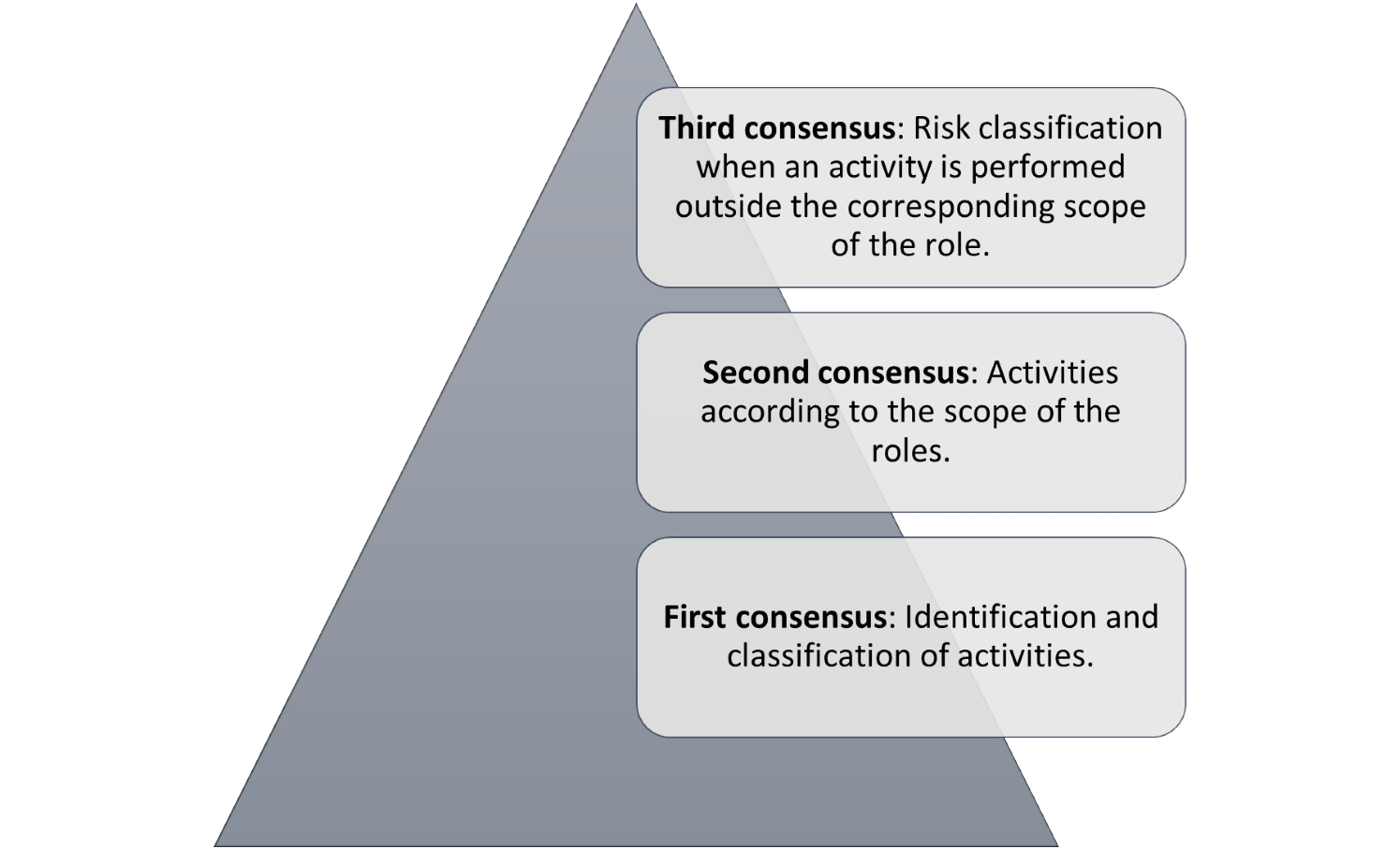
The researchers reached consensus on the activities performed by nursing personnel during each
shift,
defining five categories: basic nursing care, specialized nursing care, education and
communication, management, and other activities not directly related to patient care but
assigned to nursing personnel.
An Excel matrix was used with the activities listed in the first column and the five categories
in the
subsequent columns. Each activity was classified into a category when at least 75% of the group
reached
agreement. This manuscript presents information on basic and specialized nursing care.
To determine whether an activity fell within the scope of practice of nursing assistants or
professional
nurses, a second consensus process was conducted using the same procedure described above. The
same approach was used to identify risk or critical situations in which an activity performed by
a
nursing assistant fell within the scope of practice of a professional nurse because it required
specialized
competence or involved a higher level of complexity Figure 1.
Figure 1: Representation of the three consensus processes conducted in
the study
Basic nursing care corresponded to activities aimed at providing patient comfort and safety, as
well as
procedures such as medication administration, peripheral vascular access, nasogastric or
orogastric
intubation, urinary catheterization, and neurological assessment. Specialized nursing care
included
activities performed by nursing staff for patients or services requiring greater complexity of
care, such
as fetal monitoring, chemotherapy administration, and post-anesthesia care32.
Hospitalization, emergency, internal medicine, and gynecology services were classified as
general
services, whereas operating rooms, delivery rooms, intensive care units, neonatology, the
kangaroo
care program, and oncology were classified as specialized services. Regarding shift duration,
morning
and afternoon shifts lasted 6.5 hours, whereas night shifts lasted 12.5 hours.
Data analysis
Sociodemographic variables, occupational variables, and activities were described using absolute
and
relative frequencies, medians, and minimum and maximum values, depending on the variable type
and
distribution. Based on the consensus regarding role-specific activities, activities classified
as critical in
each category were selected to estimate whether statistically significant differences existed
between nursing assistants and professional nurses regarding the number of responses indicating
performance
of the activity, using the chi-square test or Fisher’s exact test, as appropriate, and the
median frequency
and duration of these activities using the Mann-Whitney test. Calculations of median frequency
and
time were based on the maximum values, as these were considered to represent the extreme values
for
both activity frequency and duration. All collected data are freely available for access and
consultation
through Mendeley Data33.
Ethical considerations
The research project was approved by the Institutional Research and Ethics Committee of
Universidad
del Rosario, approval number DVO005 983-CV1165. All the participants provided signed informed
consent.
Results
A total of 400 individuals participated in the study, including 259 nursing
assistants and 141 professional
nurses. Most participants were female, between 18 and 35 years of age, and had educational
backgrounds consistent with their roles, except for two respondents with nursing degrees who
were
working as nursing assistants. Most participants worked morning shifts in non-specialized
services,
and nursing assistants had longer clinical experience and longer tenure at the institution Table 1.
Table 1. Participants’ socio-demographic characteristics: Qualitative variables
X
Table 1. Participants’ socio-demographic characteristics: Qualitative
variables
|
Variables
|
Survey
|
Nursing
assistants
n=259
% (n)
|
Professional
nurses
n=141
% (n)
|
| Sex |
|
|
|
Female
|
83.78 (217) |
80.85 (114) |
|
|
Male
|
16.21 (42) |
19.14 (27) |
|
| Age |
|
18
to 35 years |
63.32 (164) |
65.95 (93) |
|
|
36
to 55 years |
32.43 (84) |
32.62 (46) |
|
|
56
to 65 years |
4.24 (11) |
1.41 (2) |
|
| Educational
level
|
|
|
|
Postgraduate
degree
|
0 (0) |
13.47 (19) |
|
|
Nursing
degree
|
0.77 (2) |
86.52 (122) |
|
|
Technical
qualification
|
99.22 (257) |
0 (0) |
|
| Shift
|
|
|
|
Morning
|
37.45 (97) |
29.78 (42) |
|
|
Afternoon
|
27.41 (71) |
35.46 (50) |
|
|
Full
daytime shift
|
3.86 (10) |
4.96 (7) |
|
|
Night
|
31.27 (81) |
29.78 (42) |
|
| Services
|
|
|
|
General
|
57.91 (150) |
64.53 (91) |
|
|
Specialized
|
42.08 (109) |
35.46 (50) |
|
Identification of activities
In basic nursing care, a total of 40 activities were identified, of which 17 fell within the
scope of practice of
professional nurses, 18 within that of nursing assistants, and 5 were shared by both roles.
In specialized
nursing care, a total of 17 activities were identified: 10 within the scope of practice of
professional
nurses, 5 within that of nursing assistants, and 2 shared by both roles.
Role-specific activities
Basic nursing activities
Among the 259 nursing assistants, 37.45% reported performing neurological assessments,
compared
with 26% of the 141 professional nurses, a statistically significant difference (p=
0.02). However, no
statistically significant differences were observed in the frequency or time spent
performing this activity
between roles. Nursing care for pain management was performed by 24.71% of the nursing
assistants
and 34% of the professional nurses (p= 0.04). When evaluating the frequency of activity
performance,
nursing assistants reported monitoring medication effects a median of 9 times, whereas
professional
nurses reported performing this activity 4 times (p= 0.00). Medication administration
was the most
time-consuming activity among professional nurses, whereas specialized specimen
collection for
testing required the most time among nursing assistants
Table 2.
Table 2. Critical basic nursing activities reported in the survey
X
Table 2. Critical basic nursing activities reported in the survey
Activity
performed during the shift
Yes |
Frequency |
Time (minutes)
|
| Activity
|
Nursing
assistant
n=259
%(n) |
Professional
nurse
n=141
%(n)
|
p-value |
Nursing
assistant
n=259
Med [IQR]
|
Professional
nurse
n=141
Med [IQR]
|
p-value |
Nursing
assistant
n=259
Med [IQR]
|
Professional
nurse
n=141
Med [IQR]
|
p-value |
Medication
administration |
5.79 (15) |
80.14 (113) |
0.01 |
7[3;22] |
3[2;4] |
0.03 |
6 [3;10] |
60[30;90] |
0.01 |
Monitoring
of medication
effects
|
5.41 (14) |
41.13 (58) |
0.01 |
9 [4;30] |
4[3;6] |
0.01 |
8 [2;10] |
14[9;38] |
0.02 |
Parenteral
nutrition
administration
|
5.41 (14) |
8.51 (12) |
0.22 |
1[1;2] |
3[1;5] |
0.38 |
4 [2;6] |
10[10;15] |
0.01 |
|
Drainage care
|
13.90 (36) |
8.51 (12) |
0.11 |
2 [1;3] |
2[2;3] |
0.51 |
5 [3;10] |
10[10;15] |
0.01 |
Nasogastric
intubation
|
4.25(11) |
10.64 (15) |
0.01 |
2 [1;2] |
2[2;3] |
0.51 |
15 [8;18] |
15[14;28] |
0.76 |
Orogastric
intubation
|
3.09 (8) |
7.80 (11) |
0.03 |
2 [2;2] |
2[2;3] |
0.65 |
15 [6;16] |
15[11;23] |
0.49 |
Specialized
specimen
collection and
blood cultures |
23.2 (6) |
19.15 (27) |
0.01 |
2 [1;3] |
2[2;3] |
0.42 |
23[16;29] |
35[18;60] |
0.12 |
Nursing
care for pain
management
|
24.71 (64) |
34.04 (48) |
0.04 |
6[3;10] |
6[3;17] |
0.40 |
5 [3;10] |
10[5;13] |
0.01 |
Neurological
assessment |
37.45 (97) |
26.24 (37) |
0.02 |
8 [3;10] |
8[3;17] |
0.27 |
4[2;10] |
10[3;15] |
0.01 |
Med: Median; IQR:
Interquartile range; The tests used to evaluate differences between
assistants and professionals regarding
whether or not they performed the activity were the Chi-square and
Fisher's exact tests, and the
test used to evaluate differences
regarding frequency and execution time was the Mann-Whitney test.
Specialized nursing activities
Both nursing assistants and professional nurses reported performing the 9 critical activities.
Statistically
significant differences between roles were observed in reporting, frequency, and time devoted
to injection administration, specialized services, assessment of diagnostic test results, and
clinical
documentation
Table 3.
Table 3. Specialized nursing activities reported in the survey
X
Table 3. Specialized nursing activities reported in the survey
| Number of participants
|
Frequency |
Time (minutes) |
| Activity |
Nursing
Assistant
n=259
%(n)
|
Professional
Nurse
n=141
%(n)
|
p-value |
Nursing
Assistant
n=259
Med [IQR] |
Professional
nurse
n=141
Med [IQR] |
p-value |
Nursing
Assistant
n=259
Med [IQR] |
Professional
nurse
n=141
Med [IQR] |
p-value |
Fetal monitoring
interpretation |
1.93 (5) |
0.71 (1) |
0.33 |
5[2 ;6] |
8[8;8] |
0.67 |
25[20;25] |
25[25;25] |
0.67 |
Management
of
fetal complications
|
0.77 (2) |
1.42 (2) |
0.53 |
4[4;4] |
13[10;16] |
0.67 |
9[8,5;9,5] |
17.5[14;21] |
0.33 |
Postpartum
hemorrhage
assessment and
management
|
1.16 (3) |
3.55 (5) |
0.10 |
3.50[2;6] |
7[5,5;12] |
0.40 |
20[18;20] |
17[15;20] |
0.57 |
Post-anesthesia
care
|
2.32 (6) |
2.84 (4) |
0.75 |
5[3.5;7] |
2[1.5;3.5] |
0.27 |
10[6;14] |
17.5[12;195] |
0.35 |
Chemotherapy
administration and
monitoring
|
0.77 (2) |
3.55 (5) |
0.04 |
5.50[4.8;6.2] |
5[4;6] |
0.86 |
4[3.5;4.5] |
40[20;360] |
0.19 |
Hemodynamic
monitoring and
interpretation
|
5.02 (13) |
14.89 (21) |
0.01 |
9[3;13] |
5[5;17] |
0.33 |
10[10;15] |
10[10;15] |
0.94 |
Intramuscular
and intravenous
medication
administration
in specialized
services.
|
10.81
(28) |
24.11 (34) |
0.01 |
4[2;8.5] |
10[4.25;18] |
0.02 |
3[2;5.25] |
15[8;30] |
0.01 |
Blood product
administration
|
5.41 (14) |
21.28 (30) |
0.01 |
3 [1;4.25] |
2[2;4] |
0.82 |
105[33.8;120] |
120[40;120] |
0.48 |
Diagnostic test
assessment
and clinical
documentation
|
2.70 (7) |
29.79 (42) |
0.01 |
2[1.5;2.5] |
6[5;10] |
0.01 |
4[1.5;4.5] |
15[8;30] |
0.01 |
Med: Median;
IQR: Interquartile Range; The tests used to evaluate differences between
assistants and professionals regarding
whether or not they performed the activity were the Chi-square and Fisher's
exact tests, and the test used to
evaluate differences
regarding frequency and execution time was the Mann-Whitney test..
Discussion
Within the categories of basic and specialized nursing care, activities classified as
critical were
identified when performed by nursing assistants. Nursing assistants showed greater participation
in basic nursing activities, whereas professional nurses showed greater participation in specialized
nursing care activities.
The researchers defined three lines of analysis regarding activities performed by nursing assistants
that fall outside their role. The first concerns institutional factors that determine nursing practice;
the second concerns the delegation of activities from professional nurses to nursing assistants in
response to workload demands, both of which have potential effects on patient health outcomes;
and the third concerns activities labeled identically regardless of the role performing them. These
lines of analysis are further discussed below.
The nursing assistants’ education in Colombia is oriented toward basic patient care; however, findings
from the study institution indicate that personnel in this role perform specialized nursing activities
that require clinical judgment and advanced education. Thus, a mismatch between competence and
professional practice is observed. In countries such as the United States, Canada, and Brazil, formal
national guidelines and/or mechanisms exist regarding the competencies and defined limitations
of personnel at each level of care, including professional nurses, nursing technicians, and nursing
assistants9,10,13. The official definition of the competencies and
responsibilities of each group, along
with the existence of an intermediate level of care focused on basic care and some specialized care
activities, differs from what was identified at the institution where the present study was conducted.
Nursing assistants participate in medication administration and parenteral nutrition
administration,
although institutional protocols define these activities within the scope of practice of professional
nurses. Nevertheless, it is established that nursing assistants may exceptionally perform these
activities in high-volume clinical services. Authors such as Maghsoud et al.34
noted that workload
leads to task delegation and negatively affects the quality of nursing care in specialized services.
Wilson et
al.35 reported that delegation
to nursing assistants or staff without formal education may
lead to consequences such as medication errors, incomplete clinical documentation, lower patient
satisfaction, and confusion regarding professional roles. Despite mentioning the positive effects of
delegating tasks, such as improved efficiency in high-volume clinical services, Shore et al.36 noted
that these benefits are primarily linked to adequate competence and delegation conducted under
clear institutional regulations.
In addition, medication administration by nursing assistants results from professional
nurses
delegating to them in response to a high workload37. In 2023, Kagonya et al.38 identified medication
administration as an activity performed by nursing assistants. Similarly,
Fitzgerald et al.39, when
evaluating the role of healthcare assistants, describe how professional nurses, due to high workload,
delegate time-consuming tasks to untrained personnel, particularly those considered low in
complexity. One possible explanation for why nursing assistants in Colombia perform this activity
is that the nurse-to-patient ratio falls below international standards16,31,32,34,37-40.
Studies conducted
in the United States41, 42
and Canada43 have reported
positive effects of task delegation to assistive
personnel, including greater patient and staff satisfaction and increased efficiency, when
competencies are validated within a formal national system for nursing delegation.
Furthermore, the eight activities described below are delegated to nursing assistants
and fall within
their role, including drainage care and pain management. However, during drainage care, nursing
assistants monitor drainage output while also providing care instructions and, in pain management,
use basic comfort assessment scales. These activities are intended for professional nurses, particularly
patient education on self-care and the early identification of complications. The literature reports
that,
due to workload demands, professional nurses omit role-specific activities, a phenomenon known as
missed nursing care, which may affect patient safety44 - 46.
Nasogastric and orogastric intubations are activities performed by nursing assistants in
response to
high demands placed on professional nurses. However, due to adverse events, the institution assigns
these procedures to professional nurses. Kim et al.47 found poorer health outcomes in services
where direct care was provided primarily by nursing assistants or where an appropriate nurse-topatient
ratio was lacking.
Nursing assistants participate in neurological assessment, fetal monitoring
interpretation,
hemodynamic monitoring, assessment and management of postpartum hemorrhage, postanesthesia
care, and monitoring medication effects. Although nursing assistants may participate in
the assessment stage of these activities, interpretation and decision-making fall within the scope of
practice of professional nurses because alterations may be underestimated. In addition, no differences
were observed between the two roles in the management of fetal
complications, suggesting that nursing assistants intervene only when they identify an abnormality,
which may affect the quality of care. Although the interpretation of diagnostic test results and the
clinical documentation are activities exclusive to professional nurses, the study identified
participation
of nursing assistants in these activities, with the risk of failing to identify potential complications
in
patient management promptly. Duffield et al.32, in a study evaluating health outcomes associated
with the participation of nursing assistants, emphasized the importance of distinguishing between
basic tasks and those requiring decision-making to achieve better health outcomes.
In the United States, the national guidelines for nursing delegation establish five
rights of delegation:
right task, right person, right circumstance, right directions and communication, and right supervision
and evaluation9. In the study
institution, according to these guidelines, tasks that fall outside the
scope of practice of nursing assistants are delegated. This research did not examine the remaining
components.
Blood product and chemotherapy administration fall exclusively within the scope of
practice of
professional nurses; the participation reported by nursing assistants may be attributed to a supportive
role during their execution. Thus, this participation is assumed to be complementary rather than
substitutive, based on differences observed in frequency and duration. Similarly, the participation of
nursing assistants in specialized specimen collection and blood cultures may be attributed to overlap
in the conceptualization of the activity or to poorly defined role boundaries. In this regard, the
Nursing
Interventions Classification (NIC)30 is not standardized according to professional role,
which may lead
to overlap in institutional protocols.
There are other ways of organizing nursing care. For example, Dubois et al.48 describe four role-based
nursing care models that optimize the workforce distribution. Although workload and nurse-topatient
ratios lead to task delegation and may necessitate adjustments, it is necessary to assess their
implications for the quality, safety, and timeliness of meeting patient needs49.
The cost-reduction perspective and the limited availability of professional nurses tend to normalize
the delegation of professional nursing tasks to nursing assistants, without considering the impact on
patient care50.
Policies aimed at strengthening nursing practice should consider circumstances such as time,
setting, and expected health outcomes51. As demonstrated by this study, it is essential to
define,
within job descriptions, the activities assigned to each role, establish their scope of practice,
specify
responsibilities, and determine the conditions under which tasks may be delegated.
Finally, study limitations to consider include the time gap between the invitation to participate
and the start of fieldwork due to the COVID-19 pandemic, as well as changes in service assignment
among some participants, which initially hindered implementation of the weighted sampling plan.
Nevertheless, a greater proportion of participants from general services was achieved. It should also
be noted that during the consensus process for identifying activities, it was not possible to clearly
distinguish the activities performed by each role for some tasks, making it difficult to estimate
rolespecific
activities.
Likewise, different stages of the COVID-19 pandemic occurred in Bogotá during the study period,
including successive waves of increased and decreased transmission52-54, which may have influenced
the study results and favored the delegation of specialized tasks to nursing assistants.
Conclusions
The study confirms that nursing assistants perform activities beyond their scope of
competence. This
situation arises from delegation practices adopted by institutions as an alternative to address the
shortage of professional nurses, as well as from the lack of clear differentiation in institutional
protocols
regarding the responsibilities assigned to each role. Delegation is also promoted by professional
nurses in response to a high workload. Both factors may negatively affect patient safety and contribute
to missed nursing care and compromised quality of care. The widespread normalization of delegating
activities inherent to professional nursing competencies affects patients and their families, poses a
risk to healthcare institutions through the performance of procedures that may compromise patient
safety, and ultimately affects the nursing profession as a whole by blurring its identity, its social
role
in care delivery and healthcare services, and reducing recognition of its professional profile while
contributing to precarious working conditions.
This study contributes to the analysis of basic and specialized clinical care activities
performed by
both professional nurses and nursing assistants, highlighting the limitations of national regulations
and guidelines regarding the scope of practice for each role, a situation that ultimately determines
the quality of care actions.
Conflicts of interest: The authors declare no conflicts of interest.
Funding: This study was funded through the CIMED 2019 Call for
Proposals, Project B-007-2019.
Acknowledgements: The authors thank the study participants for their
valuable contribution, as
well as the institutional authorities and the CIMED research center for their support and guidance.
Author contributions: AFEA: Conceptualization; Data Curation; Formal
Analysis; Funding Acquisition;
Investigation; Methodology; Project Administration; Resources; Software; Supervision; Validation;
Visualization; Writing – Original Draft Preparation; Writing – Review & Editing. SMTT:
Conceptualization;
Data Curation; Funding Acquisition; Investigation; Methodology; Resources; Supervision; Validation;
Visualization; Writing – Original Draft Preparation. AMDV: Conceptualization; Data Curation; Formal
Analysis; Investigation; Methodology; Software; Validation; Visualization; Writing – Original Draft
Preparation; Writing – Review & Editing. ALCM: Conceptualization; Visualization; Writing – Original
Draft Preparation; Writing – Review & Editing. APPQ: Conceptualization; Data Curation; Funding
Acquisition; Investigation; Methodology; Resources; Validation; Visualization; Writing – Original Draft
Preparation.
References
-
Li Y, Liu S, Cai Y, Cun W, Zhang X, Jiang Y. Effectiveness of
nursing interventions on
patient experiences with health care: A systematic review and meta-analysis. Int Nurs
Rev.
2025;72(3):e13075.
http://dx.doi.org/10.1111/inr.13075
-
Burton E. Defensa e influencia de la enfermería en la política
de salud global. Consejo
Internacional de Enfermeras; 2023 sep. (76a Asamblea Mundial de la Salud Informe del CIE).
Report No.: AMS76. Consulta: Marzo 18, 2025 Disponible en:
https://www.icn.ch/es/recursos/publicaciones-e-informes/informe-ams76-defensa-e-influencia-de-la-enfermeria-en-la
-
Crevacore C, Coventry L, Duffield C, Jacob E.
Factors impacting nursing assistants to accept
a delegation in the acute care settings: A mixed method study.
J Clin Nurs
33(6):2153-2164.
http://dx.doi.org/10.1111/jocn.17127
-
American Nurses Association.
Code of Ethics for Nurses. [Internet] 2025 [cited 2025 Mar 18].
Available from:
https://codeofethics.ana.org/home
-
Moradi T, Rezaei M, Alavi NM. Delegating care as a double-edged
sword for quality of
nursing care: a qualitative study.
BMC Health Serv Res.
2024;24:592 https://doi.org/10.1186/s12913-024-11054-4
-
Anthony M, Vidal K. Mindful communication: A novel approach to
improving delegation
and increasing patient safety.
Online J Issues Nurs. 2010;15(2). https://doi.org/10.3912/OJIN.Vol15No2Man02
-
Wit RF, de Veer AJE, de Groot K, Batenburg RS, Francke AL. Task
shifting in Dutch
nursing practice: A repeated cross-sectional analysis of nurses’ experiences. J Adv
Nurs. 2024;80(11):4593-4602. https://doi.org/10.1111/jan.16173
-
Yankam BM, Adeagbo O, Amu H, Dowou RK, Nyamen BGM, Ubechu SC, et
al. Task shifting
and task sharing in the health sector in sub-Saharan Africa: evidence, success indicators,
challenges, and opportunities. Pan Afr Med J.
2023;46(11). https://doi.org/10.11604/pamj.2023.46.11.40984
-
National Council of State Boards of Nursing [NCSBN], American Nurses
Association
[ANA].
National Guidelines for Nursing Delegation [Internet]. 2019 [cited 2025 Mar 18].
Available from:
https://www.ncsbn.org/public-files/NGND-PosPaper_06.pdf
-
British Columbia College of Nurses and Midwives (BCCNM).
Delegation to Unregulated
Care Providers: Practice Guidance [Internet]. Vancouver (BC): BCCNM.
-
Accreditation Commission for Education in Nursing (ACEN).
2023 Accreditation Manual
for Nursing Education Programs [Internet] 2023 [cited 2025 Nov 5]. Available from:
https://www.acenursing.org/accreditation/accred-manual/accreditation-manual
-
Canadian Council for Practical Nurse Regulators (CCPNR).
Become a LPN/RPN – Minimum
requirements for licensure [Internet]. Ottawa: CCPNR.
-
Conselho Federal de Enfermagem (COFEN).
Resolução COFEN nº 564/2017: Aprova o
novo Código de Ética dos Profissionais de Enfermagem. 2017. Consulta: Novembro 5, 2025.
Disponível em: https://www.cofen.gov.br/resolucao-cofen-no-5642017/
-
Congreso de la República de Colombia.
Ley 911 de 2004 (octubre 5): Por la cual se dictan
disposiciones en materia de responsabilidad deontológica para el ejercicio de la profesión
de enfermería en Colombia; se establece el régimen disciplinario correspondiente y se dictan
otras disposiciones. Diario Oficial No. 45.693. Consulta: Marzo 24, 2025. Disponible en:
https://www.mineducacion.gov.co/1759/articles-105034_archivo_pdf.pdf
-
Congreso de la República de Colombia. Ley 266 de 1996 Por la
cual se reglamenta la
profesión de enfermería en Colombia y se dictan otras disposiciones. Diario Oficial No.
42.710. Consulta: Marzo 24, 2026. Disponible en:https://www.mineducacion.gov.co/1759/articles-105002_archivo_pdf.pdf
-
Ministerio de Salud y Protección Social.
Resolución 755 de 2022 (12 de mayo). Por la cual
se adoptan la “Política Nacional de Talento Humano de Enfermería y el Plan Estratégico
2022–2031” para el fortalecimiento del talento humano en salud. Bogotá D.C. Colombia.
Consulta: Marzo 24, 2025. Disponible en: https://www.suin-juriscol.gov.co/viewDocument.asp?id=30044300
-
Ministerio de Salud y Protección Social, Academia Nacional de Medicina.
Perfiles y
competencias profesionales en salud: perspectiva de las profesiones, un aporte al cuidado
de la salud, las personas, familias y comunidades. Minsalud; 2016. Consulta: Marzo 18, 2025.
Disponible en:
https://www.minsalud.gov.co/sites/rid/Lists/BibliotecaDigital/RIDE/VS/TH/Perfiles-profesionales-salud.pdf
-
Ministerio de Protección Social.
Perfiles ocupacionales y competencias laborales para auxiliares en salud. Bogotá D.C. Ministerio
de Educación Nacional; 2004. Consulta: Noviembre 5, 2025. Disponible en: https://www.mineducacion.gov.co/1780/articles-237704_recurso_5.pdf
-
Ministerio de la Protección Social.
Perfiles ocupacionales y normas de competencia laboral
para auxiliares en las áreas de la salud. Programa de Apoyo a la Reforma de Salud PARS. PARS;
2005. Consulta: Marzo 18, 2025.
-
Ministerio de la Protección Social Colombia. Decreto 3616 de
2005 (octubre 10): Por el cual
se establecen las denominaciones de auxiliares en las diferentes áreas del área de la salud, sus
perfiles ocupacionales y competencias. Diario Oficial No. 46.059. Consulta: Marzo 24, 2025.
Disponible en: https://www.minsalud.gov.co/Normatividad_Nuevo/DECRETO%203616%20DE%202005.PDF
-
Alfonso M. Proyecto de Ley 024 de 2024: “Por medio de la cual
se expide el Código
Deontológico de la profesión de Enfermería, se deroga la Ley 911 de 2004 y se dictan otras
disposiciones”. Bogotá: Senado de la República; 2024. Consulta: Marzo 24, 2025. Disponible
en:
https://scare.org.co/wp-content/uploads/PL-024-24-CODIGO-DEONTOLOGICA-DEENFERMERIA.pdf
-
Ortega M, Jiménez A. Situación actual de enfermería en Colombia
una reflexión. Revista
cuidado y ocupación humana. 2020;9(1)
https://ojs.unipamplona.edu.co/index.php/coh/article/view/894/862
-
El Espectador.
Falta de enfermeros profesionales en Colombia pone en riesgo a los pacientes.
Bogotá: El Espectador; 2014 abr 27. Consulta: Nov 4, 2025. Disponible en:
https://www.elespectador.com/salud/falta-de-enfermeros-profesionales-en-colombia-pone-en-riesgo-a-los-pacientes-article-482029/
-
Adamuz J, González-Samartino M, Jiménez-Martínez E, Tapia-Pérez M,
López-Jiménez
M-M, Valero-Valdelvira P, et al.
Impact of nurse staffing coverage and care complexity
factors on health outcomes in hospitalized COVID-19 patients: a cross-sectional study.
BMC
Nurs.
2025;24:520
https://doi.org/10.1186/s12912-025-03142-5
-
Papathanasiou I, Tzenetidis V, Tsaras K, Zyga S, Malliarou M.
Missed Nursing Care;
Prioritizing the Patient’s Needs: a review of reviews.
Healthcare. 2024;12(2):224. https://pubmed.ncbi.nlm.nih.gov/38255111/
-
Arias Barrera KP, Niño Cardozo CL, Sanjuanelo Corredor DW.
Carga mental en
enfermeros(as) que laboran en diferentes unidades de un hospital de Bogotá, Colombia.
Rev Cubana Enfermer.
2018;34(1)
https://www.medigraphic.com/pdfs/revcubenf/cnf-2018/cnf181a.pdf
-
Bridges J, Griffiths P, Oliver E, Pickering RM.
Hospital nurse staffing and staff–patient
interactions: an observational study.
BMJ Qual Saf. 2019;28(9):706-713. https://doi.org/10.1136/bmjqs-2018-008948
-
Departamento Administrativo Nacional de Estadística.
Clasificación Única de Ocupaciones
para Colombia CUOC 2025. Bogotá. p. 296,1117. Consulta: Marzo 24, 2025. Disponible en:
https://www.dane.gov.co/files/sen/nomenclatura/cuoc/documento-clasificacion-unica-ocupaciones-colombia-CUOC-2025.pdf
-
International Council of Nurses (ICN).
Current nursing definitions. Geneva: ICN. [Internet]
2025 [cited 2025 March 24]. Available from:
https://www.icn.ch/resources/nursingdefinitions/current-nursing-definitions
-
Wagner CM, Butcher HK, Bulechek GM, Dochterman JM, Clarke MF,
editors.
Nursing
Interventions Classification (NIC). 8th ed. St. Louis (MO): Elsevier; 2024.
-
Arrogante O.
Sampling techniques and sample size calculation: How and how many
participants should I select for my research?
Enferm Intensiva. 2022;33(1):44-47. https://doi.org/10.1016/j.enfie.2021.03.004
-
Duffield C, Gardner G, Doubrovsky A, Wise S.
Manager, clinician or both? Nurse managers’
engagement in clinical care activities.
J Nurs Manag. 2019;27(7):1538-1545. https://doi.org/10.1111/jonm.12841
-
Espinosa A.
Dataset_Cuidado básico y especializado de enfermería en un hospital
universitario en Bogotá: correspondencia según formación.
Mendeley Data V1, https://doi.org/10.17632/gf63vz9r24.1
-
Maghsoud F, Rezaei M, Asgarian FS, Rassouli M.
Workload and quality of nursing care:
the mediating role of implicit rationing of nursing care, job satisfaction and emotional
exhaustion by using structural equations modeling approach.
BMC Nurs. 2022;21:273. https://doi.org/10.1186/s12912-022-01055-1
-
Wilson NJ, Pracilio A, Morphet J, Kersten M, Buckley T, Trollor J, et
al.
A scoping review of
registered nurses’ delegating care and support to unlicensed care and support workers.
J Clin
Nurs. 2023;32(17-18):6000-6011. https://pubmed.ncbi.nlm.nih.gov/37149737/
-
Shore CB, Maben J, Mold F, Winkley K, Cook A, Stenner K.
Delegation of medication
administration from registered nurses to non-registered support workers in community
care settings: A systematic review with critical interpretive synthesis.
Int J Nurs Stud. 2022;126:104121. https://pubmed.ncbi.nlm.nih.gov/34896760/
-
Stalpers D, Schoonhoven L, Dall’Ora C, Ball J, Griffiths P.
“Entanglement of nursing care”: A
theoretical proposition to understand the complexity of nursing work and division of labour
Int J Nurs Stud. 2025;163:104995. https://doi.org/10.1016/j.ijnurstu.2025.104995
-
Kagonya VA, Onyango OO, Maina M, Gathara D, English M, Imam A.
Characterising
support and care assistants in formal hospital settings: a scoping review.
Hum Resour Health. 2023;21:90. https://doi.org/10.1186/s12960-023-00877-7
-
Fitzgerald L, Gathara D, McKnight J, Nzinga J, English M.
Are health care assistants part
of the long-term solution to the nursing workforce deficit in Kenya?
Hum Resour Health. 2020;18:79. https://doi.org/10.1186/s12960-020-00523-6
-
Achury Saldaña DM, Achury Beltrán LF, Rodríguez Colmenares SM, Alvarado
Romero
HR, Cavallo E, Ulloa AC, et al.
Professional profile and work conditions of nurses working in
intensive care units: A multicentre study.
J Clin Nurs. 2022;31(11-12):1697-1708. https://doi.org/10.1111/jocn.16026
-
Campbell AR, Layne D, Scott E, Wei H.
Interventions to promote teamwork, delegation
and communication among registered nurses and nursing assistants: An integrative review.
J
Nurs Manag. 2020;28(7):1465-1472. https://pubmed.ncbi.nlm.nih.gov/32621342/
-
Hopkins U, Itty AS, Nazario H, Pinon M, Slyer J, Singleton J.
The effectiveness of delegation
interventions by the registered nurse to the unlicensed assistive personnel and their impact
on quality of care, patient satisfaction, and RN staff satisfaction: a systematic review.
JBI Libr
Syst Rev. 2012;10(15):895-934. https://pubmed.ncbi.nlm.nih.gov/27820462/
-
Almost, J.
Regulated nursing in Canada: The landscape in 2021. Canadian Nurses Association.
2021.
-
Imam A, Obiesie S, Gathara D, Aluvaala J, Maina M, English M.
Missed nursing care in
acute care hospital settings in low-income and middle-income countries: a systematic review.
Hum Resour Health. 2023;21:19. https://doi.org/10.1186/s12960-023-00807-7
-
Nahasaram ST, Ramoo V, Lee WL.
Missed nursing care in the Malaysian context: A crosssectional
study from nurses’ perspective.
J Nurs Manag. 2021;29(6):1848-1456. https://doi.org/10.1111/jonm.13281
-
Wieczorek‐Wojcik B, Gaworska‐Krzemińska A, Owczarek AJ, Kilańska
D.
In‐hospital
mortality as the side effect of missed care.
J Nurs Manag. 2020;28(8):2240-2246. https://doi.org/10.1111/jonm.12965
-
Kim CG, Bae KS.
Relationship between nurse staffing level and adult nursing-sensitive
outcomes in tertiary hospitals of Korea: Retrospective observational study.
Int J Nurs Stud. 2018;80:155-164. https://doi.org/10.1016/j.ijnurstu.2018.01.001
-
Dubois CA, D’Amour D, Tchouaket E, Rivard M, Clarke S, Blais R.
A taxonomy of nursing
care organization models in hospitals.
BMC Health Serv Res. 2012;12:286. https://doi.org/10.1186/1472-6963-12-286
-
Chen X, Tao Z, Tang Y, Yan X.
Status and associations of nursing practice environments in
intensive care units: A cross-sectional study in China.
J Nurs Manag. 2022;30(7):2897-2905. https://doi.org/10.1111/jonm.13616
-
Morris ME, Brusco NK, McAleer R, Billett S, Brophy L, Bryant R, et
al.
Professional care
workforce: a rapid review of evidence supporting methods of recruitment, retention, safety,
and education.
Hum Resour Health. 2023;21:95. https://doi.org/10.1186/s12960-023-00879-5
-
Jeong S.
Forecast accuracy of demand for registered nurses and its determinants in South
Korea.
Hum Resour Health. 2024;22:44. https://doi.org/10.1186/s12960-024-00910-3
-
Instituto Nacional de Salud.
COVID-19 en Colombia. [Internet]. Consulta: Noviembre 3,
2025. Disponible en: https://www.ins.gov.co/Noticias/Paginas/coronavirus-filtro.aspx
-
Datos Abiertos Bogotá.
Porcentaje de ocupación de los servicios de hospitalización general,
UCIM y UCI en Bogotá D.C. Bogotá: Datos Abiertos; 2022. Consulta: Noviembre 3, 2025.
Disponible en: https://datosabiertos.bogota.gov.co/dataset/porcentaje-de-ocupacion-de-los-servicios-de-hospitalizacion-general-ucim-y-uci-en-bogota-d-c
-
SaluData – Observatorio de Salud de Bogotá.
Porcentaje de ocupación de los servicios
de urgencias en las instituciones adscritas a la red pública de Bogotá D.C. 2022. Consulta
Noviembre 3, 2025. Disponible en: https://saludata.saludcapital.gov.co/osb/indicadores/porcentaje-de-ocupacion-de-los-servicios-de-urgencias-en-las-instituciones-adscritas-a-lared-publica-de-bogota-d-c/