Abstract
Introduction: Heart disease in childhood is the fourth leading cause of
illness and, in many cases,
requires complex surgical procedures and intensive care unit care. This situation has a significant
impact on family caregivers, especially at the psychosocial and emotional levels, due to the uncertainty
about the children's prognosis. Therefore, it is essential to provide support to facilitate coping with
this critical experience. Objective: To describe the experiences of parents and family
caregivers
caring for children postoperatively after cardiovascular surgery, hospitalized in in pediatric intensive
care units and neonatal intensive care units of a fourth-level institution, during 2023.
Materials and
Methods: A qualitative study with a descriptive phenomenological approach based on the
Colaizzi
method. In-depth interviews were conducted with family caregivers, selected by convenience, until
data saturation was achieved. Data collection was conducted by the researcher and data analysis was
supported by Nvivo software. The information was structured into core themes and subthemes through
methodological triangulation. Results: Ten mothers, aged 23 to 46 years, mostly from
stratum 2, were
interviewed. The children ranged in age from 14 days to 6 years, with common surgical diagnoses such
as closure of patent ductus arteriosus. Discussion: The analysis yielded six
categories, 15 codes, and
common themes such as the need for effective communication and the coping strategies employed.
Conclusion: Caregivers require professionals with assertive communication skills who
build trust,
include them in care, and respect their beliefs to reduce the emotional impact.
Keywords: Parents; Child Hospitalized; Life Experiences; Thoracic
Surgery; Intensive Care Units,
Pediatric.
Resumen
Introducción: Las cardiopatías en la infancia constituyen la cuarta
causa de enfermedad y, en muchos casos, requieren procedimientos
quirúrgicos complejos y atención en unidades de cuidado intensivo.
Esta situación genera un impacto significativo en los cuidadores
familiares, especialmente a nivel psicosocial y emocional, debido a
la incertidumbre sobre el pronóstico de los niños. Por ello, se hace
fundamental brindar apoyo que facilite el afrontamiento de esta
experiencia crítica. Objetivo: Describir las vivencias de los padres y
cuidadores familiares frente al cuidado de niños en postoperatorio
de cirugía cardiovascular, hospitalizados en unidades de cuidado
intensivo pediátrico y neonatal de una institución de cuarto nivel,
durante el año 2023. Materiales y Métodos: Estudio cualitativo de
enfoque fenomenológico descriptivo, basado en el método de Colaizzi.
Se realizaron entrevistas a profundidad a cuidadores familiares,
seleccionados por conveniencia hasta la saturación de la información.
La recolección fue realizada por el investigador y el análisis de datos
se apoyó en el software Nvivo. Se estructuró la información en
temas centrales y subtemas mediante triangulación metodológica.
Resultados: Se entrevistaron 10 madres, de entre 23 y 46 años, en
su mayoría del estrato 2. Los niños tenían entre 14 días y 6 años, con
diagnósticos quirúrgicos frecuentes como cierre de ductus arterioso
persistente. Discusión: El análisis arrojó seis categorías, 15 códigos
y temas comunes como la necesidad de comunicación efectiva y las
estrategias de afrontamiento empleadas. Conclusión: Los cuidadores
requieren profesionales con habilidades comunicativas asertivas,
que les generen confianza, los incluyan en el cuidado y respeten sus
creencias para reducir el impacto emocional.
Palabras Clave: Padres; Niño Hospitalizado; Experiencias de Vida;
Cirugía Torácica; Unidades de Cuidado Intensivo Pediátrico.
Resumo
Introdução: A cardiopatia congênita é a quarta principal causa de
morbidade na infância e, em muitos
casos, requer procedimentos cirúrgicos complexos e cuidados intensivos. Essa situação impacta
significativamente os familiares cuidadores, principalmente nos âmbitos psicossocial e emocional,
devido à incerteza quanto ao prognóstico da criança. Portanto, é essencial oferecer suporte que facilite
o enfrentamento dessa experiência crítica. Objetivo: Descrever as experiências de pais
e familiares
cuidadores de crianças no período pós-operatório de cirurgia cardiovascular, internadas nas Unidades
de Terapia Intensiva Pediátrica e Neonatal de uma instituição terciária de saúde durante o ano de
2023. Materiais e Métodos: Estudo qualitativo com abordagem fenomenológica descritiva,
baseado
no método de Colaizzi. Foram realizadas entrevistas em profundidade com familiares cuidadores,
selecionados por amostragem de conveniência, até a saturação dos dados. A coleta de dados foi realizada
pela pesquisadora e a análise dos dados foi feita utilizando o software NVivo. As informações foram
estruturadas em temas centrais e subtemas utilizando triangulação metodológica.
Resultados: Dez
mães, com idades entre 23 e 46 anos, em sua maioria do estrato socioeconômico 2, foram entrevistadas.
As crianças tinham idades entre 14 dias e 6 anos, com diagnósticos cirúrgicos frequentes, como oclusão
de canal arterial patente. Discussão: A análise resultou em seis categorias, 15 códigos
e temas comuns,
como a necessidade de comunicação eficaz e as estratégias de enfrentamento empregadas.
Conclusão:
os cuidadores necessitam de profissionais com habilidades de comunicação assertiva que inspirem
confiança, os incluam no processo de cuidado e respeitem suas crenças para reduzir o impacto emocional.
Palavras-Chave: Pais; Criança Hospitalizada; Experiência de Vida;
Cirurgia Torácica; Unidades de Terapia
Intensiva Pediátrica.
Introduction
Many diseases affecting the pediatric population are managed in intensive care
units (ICUs), where
continuous hemodynamic monitoring is conducted due to life-threatening clinical instability. For
such cases, various invasive and non-invasive interventions are used, such as mechanical
ventilation,
sedation, muscle relaxants, central catheters, as well as feeding tubes and urinary drainage
catheters1.
This practice has a strong emotional impact on parents and family caregivers, who
experience sadness,
anxiety, frustration, and uncertainty about the health of their children1,2. The mere knowledge
that
their child will be admitted to an ICU might induce fear regarding the prognosis and outcome of
the
disease. Therefore, it is essential to provide emotional support from the time of admission in
order to
help caregivers cope with the situation.
One of the most frequent conditions in pediatrics is congenital heart defects. These diseases
are the
fourth leading cause of childhood morbidity and, in many cases, require complex surgical
interventions
with recovery in the ICU3-5. ICU stays allow the monitoring of possible
postoperative complications,
restoration of cardiac function, and fulfillment of the child’s physiological needs. This level
of care
requires the intervention of a trained interdisciplinary team, wherein nurses, being the staff
with the
greatest contact with the critically ill child, play an essential role in the direct and
comprehensive care
of the patient and family6.
In view of this reality, it is essential to learn about the lived experiences of
primary caregivers of children
undergoing cardiovascular surgery, in order to delve deeper into their care-related experiences.
This
knowledge can enrich nursing practice from a reflective, ethical, and humanized perspective
within a
qualitative research approach. This methodological stance contributes to disciplinary
advancement
by allowing the phenomenon to be addressed through the analysis of the relationships and
meanings
constructed around critical care7.
Likewise, it is understood that the caregiver-patient relationship is disrupted and reconfigured
during
the ICU stay. This situation can be analyzed through Merle Mishel’s theory of uncertainty in
illness,
which proposes that caregivers go through coping or buffering processes in the face of uncertain
events. In this context, interventions that improve their experience and promote emotional and
relational well-being during the child’s treatment can be implemented8.
The objective was to describe the experience of parents regarding postoperative cardiovascular
care
in pediatric critical care at a fourth-level institution during the second and third quarters of
2023.
Materials and Methods
This study corresponds to descriptive qualitative research conducted under a phenomenological
approach. Its purpose was to gain an in-depth understanding of the experience of parents of
children
hospitalized in pediatric intensive care units (PICU) and neonatal intensive care units (NICU)
after
cardiovascular surgery. This methodological perspective makes it possible to explore the
meanings
attributed by caregivers to their experience, recognizing the subjectivity and complexity of the
phenomenon under study9.
Participants and sampling
Participants were selected by convenience sampling; only those who presented the phenomenon of
interest were included in the study. Theoretical saturation was used as a criterion to determine
the
number of participants, i.e., the collection process was continued until no new categories or
relevant
ideas emerged9.
Inclusion criteria were as follows: being a parent or primary family caregiver of a child
hospitalized
in PICU or NICU after cardiovascular surgery and being of legal age. Caregivers with cognitive
or
communication impairments that prevented an adequate interview were excluded.
Data collection techniques and instruments
Data were collected through semi-structured interviews, recorded with prior consent, together
with
nonverbal observations documented in a field journal. One researcher conducted the interviews,
while a second observer noted participants’ gestures, attitudes and emotional reactions, aspects
that
are fundamental to the phenomenological approach9,10.
El proceso de recolección se desarrolló en cuatro fases:
-
Planning: Identification of potential participants from PICU and NICU admission records,
followed by telephone calls to explain the objectives of the study and arrange interviews.
- Opening: Signing of the informed consent form, completion of the sociodemographic form,
and explanation of the researchers’ role.
- Development: Conduct of the interview (20 to 60 min), ensuring an environment of respect,
active listening, and emotional support.
- Closing: A space for gratitude, validation of contributions, and general feedback on the
process.
Data analysis
The analysis followed rigor criteria for qualitative research, ensuring credibility,
transferability,
confirmability, and adequacy9,10. Colaizzi’s phenomenological method was
used, which included
exhaustive reading of the transcripts, extraction of significant phrases, formulation of
meanings,
organization into categories, and elaboration of an exhaustive description of the experience,
later
validated with some participants. Interviews were transcribed verbatim, and repeated readings
were
conducted by researchers. This approach made it possible to identify the first units of meaning.
Coding
and categorization were performed using the NVivo 12 Pro software, and information was organized
based on the emerging codes. Word clouds were constructed to identify the most frequent terms,
facilitating initial categorization. In total, six main categories and 15 codes were defined,
derived
from approximately 55 significant phrases extracted from the interviews. The complete dataset is
available for open access and consultation in Mendeley Data11.
Ethical considerations
This study was classified as minimal risk according to Resolution 8430 of 1993 of the Colombian
Ministry of Health12.
However, given that emotionally sensitive experiences were addressed, a care
protocol was established in the event of emotional distress during the interview, with support
from
the institution’s psychology, spirituality, and social work services.
The study was approved by the Ethics Committee of the Faculty of Medicine of
Pontificia Universidad
Javeriana, in conjunction with Hospital Universitario San Ignacio, under code 2023/158, minutes
13/2023.
Results
Participants’ sociodemographic characteristics
Ten individuals participated in the study. Ages ranged from 23 to 46 years, with most
participants in
the 21 to 25 and 31 to 35 age groups. In terms of socioeconomic level, five of the participants
belonged
to stratum 2, three to stratum 1, and two to strata 3 and 4. In terms of education, two
participants had
completed primary education, five had completed high school, two had an undergraduate degree,
and
one had a postgraduate degree.
Clinical characteristics of children
Among the children, 20% were neonates (1 to 30 days old), 60% were between 1 month and 2 years
old,
and the remaining 20% were between 5 and 11 years old. The most frequent surgical interventions
were
closure of patent ductus arteriosus (PDA), pulmonary artery banding, and correction of
coarctation of
the aorta. Postoperative PICU stay ranged from 4 to 40 days, depending on the type of surgery
and the
occurrence of clinical complications.
Categorization and thematic analysis
After verbatim transcription of the interviews and their analysis using the NVivo version 12 Pro
software,
a word cloud was constructed to identify the most relevant terms associated with caregivers’
experience.
From this analysis, six main categories and fifteen codes were established, emerging from about
55
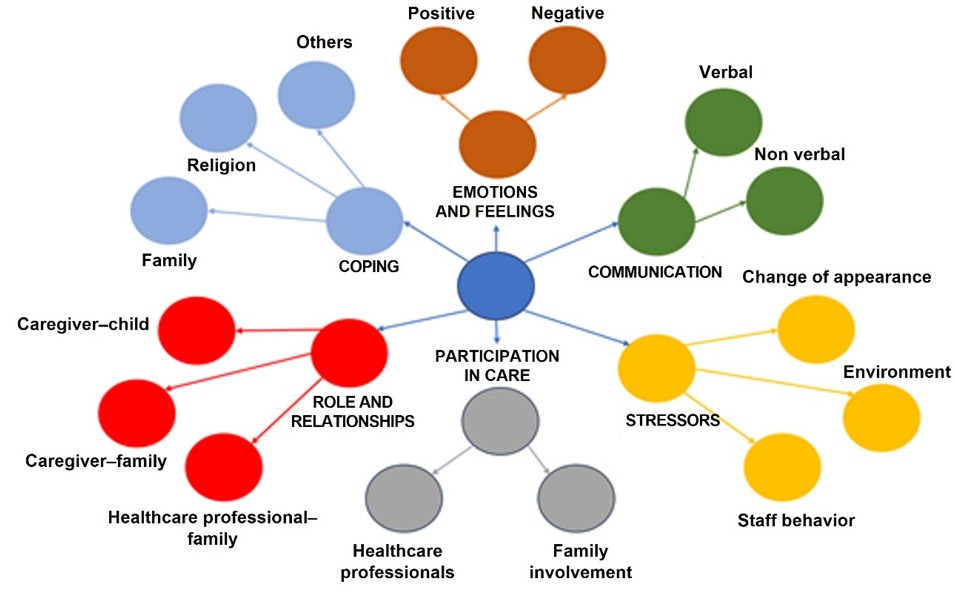
significant phrases. The following categories were identified: emotions and feelings,
communication,
stressors, participation in care, role and relationships, and coping7.
Figure 1. Cluster diagram of category emergence
Category 1: Emotions and feelings
Based on the opening question: “¿“How did you feel when you saw your child in the intensive
care unit for
the first time?”, the initial emotional impact on caregivers was explored. Two codes
emerged:
Negative emotions and feelings: Caregivers expressed
distress, anxiety, and sadness in response to
their child’s hospitalization, evidencing the strong emotional impact of the experience.
Testimonials:
“I felt so distressed, anxious, concerned. It is not easy to have a child in... an
intensive care unit,” E6P6N4, “I felt really sad,” E7P7P3, “...Fear... I
cried,”
E8P8P4.
Positive emotions and feelings: Caregivers also highlighted
feelings of relief, joy, and reassurance in
response to the child’s clinical progress and the care received. Examples:
“... She was extubated, so for me that was a relief...,” E3P3P2,
“... A lot of joy and a sense of gratitude,” E5P5N3,“What I liked most was doctors’ human
warmth, which is something you don’t see anywhere
else...,”E3P3P2 “... A lot of tranquility” E7P7P3.
Category 2: Communication
Communication was identified as a key aspect for adaptation to the PICU environment. Two types of
communication were identified:
Verbal communication: LParticipants highlighted the clarity and
continuity of the information
provided by the healthcare team, which favored trust and understanding of the process. Testimonials:
“They always explained what they were going to do and how,”
E3P3P2, “The specialists, the intensivists
and the head nurses always explained to us the procedure, how invasive it would be, its risks, the
approximate number of machines he would be connected to afterward” E9P9P5, “They explained
it to
me very well,” E7P7P3.
Non-verbal communication: The caregivers identified gestures of
support and closeness that
conveyed trust, such as “Seeing that the head nurses and the medical team would sometimes celebrate
with us with the same joy,” E9P9P5. However, when analyzing the relationship between staff and
participants, information flow showed some weaknesses. In this sense, actions by some team members
stood out, and their abrupt manners somewhat affected participants. The following phrases were
recorded:
“Because I knew that they were going to respond harshly, and I didn’t want to upset them, or
myself...,” E6P6N4, “Because you feel like you got it wrong by asking, or that you should
not have done it, or that
you’d better ask” E6P6N4, “As if they were saying ‘don’t ask me, ask this or that person,
but not me!’,” E6P6N4.
Category 3: Stressors
This category grouped items that increased emotional distress during hospitalization:
Change in the child’s appearance: Caregivers expressed the
emotional impact of watching their
children’s physical appearance change during hospitalization. They made comments such as:
“...intubated, I mean, seeing him swollen was very painful for me...,” E2P2P1,
“...He had many things
around, he had so many things on him, like the catheter, and that always made you feel afraid,”
E3P3P2,
“...So many machines, so many beeps, seeing him intubated, it was very, very hard...,” E9P9P5.
Hospital environment: Caregivers’ accounts reveal both positive aspects and
limitations of the
hospital environment. For some, the infrastructure offered a sense of security:
“And to expand the
unit ... partly because you feel a little more protected,” E1P1N1, However, shortcomings
associated with
human resources and accommodation conditions were pointed out:
“...I feel that sometimes more staff is needed. I mean sometimes, I see that their workload
is much
heavier than it should normally be...,”
E3P3P2, “In the unit where I was, I had to sleep sitting down, next
to her...,” E4P4N2.
Professional behavior: Participants highlighted differences in the way health
personnel treated
them, ranging from empathy to a lack of sensitivity. Some pointed out the absence of a human
supportive approach in communication:
“[Doctors]... sometimes didn’t seem to have the heart to tell me, this is what is going to
happen, this,
this, and this…,” E4P4N2, “...They don’t address you with kindness, like, with an
understanding of the
situation, like with empathy,” E6P6N4. However, the positive attitude of some professionals
was also
acknowledged: “...Some shifts have people who are always friendly and some others don’t,”
E6P6N4.
Category 4: Participation in care
Caregivers positively valued the opportunities for physical and emotional contact with their children
during the PICU stay, which strengthened their parent-child bond and allowed them to take an active
role in recovery.
Healthcare professionals: Caregivers highlighted the commitment
and dedication of the healthcare
team, especially the nurses, whose constant presence provided trust and security. The following
phrases were recorded:
“...The nurses were very attentive to my daughter, and what I liked was that I arrived the
next day and
everyone knew about my child’s situation...,” E1P1N1,
“...They were keeping a close eye on my baby
every day, checking whether her blood pressure was dropping, her saturation, they were always there
watching her,” E2P2P1, “They were very attentive to him, they’ve saved his life here many
times,” E5P5N3.
Family member involvement: Caregivers positively valued the
opportunities to participate in care
and the information shared by the healthcare team. They uttered phrases such as:
“...She taught me how to put her to sleep...,” E3P3P2, “Because,
yes, obviously we are all a team,” E6P6N4 “...I think it’s very important that they tell
me,” E7P7P3,
“...The head nurses, especially when it came to
medications and keeping track of all those things, I think their care was appropriate, all the
nurses who
cared for my daughter would explain to me: I’m going to administer this medication, we’re going to
give her this medication; this is for this and this, and they prescribed this many doses; I thought
that
was great,” E1P1N1.
Category 5: Roles and relationships
During hospitalization, three main types of human relationships were identified that significantly
impacted caregivers’ experience:
Healthcare professional-caregiver relationship: The caregivers
highlighted the support received
from the nurses and other professionals, whom they perceived as close and constant companions:
“...The head nurses, the nursing assistants (...) are a great support,”
E1P1N1, “...They were always there
for me; they were angels...,” E2P2P1. “The nursing team, the intensivists, the
pediatricians, were also the
ones who lifted our spirits,” E9P9P5. “I will never get tired of saying that San Ignacio
Hospital was also
like a family for my home, for my husband, and for my son,” E9P9P5. Among the differences
within the team, parents reported:
“...I felt closer... to the head nurse and to the nursing assistants...,”E3P3P2,
“...Because with the doctor, I don’t know, during rounds, his work was like... he came, examined,
asked you questions, but you don’t develop that same level of trust,” E3P3P2, “I perhaps
received more
attention and support from a therapist (respiratory therapist) than from a nursing assistant and a
doctor,”
E6P6N4.
Caregiver-family relationship: Testimonials evidenced the
tensions arising when caregivers had to
balance care for the hospitalized child and their family responsibilities. Some reported difficulties in
visiting their child in the ICU:
“I would say to my mother, ‘I really cannot go in and see her there; it is very hard for me’,”
E4P4N2, “I have
a daughter, and I had to leave her, not alone because she was with my sisters, but it wasn’t the
same...,” E8P8P4, “Well, we took turns with my husband, but he had to travel, so it was
my turn.” E8P8P4, “...to
leave our other 3 children...,”
E9P9P5.
Parent-child relationship: Caregivers expressed deep emotional
connection with their children,
marked by fear, protection, and a sense of purpose in the experience. Expressions such as the following
were recorded:
“My God, may she not be in pain,” E1P1N1, “I think that was... like a purpose I have with
her in life,” E4P4N2, “At first I thought it was something very risky and that I was going
to lose my child,” E5P5N3.
Category 6: Coping
The coping process was structured around various strategies that enabled caregivers to cope with the
emotional impact of hospitalization:
Family support: Caregivers highlighted the importance of the
support network during hospitalization,
both for the child and the family. They uttered phrases such as:
“The child never really loses that sense of familiarity,” E3P2P2,
“Well, we have a functional home with
my husband and we were here, taking turns 24 hours a day,” E9P9P5, “... I really would
have liked to be
with my mother. Yes, but she’s with my other child...,”
E6P6N4, “... The care... is very good; however, a
support network of parents would be nice, even though there are psychology meetings on Wednesdays,”
E6P6N4.
Religion and spirituality: Faith became a fundamental coping
resource for the caregivers, who
attributed recovery and strength throughout the process to God. The following testimonials were
recorded:
“Thanks to God, my son came out of the surgery very well and my Lord Jesus worked wonderfully,”
E6P6N4, “Thanks to God everything went very well, E3P3P2,
“Because I fully relied on God,” E6P6N4.
Other strategies: Some caregivers shared personal and external
resources that helped them cope
with the experience. One of them was early preparation:
“I had to prepare very well, because as soon as I had her, she was going into intensive care,”
E4P4N2, “Suddenly hearing those words, many times alleviated the way us parents handled our
emotions,” E6P6N4.
Discussion
When analyzing emotions and feelings, negative emotions and feelings stood out:
Participants
expressed distress, fear, despair, sadness, anxiety, and pain. The literature describes this experience
as
an “emotional roller coaster”, with divergent thoughts and changing feelings, especially in the face of
the child’s critical condition13-18.
Positive emotions and feelings were also identified: feelings of relief,
confidence, and satisfaction related to the success of the surgery and the care provided by healthcare
staff. Although these feelings are less frequently reported in the literature, some studies highlight
that the quality of care received generates peace of mind in caregivers13-19.
Communication was identified as a key aspect for adaptation to the PICU environment. Two types
of communication were identified. The first was verbal communication, wherein caregivers valued
clear, anticipatory information about the surgical procedure, the child’s appearance, the devices used,
and the clinical condition, which allowed them to prepare emotionally for the postoperative reunion.
Literature confirms the importance of effective communication as a coping strategy in contexts of
high uncertainty13-18. The second was non-verbal
communication: staff attitudes and expressions
also influenced the perception of care. Although there is scarce scientific literature on this
topic20, lcaregivers
noted that gestures such as a smile, eye contact, or a calm tone were comforting and
facilitated interaction.
Stressors grouped the elements that increased emotional distress during hospitalization, including
changes in the child’s appearance. In this sense, the presence of invasive devices generated feelings
of pain, sadness, and helplessness. Previous studies report that these changes in body appearance
intensify perception of the child’s vulnerability15,18.
The hospital environment was also identified as
a stressor: caregivers described equipment noise, intense lighting, confined space, and constant
staff activity as stressors. Literature suggests that these aspects contribute to an overwhelming
experience and hinder patients’ and caregivers’ rest14-19,21,22 . Healthcare professionals’ behavior was
another stressor, and in this regard, some caregivers reported cold or unempathetic treatment by
certain professionals, which increased their level of stress. This perception is related to information
inconsistencies, insensitive attitudes, and visible stress by the staff during critical patient
care16-19,21,23,24.
Caregivers positively valued the opportunities for physical and emotional contact with
their children
during the PICU stay, which strengthened the parent-child bond and allowed them to play an active
role in recovery. In addition, caregivers highlighted the humanized care provided by doctors, nurses,
assistants, and therapists, who facilitated safe closeness to the child. The perception of competent
professional care generated trust in the care provided19,22,25-28. Involvement of family members,
reflected in the possibility of participating in daily activities such as bathing or feeding, was
described
as important. This participation reduced their fear of causing harm and promoted the perception
of control over the situation. Literature highlights the role of nursing in facilitating this
interaction,
promoting active, safe, and emotionally restorative participation by caregivers13,16-21.
During hospitalization, three main types of human relationships were identified that
significantly
impacted the caregiver experience. The first type was the relationship between healthcare
professionals and caregivers, which proved to be a fundamental source of support. Communication
quality, empathy, and respect were key to establishing a relationship of trust. However, some
caregivers reported negative experiences with certain staff members, which affected their overall
perception of care. The literature suggests that empathic interaction between healthcare staff and
caregivers is essential for a satisfactory experience, facilitating understanding of the process and
emotional adaptation16,21,22. The second type was the relationship between
caregivers and families.
Support from family members was recognized as vital for the emotional, economic, and logistical
sustenance of the primary caregiver. However, prolonged hospitalization also generated tensions,
because some parents had to leave their other children or experienced responsibility overload.
Previous studies show that family separation can generate feelings of guilt, fatigue, and isolation,
affecting the emotional well-being of the caregiver13,15-18,23,24. The third type of relationship was the
parent-child relationship. Physical contact, expressions of affection, and participation in direct care
were described as strategies to alleviate parental stress. However, some caregivers expressed fear or
anxiety about their child’s critical condition, which generated emotional ambivalence. The literature
also reports this tension between the desire to protect the child and the fear of intensifying their
suffering, as well as admiration for the child’s strength in the face of surgery13,18,24.
The coping process was structured around various strategies that allowed caregivers to
manage the
emotional impact of hospitalization. Family support played a significant role, as the companionship
and practical help of relatives allowed caregivers to share the emotional burden, receive comfort, and
strengthen their resilience. Literature supports the importance of these networks as facilitators of
coping and adaptation to complex situations13,18. One of the coping approaches involved religion and
spirituality. Faith was expressed as a source of meaning and hope, helping to re-signify the experience
as a “test” or “divine will.” This perspective made it possible to alleviate suffering, accept
uncertainty,
and value the role of healthcare staff as an instrument of divine intervention. Several studies agree
that spirituality plays a protective role against emotional distress in contexts of high
uncertainty28. Other coping
mechanisms included the use of humor, positive thinking, seeking shared experiences
with other caregivers, and reinterpreting the event as an opportunity for growth. These strategies
are supported by the literature as effective mechanisms to mitigate the psychological impact of the
intensive care environment18.
Conclusions
The experience of parents and family caregivers of children in the postoperative period
following
cardiovascular surgery in pediatric intensive care units is characterized as emotionally intense,
uncertain, and challenging. From admission, caregivers deal with a reality that transforms their daily
lives, marked by fear of loss, uncertainty regarding the prognosis, and adaptation to a highly technical
environment specialized in pediatric cardiovascular care.
During the process, ambivalent emotions emerge. Initially, fear, sadness, and distress
predominate,
which progressively turn into hope and tranquility with the clinical evolution of the child and the
bond built with the healthcare team. This emotional transition highlights the importance of coping
strategies and professional support to facilitate adaptation.
Communication is recognized as a central element of the experience. When it is clear,
empathetic,
and respectful, whether verbal or nonverbal, it helps reduce anxiety and encourages the active
participation of caregivers in the child’s care.
Interpersonal relationships with the healthcare team, the hospitalized child, and other
family
members play a key role. Maintaining a close bond through inclusion in pediatric cardiovascular care
is experienced as an emotionally accurate and protective mechanism in the face of suffering.
Finally, spiritual and family support emerges as a resource for resilience, providing meaning
and strength in the midst of adversity. These findings demonstrate the need for a holistic and
comprehensive approach in pediatric cardiovascular care, wherein nurses and the healthcare team
recognize caregivers’ suffering, promote their active involvement, and strengthen a family-centered
model of care.
Conflicts of interest: The authors declare that they have no conflicts
of interest.
Funding: This study did not receive any external funding.
Acknowledgments:We would like to thank our Director of the Master’s
Degree Project in Critical
Care Nursing, Herly Ruth Alvarado Romero.
Author Contributions: SAA-C: Conceptualization; Data Curation; Formal
Analysis; Investigation;
Methodology; Project Administration; Software; Validation; Visualization; Writing-Original Draft
Preparation; Writing – Review & Editing. GTP-N: Conceptualization; Data Curation; Formal Analysis;
Investigation; Methodology; Project Administration; Software; Validation; Visualization; Writing –
Original Draft Preparation; Writing – Review & Editing. LPT-M: Conceptualization; Data Curation;
Formal Analysis; Investigation; Methodology; Project Administration; Software; Validation;
Visualization; Writing – Original Draft Preparation; Writing – Review & Editing.
References
-
Izquierdo-Sánchez Laura, Ferrer-Ribot
María. Las experiencias
del padre en las Ucin: una
revisión desde la perspectiva de género. Revista Latinoamericana de
Ciencias Sociales, Niñez
y
Juventud.
2018;16(1):55-69.
https://doi.org/https://doi.org/10.11600/1692715x.16102
-
Lalama DS, Pino-Loza ED. Políticas y
programas de salud
pediátrica y atención a niños
con enfermedades catastróficas hospital general IESS Ambato. Dominio
de las Ciencias.
2021;7(4):477-486.
https://dominiodelasciencias.com/ojs/index.php/es/article/view/2103
-
Valentín Rodríguez A.
Cardiopatías congénitas en edad pediátrica, aspectos clínicos y
epidemiológicos.
Rev. Med. Electrón
2018;40(4):1083-1099.
https://www.medigraphic.com/cgi-bin/new/resumen.cgi?IDARTICULO=83247
-
Tassinari S, Martínez-Vernaza S, Erazo-Morera N,
Pinzón-Arciniegas MC,
Gracia G,
Zarante I.
Epidemiología de las cardiopatías congénitas en Bogotá, Colombia, entre
2001 y
2014: ¿mejoría en la vigilancia o aumento en la prevalencia? Revista
de la Facultad de
Medicina.
2018;38(1):141–8.
https://www.redalyc.org/journal/843/84356697016/movil
-
Sandoval N. Congenital heart disease in
Colombia and worldwide.
Revista Colombiana de
Cardiología.
2015;22(1):e1–2 https://doi.org/10.1016/j.rccar.2015.03.005
-
Alvarado HR, Rodriguez Colmenares SM.
Necesidades percibidas de
atención por niños,
cuidadores y enfermeros durante la hospitalización en una unidad de
cuidado intensivo.
Investigación en Enfermería: Imagen y Desarrollo.2014;17(1). https://doi.org/10.11144/javeriana.ie17-1.npan
-
Uhm Ju-Yeon, Choi Mi-Young. Mothers'
needs regarding
partnerships with nurses during
care of infants with congenital heart defects in a paediatric cardiac
intensive care unit.
Intensive and Critical Care Nursing. 2019;54:79-87. https://doi.org/10.1016/j.iccn.2019.07.003
-
Raile Alligood M, Marriner-Tomey A.
Modelos y teorías en
enfermería. 9ª ed. Philadelphia:
Elsevier; 2018. p. 447–462.
-
Núñez CAS, Celis IEV. La Fenomenología de
Husserl y Heidegger.
Cultura de los Cuidados.
2017;21(48):43-50.
http://dx.doi.org/10.14198/cuid.2017.48.05
-
Aguilar Gavira S, Barroso Osuna J.
La triangulación de datos como estrategia en
investigación educativa. Pixel-Bit. Revista de Medios y
Educación. 2015;(47):73-88. https://www.redalyc.org/pdf/368/36841180005.pdf
-
Acuña Caicedo SA, Piraquive Niño GT, Triana
Monrroy LP.
Entrevistas experiencia de
los padres en el POP cardiovascular. Mendeley Data V1. 2026.
https://doi.org/10.17632/gxg8pzyrjn.1
-
Ministerio de Salud.
Resolución 8430 de 1993. Colombia. Por la cual se establecen las
normas científicas, técnicas y administrativas para la investigación en
salud. Consulta: Mayo
4, 2025.
-
Rativa Velandia M, Carreño Moreno SP.
Family Economic Burden Associated to Caring
for Children with Cancer. Investigación Y Educación En
Enfermería. 2018;36(1). https://doi.org/10.17533/udea.iee.v36n1e07
-
Cruz Ipanaqué JP.
Percepción del cuidador acerca del cuidado de enfermería en el servicio
de pediatría del Hospital de Apoyo II – 2 Sullana, septiembre -
diciembre 2018. [Tesis pregrado
Enfermería] Piura-Perú: Faculta de ciencias médicas, Universidad César
Vallejo;2019.
https://hdl.handle.net/20.500.12692/40346
-
Terp K, Sjöström-Strand A. Parents'
experiences and the effect
on the family two years
after their child was admitted to a PICU-An interview study.
Intensive and Critical Care
Nursing.
2017;43:143-148.https://doi.org/10.1016/j.iccn.2017.06.003
-
Alzawad Z, Lewis F, Kantrowitz-Gordon I, Howells
AJ.
A qualitative study of parents’
Experiences in the Pediatric Intensive Care Unit: Riding a Roller
Coaster. Journal of
Pediatric
Nursing.
2019;51:8-14. http://dx.doi.org/10.1016/j.pedn.2019.11.015
-
Toobe M.
Síndrome post cuidados intensivos en pediatría. Revista Facultad de Ciencias
Médicas Universidad Nacional de Cordoba. 2021;78(4).
https://doi.org/10.31053/1853.0605.v78.n4.32809
-
Wei H, Roscigno CI, Swanson KM, Black BP, Hudson-Barr D,
Hanson
CC.
Parents'
experiences of having a child undergoing congenital heart surgery: An emotional
rollercoaster from shocking to blessing. Heart & Lung.
2016;45(2):154-60. https://doi.org/10.1016/j.hrtlng.2015.12.007
-
Annuar WSHWM, Ludin SM, Amran NA.
Parents’ experience in taking care of critically
ill children while hospitalization. Enfermería Clínica.
2021;31(2):S67-71. http://dx.doi.org/10.1016/j.enfcli.2020.10.021
-
Sjostrom-Strand A, Terp K. Parents' Experiences
of
Having a Baby
With a Congenital Heart
Defect and the Child's Heart Surgery. Comprehensive Child and Adolescent
Nursing.
2017;42:10-23. https://doi.org/10.1080/24694193.2017.1342104
-
Alzawad Z, Lewis FM, Ngo L, Thomas K.
Exploratory model
of
parental stress during
children’s hospitalisation in a paediatric intensive care unit. Intensive
and
Critical Care
Nursing.
2021;67:103-109.
http://dx.doi.org/10.1016/j.iccn.2021.103109
-
Obas KA, Leal JM, Zegray M, Rennick JE.
Parental
perceptions of
transition from intensive
care following a child's cardiac surgery. Nursing in Critical Care.
2016;21(3):e1-e9.
https://doi.org/10.1111/nicc.12202
-
Lumsden MR, Smith DM, Wittkowski A.
Coping in Parents of Children with Congenital Heart
Disease: A Systematic Review and Meta-synthesis. Journal of Child and Family
Studies.
2019;28:1736-1753.
https://doi.org/10.1007/s10826-019-01406-8
-
Hagstrom S.
Family Stress in Pediatric Critical Care.
Journal of Pediatric Nursing.
2017;32:32-40.
https://doi.org/10.1016/j.pedn.2016.10.007
-
Barreto JBV, Boeckel MG.
Regulação emocional e conjugalidade: vivência de pais com
filhos internados em Unidade de Terapia Intensiva.
Contextos Clínicos. 2019;12(1). https://doi.org/10.4013/ctc.2019.121.14
-
Tautiva Ochoa K, López CM, Guzmán-Romero SY, González
Ruíz DP,
Hernández
Zambrano SM.
Estrategias de afrontamiento en familiares de pacientes críticos.
Repertorio
de Medicina y Cirugía.
2020;31(1):3–10.
https://doi.org/10.31260/RepertMedCir.01217372.950
-
Kasparian NA, Kan JM, Sood E, Wray J, Pincus HA,
Newburger
JW.
Mental health
care for parents of babies with congenital heart disease during intensive care
unit
admission: Systematic review and statement of best practice.
Early Human Development. 2019;139:104837. https://dx.doi.org/10.1016/j.earlhumdev.2019.104837
-
Hill C, Knafl KA, Docherty S, Santacroce SJ.
Parent perceptions of the impact of the
Paediatric Intensive Care environment on delivery of family-centred care.
Intensive
and
Critical Care Nursing. 2019;50:88-94.
https://doi.org/10.1016/j.iccn.2018.07.007