Abstract
Introduction: Parkinson’s disease requires complex
care. Caregivers, predominantly women, face
substantial physical and emotional burden; however, they also find gratification.
Objective: To
understand the caregiving experiences of female caregivers of patients with Parkinson’s disease in
Cali, Colombia. Materials and Methods: A qualitative study with a reflexive
thematic analysis design
was conducted. A focus group was held with six caregivers. Data were analyzed using ATLAS.ti 25.
Results: Three main themes were generated: (1) Sacrificed performance, in which
caregivers expressed
unconditional dedication to the patient, developed spiritual and emotional coping strategies, and
sought
to promote the patient’s autonomy and participation; (2) Emotional impact, which included emotional
exhaustion in response to the patient’s demands, compassion in caregiving, and satisfaction with
healthcare professionals; and (3) Experienced needs, which encompassed needs for training,
information,
knowledge of digital tools, comprehensive medical care, and human support.
Discussion: Caregivers
experience sacrificed performance, emotional impact, and diverse needs, which are consistent with
the literature reported to date. Training, the promotion of patient autonomy, emotional and
spiritual
coping, as well as the value of human, technological, and interdisciplinary support, were
highlighted.
Conclusions: Caregivers make significant personal and emotional sacrifices,
underscoring the need
for
interventions that provide comprehensive support and adequate resources. This study highlights the
importance of recognizing and addressing caregivers’ needs to enhance their well-being and the
quality
of care they provide.
Keywords: Parkinson's Disease; Caregivers; Caregiver Burden;
Family Care;
Qualitative Research.
Resumen
Introducción: La enfermedad de Parkinson requiere
cuidados
complejos. Las cuidadoras, principalmente mujeres, enfrentan sobrecarga
física y emocional; sin embargo, también encuentran gratificación.
Objetivo: Conocer las experiencias de cuidado de cuidadoras de
pacientes con enfermedad de Parkinson en Cali, Colombia. Materiales
y Métodos: Se llevó a cabo un estudio cualitativo con diseño de análisis
temático reflexivo. Se aplicó un grupo focal con seis cuidadoras. El
análisis de los datos se realizó con el apoyo de ATLAS.ti 25. Resultados:
Se generaron tres temas principales: 1. Desempeño sacrificado, en el cual
las cuidadoras expresan una dedicación incondicional hacia el paciente,
desarrollan estrategias de afrontamiento espiritual y emocional, a su vez,
buscan promover la autonomía y participación del paciente; 2. Impacto
emocional, que incluye el agotamiento emocional frente a las exigencias
del paciente, la compasión por el cuidado y la satisfacción con el
personal de salud; y 3. Necesidades experimentadas, que corresponden
a las necesidades de capacitación, información, conocimiento de
herramientas digitales, abordaje médico integral y el apoyo humano.
Discusión: Las cuidadoras presentan un desempeño sacrificado, impacto
emocional y diversas necesidades, lo cual coincide con la literatura
señalada hasta el momento. Se destacó la capacitación, promoción de
la autonomía, afrontamiento emocional y espiritual, así como el valor
del apoyo humano, tecnológico e interdisciplinario. Conclusiones: Las
cuidadoras enfrentan un alto nivel de sacrificio personal y emocional, lo
que resalta la necesidad de intervenciones que ofrezcan apoyo integral
y recursos adecuados. Este estudio subraya la importancia de reconocer
y abordar las necesidades de las cuidadoras para mejorar su bienestar y
la calidad del cuidado que proporcionan.
Palabras Clave: Enfermedad de Parkinson; Cuidadores; Carga del
Cuidador; Cuidado Familiar; Investigación Cualitativa.
Resumo
Introdução: A doença de Parkinson exige cuidados
complexos. Os cuidadores, principalmente mulheres,
enfrentam sobrecarga física e emocional; no entanto, também encontram gratificação.
Objetivo:
Compreender as experiências de cuidado de cuidadores de pacientes com doença de Parkinson em
Cali, Colômbia. Materiais e Métodos: Foi realizado um estudo qualitativo com
delineamento de análise
temática reflexiva. Um grupo focal foi conduzido com seis cuidadores. A análise dos dados foi
realizada
utilizando o software ATLAS.ti 25. Resultados: Três temas principais emergiram: 1.
Desempenho
altruísta,
em que os cuidadores expressam dedicação incondicional ao paciente, apresentam estratégias de
enfrentamento espiritual e emocional e buscam promover a autonomia e a participação do paciente; 2.
Impacto emocional, que inclui exaustão emocional diante das demandas do paciente, compaixão pelos
cuidados prestados e satisfação com a equipe de saúde; 3. Necessidades vivenciadas, que correspondem
às necessidades de treinamento, informação, conhecimento de ferramentas digitais, assistência médica
integral e apoio humano. Discussão: Os cuidadores demonstram um desempenho
sacrificial, impacto
emocional e necessidades diversas, o que coincide com a literatura revisada até o momento.
Destacouse
a importância do treinamento, da promoção da autonomia, do enfrentamento emocional e espiritual,
bem como o valor do apoio humano, tecnológico e interdisciplinar. Conclusões: Os
cuidadores
enfrentam
um alto nível de sacrifício pessoal e emocional, o que reforça a necessidade de intervenções que
ofereçam
apoio abrangente e recursos adequados. Este estudo destaca a importância de reconhecer e atender às
necessidades dos cuidadores para melhorar seu bem-estar e a qualidade do cuidado que prestam.
Palavras-Chave: Doença de Parkinson; Cuidadores; Sobrecarga do
Cuidador; Cuidado Familiar; Pesquisa
Qualitativa.
Introduction
Parkinson’s disease (PD) is the second most common neurodegenerative disease
worldwide1.
Over
recent decades, it has become an increasingly important public health concern2.
According to the
World Health Organization (WHO), its global prevalence has doubled over approximately 25
years,
reaching more than 8.5 million affected individuals in 2019, accompanied by a substantial
increase in
associated disability and mortality3. This trend is largely attributable to
the progressive aging of the
population, a phenomenon expected to drive a sustained increase in care needs over the
medium
and long term and to continue intensifying through 20504.
In Colombia, PD exhibits a similar pattern, with a higher frequency among older age groups
and
an increase in cases reported in recent registries5. In this context, the impact of the
disease extends
beyond the patient and affects caregivers as well. Informal caregiving has been consistently
associated with a high burden among those who assume this role, affecting their physical,
emotional,
and social dimensions6. The demographic profile of caregivers in
Colombia typically includes women
of working age living in vulnerable circumstances and devoting many hours each day to
caregiving
tasks7. In
addition, they are often homemakers with incomplete primary education and a high degree
of religious commitment8. Against this backdrop, the following
research question was posed: What
are the caregiving experiences of female caregivers of patients with Parkinson’s disease?.
Parkinson’s disease is a neurodegenerative condition that affects motor function,
manifesting as
tremor, bradykinesia, muscle rigidity, and postural instability, and impairing an
individual’s ability to
perform activities of daily living9. Patients require caregivers who can
safeguard their well-being. A
caregiver is typically a family member (spouse, adult children, or other relatives) or a
friend who provides
informal, unpaid support to the patient10.
Such support includes providing physical assistance,
offering emotional support, and facilitating daily activities, including mobility,
communication, and
personal hygiene11.
The interaction between caregivers and patients influences the latter’s self-care and
quality of life.
In this regard, interventions for Parkinson’s disease include digital psychological support
solutions12 and
digital care technologies that incorporate contributions from patients and caregivers13,
among
others. Such interventions indirectly benefit caregivers by reducing the emotional burden
associated
with caregiving12.
As the population ages, the need for care is expected to increase, underscoring the
importance of ensuring ongoing support and resources so that caregivers can maintain their
wellbeing
and effectiveness in carrying out their caregiving tasks14.
Care is understood as a holistic process that integrates cultural and human dimensions,
emphasizing
the interconnectedness of life and the social context15. This study draws upon Leininger’s
Culture Care
Theory16 and
Watson’s Theory of Human Caring17,
both of which are essential for understanding care.
The former focuses on activities aimed at assisting, supporting, or enabling one or more
individuals
to improve their human condition from a cultural perspective, whereas the latter
conceptualizes care
as a value and an attitude that should become a matter of will, intention, or commitment,
manifested
through concrete actions, and proposes a comprehensive and relational view of care15.
As Parkinson’s disease progresses, caregivers require guidance on managing patients’
symptoms,
including both motor and non-motor symptoms, depression, and cognitive
impairment18.
Effective
self-management strategies include medication management, physical activity, and
psychological
support, all of which should be tailored to the disease stage19.
These strategies also include
facilitating patient autonomy in self-care and participation20 within the framework of occupational
and psychosocial interventions21. In this regard, educational programs
are essential for equipping
caregivers with the competencies required for effective patient management and for fostering
a
sense of competence and confidence in their caregiving role22, which in turn improves the quality of
care and strengthens caregiver empowerment23.
However, caregivers often encounter difficulties associated with treatment demands,
medication
management, scheduling medical appointments, and implementing lifestyle modifications for
the
patient. The emotional and physical demands of caregiving may generate or exacerbate
stress24, lead to
social isolation and limited personal time25,
and contribute to depression and anxiety26, particularly among women responsible
for caregiving26.
These difficulties are influenced by factors
such as the stage of the disease, the coping mechanisms used by caregivers, and their own
mental
health status26,27. Likewise, caregiver burden is shaped
by the cultural context, which influences the
formation of caregivers’ experiences and aspirations28.
The foregoing highlights the importance of psychological support in reducing anxiety27 and enhancing
caregivers’ coping strategies, which may be problem-focused, emotion-focused29, or spiritually
oriented30. In
this regard, mutual support programs among caregivers, as well as opportunities
to share their experiences, help mitigate feelings of helplessness and inadequacy22,31. Despite the
challenges described, many caregivers perceive their role as a means of managing the
disease, finding
personal gratification, and experiencing personal growth through caregiving, which may be
viewed
as either a challenge or a rewarding experience32. As noted, caregiver burden may
generate stress,
anxiety, and isolation, particularly among women who provide care26; however,
positive aspects have
also been identified, including personal growth and emotional gratification32.
Additionally, as Inaltekin and Kocatürk27 have noted, access to
information
is important as it is necessary
to identify the factors that contribute to caregiver burden. Likewise, understanding the
emotional
impact on caregivers is essential for understanding caregivers’
experiences, given the various effects on
well-being and the presence of indicators of anxiety.
Although the literature has extensively addressed caregiver burden and the need for
psychoeducational support among caregivers of people with PD, these studies have primarily
focused on the functional, clinical, and instrumental dimensions of caregiving. Thus, the
senses,
meanings, and tensions embedded in the everyday experience of caregiving have been explored
less extensively6.
In the Colombian context, although studies have examined caregiver profiles5,8 and
caregiver burden7,
there remains a need to explore the experiential component of this phenomenon
further. In response to these gaps, the present study aimed to understand the caregiving
experiences
from the perspective of female caregivers of patients with Parkinson’s disease in Cali,
Colombia.
Materials and Methods
Study design
This was a qualitative study, epistemologically grounded in a constructionist posture. A
reflexive
thematic analysis design was employed, emphasizing the active reflexivity of the
researchers, which
enabled the generation of central themes from participants’ narratives within a critical
posture33.
Participants
Six female caregivers of patients with Parkinson’s disease participated in the study. Participants
were
selected through convenience sampling due to difficulties in accessing eligible
participants34.
Female
caregivers of patients in stages 1, 2, and 3 of the disease who had the technological skills
required to connect via videoconference were included. Individuals with comorbidities that could
affect data
collection were excluded. All participants were women affiliated with the Parkinson Foundation of
Colombia in Cali. Their mean age was 63.5 years, and the mean duration of their caregiving
experience
was 6.6 years. Regarding their relationship to the patient, most were spouses; one was a daughter,
and another was a nurse
Table 1.
Table 1. Participants’ characteristics
X
Table 1. Participants’ characteristics
| Participant |
Age |
Years as a
caregiver
|
Relationship to
the Patient
|
|
Amber
|
69 |
5 |
Wife |
|
Sapphire
|
85 |
7 |
Wife |
|
Emerald
|
61 |
8 |
Wife |
|
Onyx
|
71 |
3 |
Wife |
|
Topaz
|
57 |
9 |
Daughter |
|
Amethyst
|
38 |
8 |
Nurse |
Data collection technique
A homogeneous focus group was used, as it was considered appropriate for understanding shared
experiences among participants with similar characteristics. The focus group was conducted virtually
to facilitate participant access35. The focus group protocol was developed based
on a review of the
existing literature, with particular attention to the contributions of Inaltekin and Kocatürk27, from
which the topics of caregiving experiences, emotional impact, and information needs were identified.
An introductory topic with sociodemographic questions was also included. The instrument was
evaluated by six expert judges, who assessed the clarity, coherence, representativeness, and
appropriateness of the questions for the study Table 2.
Table 2. Focus group guide
X
Table 2. Focus group guide
| Topic |
Questions |
Experiences and lived
experiences
as a caregiver
|
What feelings do you experience in relation to the process of
caring for a patient with PD?
Briefly describe what being a caregiver of a patient with
Parkinson’s disease means to you.
|
|
Emotional impact
|
Could you share a significant experience that you remember
having as a caregiver of a patient with Parkinson’s
disease during the first three stages of the disease? (Explore:
difficulties or needs.)
What do you believe are the most important needs faced by
caregivers when caring for patients with Parkinson’s
disease during the first three stages?
|
Information
needs
|
What challenges or problems have you encountered when seeking
information on how to manage basic activities
of daily living for the care of a patient with Parkinson’s
disease in the early stages?
What concerns or situations do you face in the day-to-day care
of patients?
What type of information do you consider crucial for providing
effective care during the early stages of Parkinson’s
disease?
|
EP:
PD: Parkinson’s disease
Procedures
The researchers contacted the Parkinson Foundation of Colombia, a healthcare institution that
supports individuals with Parkinson’s disease in Cali. This institution facilitated access to
potential
participants, who were informed about the purpose of the study. After verifying the inclusion
criteria,
six participants were recruited and provided written informed consent. Subsequently, in March 2024,
a
virtual meeting was held via Zoom to conduct the focus group. During this session, the first
researcher
served as moderator and the second researcher as assistant, ensuring a comfortable environment
for the participants, who selected their own pseudonyms and the location from which they would join
the meeting (their homes). The session was conducted in Spanish, and no compensation was
provided for participation. The focus group was not repeated, and no participants withdrew from the
study. The focus group transcript was prepared manually.
Data analysis
Qualitative data were analyzed following the reflexive thematic analysis approach33.
First, the
researchers familiarized themselves with the data through verbatim transcription and repeated
readings, which enabled them to identify relevant excerpts addressing the research objective.
Initial
coding was then conducted inductively by assigning codes to the excerpts. Two coding cycles were
carried out: the first involved open and thematic coding, and the second involved axial and pattern
coding. Subsequently, themes were generated, reviewed, and defined. At this stage, a semantic
map was developed to visualize the relationships among codes and themes. It should be noted that
the reflexive nature of the design allowed the concepts and theories previously described (such as
those of Watson and Leininger) to serve as guiding frameworks; however, the codes and themes were
refined through the research team's ongoing reflection. In addition, reflexive notes were maintained
throughout the analytic process to support interpretation.
Meaning-generation criteria, including representativeness, frequency, and thickness, were
applied36.
Based on these criteria, the codes were filtered, prioritizing those considered most meaningful for
reporting the findings. Although one of the participants was a nurse, no differential analysis was
conducted in relation to the other participants because the unequal number of participants did not
allow for comparisons between them. The analysis was conducted by the three researchers, with
discrepancies resolved through consensus, and ATLAS.ti 25 was used to support the analytic process.
The complete dataset is publicly available for free access through Mendeley Data37.
With regard to ethical and quality considerations, approval was obtained from the Ethics Committee
of
Antonio José Camacho University (FEDV-003-24-01). The study adhered to ethical principles, including
the
confidentiality and anonymity of the information collected, respect for
participants’
rights and
dignity, as stated in the informed consent form, and the protection of participants’
autonomy. In
addition, rigor criteria were incorporated, including credibility through participant
validation of the
transcript and confirmability through a rigorous, systematic analytic process that helped
ensure the
quality of the findings. Finally, the study was conducted in accordance with the Consolidated
Criteria
for Reporting Qualitative Research (COREQ)38.
Results
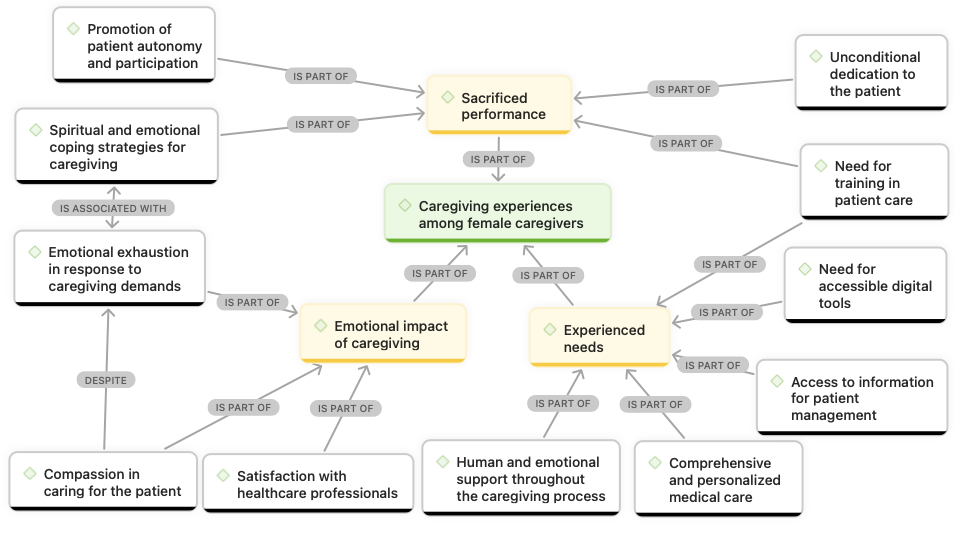
The results presented below emerged from a reflexive thematic analysis, in which the codes and
analytic themes were interpretive constructions developed through the reflexivity of the research
team, drawing on the preceding sections. In this regard, the caregiving experiences of female
caregivers of patients with PD can be understood through three significant themes: the caregiver’s
sacrificed performance, the emotional impact of caregiving, and experienced needs, which are
described below Figure
1.
Figure 1. Thematic map of caregiving experiences among female caregivers
Sacrificed performance
The caregivers described their role as a comprehensive, ongoing commitment, marked by constant
dedication to the patient, extending beyond their personal routines and requiring continuous
availability. This commitment also involved adapting their daily lives to the patient’s physical,
emotional, and spiritual needs, assuming responsibility for the patient’s well-being, and pursuing
ongoing education to improve the care provided. At the same time, caregivers coped with the strain
of caregiving through emotional and faith-based strategies, which provided strength and meaning to
the act of caring.
According to the caregivers’ accounts, sacrificed performance encompasses the following:
Unconditional dedication to the patient. This involves total commitment,
without fixed routines, as
personal activities depend on the patient’s needs. Even when wishing to engage in recreational
activities,
caregivers reported that they must include the patient, who often requires their companionship for
basic tasks. As such, they indicated that their caregiving responsibilities are constant and that
they
must remain available at all times, including for medication management.
“There’s no such thing as a set routine, because you can be doing one thing and everything changes
in an instant. [...] On top of that, they become a part of you. Even when I go to the bathroom,
[...] he’s
constantly asking, ‘Where are you?’ And I say, ‘I’m right here.’ So you have to be paying attention
all the
time. You can’t say, ‘I have my routine. I’m going to get up and do this or that.’ No. You get up
and deal
with whatever comes up throughout the day.” (Amber, 69 years old,
caregiver for 5 years).
Need for training in patient care.
Participants sought to learn about the disease through their
involvement in care centers and support groups. They attended courses and engaged in additional
activities aimed at improving the patient’s well-being. They recognized that although there was
still
much to learn, they adapted to each patient’s needs, enabling them to provide better care and foster
trust with patients.
“Yes, I’ve taken several courses. I learned about caring for a person with Parkinson’s disease,
including
things like ‘How to prepare for a neurology appointment.’ For example, keeping a journal and
updating
it regularly so that, when the day of the appointment comes, you can provide a summary [...] and
when
the doctor sees it, he can make much better progress.” (Topaz, 57
years old, caregiver for 9 years).
Promotion of patient autonomy. In this regard, participants indicated that
caregiving involved not
only careful medication management but also engaging patients in activities that promote their
emotional and physical well-being. They also emphasized the importance of going for walks, playing
games, and participating in activities such as dancing and crafts, which contributed to patients’
development and active engagement. In addition, they highlighted the need to include patients in
daily and family activities to avoid their exclusion. Participants further indicated that it is
essential for
patients to continue performing everyday activities independently, with support from the caregiver,
thereby creating an environment conducive to their progress.
“If patients aren’t taken out, if they don’t spend time with other people, if no one plays with them
[...]
believe me, they’re not going to improve. Medication does part of the job, but the emotional side,
the soul
part, is about connecting with them, listening to them [...] My mother told me, ‘I don’t need a
psychologist
anymore because you’ve become like my psychologist."
(Sapphire, 85 years old, caregiver for 7 years).
Spiritual and emotional coping strategies in caregiving. Caregivers reported
that faith-based
strategies provided them with calmness and strength to face daily challenges, exhaustion, and
uncertainty. They acknowledged the difficulty of accepting patients’ dependency and vulnerability,
which initially led them to suppress their emotions. However, many chose to focus on solutions and
accompany patients with a more positive outlook rather than dwelling on suffering.
“I ask God every day for the wisdom to guide me and show me what to do, and believe me, it’s helped.
In eight months, the progress my mother has made [...] she couldn’t move before, and now she does—
she even dances. But you have to take action [...] It’s not just about the intellectual or
psychological
side; you also have to care for the soul, because we are body, soul, and spirit.” (Emerald, 61 years old,
caregiver for 8 years).
Emotional impact of caregiving
According to the participants, the emotional impact of caregiving refers to the range of emotional
experiences they face in response to the demands of providing ongoing support. These experiences
included exhaustion, anxiety, and feelings of helplessness in the face of disease progression, as
well
as compassion, empathy, and satisfaction derived from the relationship with the patient and the
professional support received. In this sense, caregivers experienced a complex emotional process
characterized by both strain and personal fulfillment. The emotional impact of caregiving can be
understood through emotional exhaustion, compassion in caregiving, and satisfaction with healthcare
professionals.
Emotional exhaustion in response to caregiving demands. Caregivers were
constantly tasked with
shielding their family members from negative information in their surroundings, which led to fatigue
as they sought to maintain a positive attitude. This strain intensified when their family members
did
not respond as expected. In addition, they expressed anxiety about the uncertain progression of PD,
feeling that after resolving one situation, they had to start over again, which generated stress.
The unpredictable progression of PD elicited irritability, uncertainty, and feelings of helplessness
among caregivers. They commonly expressed distress when witnessing patients’ decline. Caregivers
were also emotionally affected by observing other patients in more advanced stages of the disease,
which generated feelings of hopelessness regarding the future of their family members. Difficulties
in understanding the causes and consequences of changes in the patient’s health status contributed
to their emotional strain, highlighting the need for greater emotional and psychoeducational support
throughout the caregiving process.
“Because otherwise the caregiver ends up getting sick too, ends up feeling stressed [...] and the
anxiety
starts to build up, you know? Because all you want is for them to get better.” (Topaz, 57 years old,
caregiver for 9 years).
Compassion in caring for the patient. Participants emphasized the importance
of supporting their
family members through the caregiving process with patience and understanding. Compassion was
expressed through empathy toward the patient’s emotional process, recognizing that accepting the
disease could be difficult and, at times, even denied. In this sense, caregivers demonstrated
sensitivity
to the emotions of those in their care. Within this context, they prioritized the patient’s
well-being,
often above their own, demonstrating a profound commitment to providing daily support.
“[As a caregiver] I have three basic rules: understand them, support them, and care for them,
because
they’re patients. You have to understand them because they can be very challenging, and even though
they have Parkinson’s disease, they may also have other conditions that can affect them.” (Amethyst, 38
years old, caregiver for 8 years).
Satisfaction with healthcare professionals.
Caregivers highlighted the emotional support they
received throughout the care process. They reported that healthcare professionals not only provided
medical guidance but also offered emotional support and guided caregivers during moments
of distress. This facilitated access to support groups, which was perceived as a meaningful and
compassionate form of support.
Caregivers valued the medical recommendations provided regarding physical, occupational, and
psychological therapies. They highlighted that physicians provided clear guidance, responded to
caregivers’ questions, and organized educational programs focused on PD management. They also
recognized that therapists tailored their interventions to the specific type of PD presented by each
patient, which was highly appreciated.
“We have a treasure in the
people who care for our patients, because we have a therapist who knows
exactly what she’s doing and understands how to work with people who have Parkinson’s disease.”
(Amber, 69 years old, caregiver for 5 years).
Experienced needs
According to the caregivers, experienced needs refer to the requirements identified throughout the
process of caring for people with PD. These include emotional and social support; access to support
groups and psychological therapies; clear information about disease management and medical care;
comprehensive and personalized care; accessible technological tools that facilitate communication,
and ongoing learning and support. Together, these resources enable caregivers to strengthen both
their own well-being and the patient’s.
Human and emotional support throughout the caregiving process. Caregivers
valued support
groups because their establishment provided opportunities to share their experiences of living with
the disease and exchange useful day-to-day strategies. They also emphasized the need to participate
in psychological therapies and recreational activities that promote the emotional well-being of both
the patient and themselves.
Access to support groups and psychological therapies. Participants recognized
the role of foundations
and support groups in providing spaces for interaction, education, and group activities that
strengthen
mutual support among peers. These groups also offered practical guidance on how to carry out
therapeutic
activities. In addition, participants emphasized the need for technological tools that facilitate
interaction
with others, as these would enable them to ask questions and receive responses from individuals with
similar experiences, thereby strengthening support and information networks.
“The patient needs something to keep them engaged. So, you have to look for support from other
people,
stay in communication, and have people who can help you—that interaction we were talking about.
[...]
That’s what a support group is.” (Emerald, 61 years old,
caregiver for 8 years).
Comprehensive and personalized medical care. Caregivers considered it
essential for patients to have
access to therapies such as occupational therapy, neurorehabilitation, and physical therapy from the
early stages of the disease. Likewise, they emphasized the need for specialized therapists according
to
the stage of Parkinson’s disease, as care needs vary depending on the specific presentation of the
disease
and the patient’s personality, requiring a multidisciplinary team approach. Alongside physical
treatment,
caregivers viewed psychological support and acceptance of the diagnosis as essential components of
care. They also highlighted the importance of promoting physical and cognitive activity to support
the
well-being of patients with PD.
“(We need) professionals with more specialized expertise in patients with Parkinson’s disease [...]
Every
person should have a place where they feel comfortable and where their rehabilitation works for
them,
and a patient who needs truly comprehensive care.” (Amber, 69
years old, caregiver for 5 years).
Access to information for the management of patients with PD. Caregivers
emphasized the need for
personalized informational support to understand their family members’ situations better, as each
case
of Parkinson’s disease is different and requires specific strategies. They also requested clear
information
about medications, how they work, and their interactions with food, given their impact on patients’
health.
In addition, caregivers expressed a need for more information, particularly at the time of
diagnosis, as
the information provided at that stage was perceived as primarily intended for healthcare
professionals,
making it difficult for them to understand. They also sought information about medication
combinations,
their effects, therapies, appropriate nutrition, and a comprehensive approach to the disease.
“You need to know how to manage all of their medications properly so you don’t end up causing more
problems down the road. [...] You have to know how to handle them. My doctor gave me a schedule that
has worked really well for me. An internist helped me make sure the medications wouldn’t harm his
body
either. That has helped me a lot in learning how to manage them. (Sapphire, 85 years old, caregiver for
7 years).
Need for accessible digital tools. Caregivers emphasized the need for
user-friendly, intuitive tools that
use clear, understandable language. They considered it essential for these tools to address their
needs
and be accompanied by practical training to facilitate their use. Although they used platforms such
as
Google and YouTube to search for information on the disease, nutrition, and medical recommendations,
they found the information insufficiently specific. As a result, they expressed the need for an
interactive
space, moderated by a specialist, where they could share experiences, address questions, and feel
supported.
“The most important thing about apps is that they have to be user-friendly [...] Some apps are
impossible
to use. They have too many features, and you can’t get to the information you’re looking for. So, it
has to be
simple, with language that I can understand.” (Amber, 69 years
old, caregiver for 5 years).
Discussion
This study sought to explore the caregiving experiences from the perspective of
female caregivers of
patients with PD. Through a focus group, experiences related to sacrificed performance, the
emotional
impact of caregiving, and experienced needs were identified. These findings expand the theoretical
and empirical understanding of caregiving in the context of this disease. Sacrificed performance,
reflected in unconditional dedication to the patient, was consistent with the findings of Risnarita
et al.11,
who highlighted the broad range of tasks assumed by informal caregivers, from physical
assistance to emotional support. However, the present study further demonstrates that caregivers
not only faced these demands but also actively sought educational opportunities, such as training
courses and recreational activities for patients, an aspect that has not always been made visible in
previous research. This finding is consistent with Watson’s theory17, which emphasizes the need for
a holistic approach to care. It also underscores the importance of promoting patient autonomy, a
finding that aligns with Tuijt et al.19 regarding the need to encourage physical and
cognitive activity
among patients with PD.
Regarding the promotion of patient autonomy and participation, caregivers reported making efforts
to respect patients’ wishes and decisions, which is consistent with previous studies showing that
perceived autonomy improves quality of life and reduces depressive symptoms20. This type of care
fosters patients’ sense of agency and strengthens relationships of trust. These findings are
consistent
with Watson’s perspective17, which holds that caring involves recognizing
the other person as an
active participant in the relationship, thereby contributing to their psychoemotional well-being.
With regard to spiritual coping strategies, these findings were consistent with the sociocultural
profile of Colombian caregivers, who tend to demonstrate a high level of religious commitment8.
In
this regard, Durán Badillo et al.30 found that spirituality supports coping and may
reduce caregiver
burden. Closely related to this, caregivers also drew on emotional coping strategies, including
humor,
acceptance, and positive reappraisal, which have been associated with lower levels of depressive
symptoms and better emotional well-being29.
The emotional impact of caregiving revealed psychosocial implications such as emotional exhaustion
and anxiety, which are consistent with previous research24,32. However, the compassion and empathy
developed by caregivers are particularly noteworthy, as they prioritized the patient’s well-being
and found satisfaction in their caregiving role, a finding that is consistent with Seshadri et
al.32. This
balance between challenges and rewards reinforces the need for interventions that address both
caregivers’ psychological well-being and their practical caregiving skills.
With regard to satisfaction with healthcare professionals, caregivers reported feeling heard and
acknowledged, experiencing greater confidence, and reduced uncertainty. This finding is consistent
with another study39,
which found that interdisciplinary collaboration led to better therapeutic
outcomes and greater subjective well-being among both patients and their caregivers.
The needs experienced by caregivers reflected a demand for comprehensive support, both human
and technological. The need for accessible digital tools supports the recommendations of Pinto et
al.12 and Monje et
al.13, who highlighted the
role of technology in improving care. In addition, caregivers
emphasized the need for training and mutual support networks, which are essential for reducing
stress, a finding consistent with previous studies22,31. In the Colombian context, where caregivers
are predominantly women living in situations of vulnerability7, these needs take on particular
significance and underscore the importance of public policies that promote access to resources.
Regarding access to information, caregivers expressed the need for information about the disease and
therapeutic options that is clear, up-to-date, and easy to understand, consistent with the findings
of
Hiseman and Fackrell18. In
this regard, Tuijt
et
al.19 reported that a lack
of information, or information
presented in technical language, generated distress, insecurity, and feelings of helplessness.
Conversely, training and adequate access to information facilitated coping and improved the quality
of care23. Caregivers also
valued models of care that incorporate psychological and social dimensions,
consistent with Watson’s humanistic approach17, as these models enabled a more tailored
response to
the complex needs of individuals with PD and their caregivers. In line with these findings, Foster
et
al.21 supported this
perspective by demonstrating that therapeutic approaches combining physical,
occupational, and psychosocial interventions are more effective in maintaining patients’ quality of
life
and reducing caregiver burden.
Human and emotional support was perceived as essential for long-term caregiving. In this regard,
the absence of support networks may lead to emotional exhaustion and increased psychological
vulnerability, as noted by Geerlings et al.31. Although not all studies focus specifically on
formal or
informal support networks, Watson17 emphasized that caring is a practice of human
connection in
which the emotional bond can be a source of both strain and meaning. In this sense, caregivers who
were able to reframe their role as an opportunity for connection, personal growth, and dedication
tended to experience the caregiving process more positively. These findings underscore the need for
psychological interventions27, particularly those aimed at strengthening
coping strategies, whether
problem-focused, emotion-focused29, or spiritually oriented30.
The results underscore the importance of a cultural and holistic approach to caregiving, consistent
with the perspectives advanced by several authors16,17. These findings reinforce the need to consider
cultural context when designing interventions, as suggested by Achen et al.28. This study provides a
comprehensive understanding of caregiving experiences from the perspective of female caregivers of
individuals with PD. These findings have important implications for the development of interventions
aimed not only at improving patients’ quality of life but also at enhancing caregivers’ well-being,
given
the essential role caregivers play in the management of this disease.
Conclusions
Female caregivers of individuals with PD demonstrate unconditional dedication that
involves profound
personal sacrifices and a strong commitment to the patient’s well-being. This sacrificed performance
reflects the challenges of assuming an informal caregiving role, while also highlighting caregivers’
ability
to develop adaptive strategies, such as seeking training and promoting patient autonomy.
Furthermore,
despite the significant emotional impact they face, characterized by stress and exhaustion,
caregivers
find in their role a source of emotional gratification and personal growth, illustrating the dual
nature of
caregiving as both a challenging and an enriching experience.
Furthermore, caregivers expressed an urgent need for comprehensive support, particularly in contexts
of
vulnerability where caregiving is predominantly provided by women with limited resources. Addressing
these needs, including access to accessible technological tools and mutual support networks, is
essential
to ensuring effective and sustainable care. The results also underscore the importance of a cultural
and
holistic approach, integrating spiritual and emotional dimensions into the design of interventions.
In summary, this study highlights the pivotal role of female caregivers in the management of
Parkinson’s disease and underscores the need to develop comprehensive support strategies that
promote their physical, emotional, and social well-being.
Among the study’s limitations are the small number of participants and the use of a single focus
group,
which limited triangulation across data sources and methods. In addition, the inclusion of
caregivers
affiliated with a single foundation may limit the transferability of the findings to other contexts.
For future
research, further exploration of the importance of educating close family members is recommended.
Although this emerged as a minor theme in the present study, it may be highly relevant, as the way
information is communicated can affect family communication and, consequently, the care provided
to both the patient and the caregiver.
Conflicts of interest: The authors declare no potential conflicts of interest.
Funding: This article is part of the research project PI0624, Support for
Caregivers of Patients with
Parkinson’s Disease Through a Technological Tool, approved under Resolution No. 080 of 2024
and
endorsed by the Ethics Committee of the Institución Universitaria Antonio José Camacho.
Acknowledgments: The authors would like to thank the Parkinson Foundation of
Colombia.
Author contributions: KVAD: Conceptualization; Data Curation; Formal Analysis;
Investigation;
Methodology; Project Administration. BSV: Conceptualization; Visualization; Writing – Original Draft
Preparation; Writing – Review & Editing. EM-E: Investigation, Methodology, Software, Supervision,
Writing – Review & Editing.
References
-
Dorsey E, Elbaz A, Nichols E, Abbasi N, Abd-Allah F, Abdelalim A et al.
Global, regional, and national burden of Parkinson's disease, 1990-2016: a systematic
analysis for the Global
Burden of
Disease Study 2016. The Lancet Neurology. 2018;17(11):939-953. https://doi.org/10.1016/S1474-4422(18)30295-3
-
Feigin VL, Abajobir AA, Abate KH, Abd-Allah F, Abdulle AM, Abera DF,
et al.
Global, regional,
and national burden of neurological disorders during 1990-2015: a systematic analysis for
the
Global Burden of Disease Study 2015. The Lancet Neurology. 2017;16(11):877-97.
https://www.thelancet.com/journals/laneur/article/PIIS1474-4422(17)30299-5/fulltext?platform=hootsuite
-
World Health Organization.
Launch of WHO's Parkinson disease technical brief [Internet]. 2022
[cited 2025 Jan 15]. Available from: https://www.who.int/news/item/14-06-2022-launch-of-who-s-parkinson-disease-technical-brief
-
Su D, Cui Y, He C, Yin P, Bai R, Zhu J, et al.
Projections for prevalence of Parkinson’s disease and
its driving factors in 195 countries and territories to 2050: modelling study of Global
Burden of
Disease Study 2021. BMJ. 2025;388:e080952.
https://doi.org/10.1136/bmj-2024-080952
-
Orozco JL, Valderrama-Chaparro JA, Pinilla-Monsalve GD,
Molina-Echeverry MI, Pérez
Castaño AM, Ariza-Araújo Y, et al.
Parkinson's disease prevalence, age distribution and staging
in Colombia. Neurol Int. 2020;12(1):8401. PMID: 32774822; PMCID: PMC7378539.
-
Aamodt WW, Kluger BM, Mirham M, Job A, Lettenberger SE, Mosley PE,
et al.
Caregiver
Burden in Parkinson Disease: A Scoping Review of the Literature from 2017-2022. J
Geriatr
Psychiatry Neurol. 2024;37(2):96-113.
https://doi.org/10.1177/08919887231195219
-
Carreño SP. Agrupaciones de cuidadores familiares en
Colombia: perfil, habilidad de cuidado
y sobrecarga. Pensam Psicol. 2017;15(1):87-101. https://doi.org/10.11144/Javerianacali.PPSI15-1.ACFC
-
Barreto Osorio RV, Coral Ibarra R del C, Campos MS, Gallardo Solarte
K, Támara Ortiz V.
Cuidadores y cuidadoras familiares de personas con enfermedad crónica en Colombia: más
similitudes que diferencias. Salud Uninorte. 2015;31(2):255-265 https://doi.org/10.14482/sun.31.2.6988
-
Asuku AO, Ayinla MT, Olajide TS, Ajagun EJ, Ganiyu KO, Hamza YO, et
al.
Diagnosis and
Biomarkers of Parkinson’s Disease. In: Mohamed W, editor. Zebrafish as a Model for
Parkinson’s
Disease. Boca Raton: CRC Press; 2024. p.154-66.
https://doi.org/10.1201/9781003402893-15
-
Kisangala E, Mbivnjo EL, Webb EJD, Barrett B, Rukundo GZ, Namisango
E, et al.
Health and
economic impact of caregiving on informal caregivers of people with chronic diseases in sub-
Saharan Africa: A systematic review. PLOS Glob Public Health. 2024;4(12):e0004061.
https://doi.org/10.1371/journal.pgph.0004061
-
Risnarita D, Pribadi T, Furqoni PD, Elliya R.
Depresi, kecemasan, stress dan beban perawatan
pengasuh utama caregiver pasien dengan stroke. Holistik J Kesehat.
2022;16(7):625-35.
https://doi.org/10.33024/hjk.v16i7.8843
-
Pinto C, Brown J, Hurt C, Cubi-Molla P, Chowdhury S, McCracken L, et al.
Acceptability and
feasibility randomised controlled trial of a digital mental health intervention for people
with
Parkinson’s PACT: trial protocol. Pilot Feasibility Stud. 2025;11:32.
https://doi.org/10.1186/s40814-025-01594-9
-
Monje MHG, Grosjean S, Srp M, Antunes L, Bouça-Machado R, Cacho R,
et al.
Co-Designing
Digital Technologies for Improving Clinical Care in People with Parkinson’s Disease: What
Did We
Learn?. Sensors. 2023;23(10):4957.
https://doi.org/10.3390/s23104957
-
Hailu GN, Abdelkader M, Meles HA, Teklu T.
Understanding the Support Needs and Challenges
Faced by Family Caregivers in the Care of Their Older Adults at Home. A Qualitative Study.
Clin
Interv Aging. 2024;19:481-90.
https://doi.org/10.2147/CIA.S451833
-
McCance TV, McKenna HP, Boore JRP.
Caring: theoretical perspectives of relevance to nursing. J
Adv Nurs. 1999;30(6):1388-95.
https://doi.org/10.1046/j.1365-2648.1999.01214.x
-
Leininger MM, editor.
Culture Care. Diversity & Universality: A Theory of Nursing. New York:
National League for Nursing Press; 1991.
-
Watson J.
Nursing: The Philosophy and Science of Caring. Revised ed. Denver: Boulder; 2008.
-
Hiseman JP, Fackrell R.
Chapter Fourteen - Caregiver Burden and the Nonmotor Symptoms
of Parkinson’s Disease. Int Rev Neurobiol. 2017;133:479-97. https://doi.org/10.1016/bs.irn.2017.05.035
-
Tuijt R, Tan A, Armstrong M, Pigott J, Read J, Davies N, et
al.
Self-Management Components as
Experienced by People with Parkinson’s Disease and Their Carers: A Systematic Review and
Synthesis
of the Qualitative Literature. Parkinsons Dis. 2020:8857385. https://doi.org/10.1155/2020/8857385
-
Kim E, Lee J, Chung M, Yoo S. Self-care and quality of life in people with
Parkinson’s disease and
their caregivers. Innov Aging. 2022;6(1):540-541.
https://doi.org/10.1093/geroni/igac059.2052
-
Foster ER, Bedekar M, Tickle-Degnen L.
Systematic review of the effectiveness of occupational
therapy-related interventions for people with Parkinson's disease. Am J Occup Ther.
2014;68(1):39-49.
https://doi.org/10.5014/ajot.2014.008706
-
Cianfrocca C, Caponnetto V, Donati D, Di Stasio E, Tartaglini D,
Lancia L.
The opinions and
feelings about their educational needs and role of familial caregivers of Parkinson’s
Disease
patients: a qualitative study. Acta Biomed. 2020;91(12):e2020002.
https://doi.org/10.23750/abm.v91i12-S.10264
-
Brooks DJ, Burn DJ, Clarke CE, Grosset DG, MacMahon DG, Playfer J,
et al.
Updated
guidelines for the management of Parkinson’s disease. Hosp Med. 2001;62(8):456-70.
https://doi.org/10.12968/hosp.2001.62.8.1621
-
Tan QY, Roberts HC, Fraser SDS, Ibrahim K.
1221 a cross-sectional study exploring the
treatment burden in people with Parkinson’s and their caregivers. Age Ageing.
2023;52(1).
https://doi.org/10.1093/ageing/afac322.054
-
Geerlings AD, Kapelle WM, Sederel CJ, Tenison E,
Wijngaards-Berenbroek H, Meinders MJ,
et al.
Caregiver burden in Parkinson’s disease: a mixed-methods study. BMC Med.
2023;21(1):247.
https://doi.org/10.1186/s12916-023-02933-4
-
Carpinelli L, Savarese G, Luisi E, Pellegrino F, Pellecchia
MT.
Brief Report on the Caregiver
Burden: Exploring the Risk and Psychological Factors in Caregivers of Patients with
Parkinson’s
Disease. Preprints. 2024.
https://doi.org/10.20944/preprints202406.1384.v1
-
Inaltekin A, Kocatürk I.
Burden and associated characteristics in caregivers of Parkinson’s disease
patients. Psychogeriatrics. 2024;24(6):1297-304. https://doi.org/10.1111/psyg.13191
-
Achen B, Terroba Chambi C, Bruno V.
P.022 Cross-cultural experiences and expectations from
caregivers of people living with Parkinson’s Disease: a comprehensive review. Can J
Neurol
Sci.
2023;50(S2):S63. https://doi.org/10.1017/cjn.2023.126
-
Lazarus R, Folkman S.
Appraisal, and Coping. New York: Springer Publishing Company;
1984.
-
Duran Badillo T, Donjuan-Díaz BE, Herrera Herrera JL, Llorente Pérez YJ, Cortes
Montelongo
DB, Guerra-Ordoñez JA.
Estrés y espiritualidad relacionado con la sobrecarga en cuidadores de
adultos mayores con dependencia total. Rev Cubana Enferm. 2023;(39). https://dialnet.unirioja.es/servlet/articulo?codigo=9923000
-
Geerlings AD, Meinders MJ, Bloem BR, van der Marck MA.
Using former carers’ expertise in
peer support for carers of people with Parkinson’s Disease. NPJ Parkinsons Dis.
2022;8(1):133. https://doi.org/10.1038/s41531-022-00381-0
-
Seshadri S, Contento A, Sugiura K, Abendroth M, Macchi Z, Kluger BM.
Parkinson’s Disease
Carepartners’ Perceptions of the Challenges and Rewards of Caregiving. Am J Hosp Palliat
Care.
2024;41(12):1442-50. https://doi.org/10.1177/10499091231223739
-
Braun V, Clarke V.
Thematic Analysis: A Practical Guide. London: Sage Publications; 2022.
-
Robinson OC.
Sampling in Interview-Based Qualitative Research: A Theoretical and Practical
Guide. Qual Res Psychol. 2014;11(1):25-41. https://doi.org/10.1080/14780887.2013.801543
-
Turney L, Pocknee C.
Virtual Focus Groups: New Frontiers in Research. Int J Qual Methods.
2005;4(2):32-43. https://doi.org/10.1177/160940690500400203
-
Malvaceda Espinoza E.
La generación de significado en el análisis cualitativo de información.
In: Carrasco Tapia NE, La investigación cualitativa, sus aportes teóricos, metodológicos y
prácticos. Ediciones Universidad Cooperativa de Colombia; 2023. p.177-202. https://doi.org/10.16925/9789587604245
-
Andrade Díaz K, Salazar Villegas B, Malvaceda E.
Experiencias de cuidado, desde cuidadoras
de pacientes con enfermedad de Parkinson. Mendeley Data V1. 2025. https://doi.org/10.17632/py2hf28kv9.1
-
Tong A, Sainsbury P, Craig J.
Consolidated criteria for reporting qualitative research COREQ:
a 32-item checklist for interviews and focus groups. Int J Qual Health Care.
2007;19(6):349-57.
https://doi.org/10.1093/intqhc/mzm042
-
Giladi N, Manor Y, Hilel A, Gurevich T.
Interdisciplinary Teamwork for the Treatment of People
with Parkinson’s Disease and Their Families. Curr Neurol Neurosci Rep. 2014;14:493.
https://doi.org/10.1007/s11910-014-0493-1