Abstract
Introduction: Nursing staff working in clinical care settings are
exposed to multiple stressful
situations that test their emotional and psychological resources, affecting the quality of care they
provide and their physical and emotional well-being. Objective: To validate the
Trait Meta-Mood
Scale among nursing personnel in order to provide a valid and reliable instrument. Materials
and
Methods: A quantitative, non-experimental study was conducted to evaluate the factorial
structure
and psychometric properties of the 24-item Trait Meta-Mood Scale (TMMS-24). Data were analyzed
using Python and RStudio in a sample of 189 clinical nurses from two healthcare institutions in
Bogotá, Colombia. Results: Exploratory factor analysis identified a three-factor
structure
explaining
53.7% of the total variance, providing evidence of construct validity. Confirmatory factor analysis
yielded acceptable model fit indices (CFI = 0.910; TLI = 0.897), supporting the instrument's
theoretical
structure. Discussion: The empirical performance of items 23 and 24 should be
further examined in
comparison with findings from similar studies, as should the theoretical adequacy of item 5, to
reduce
inconsistencies in sensitivity. It should also be considered the context in which the instrument is
applied and include samples with greater geographic diversity to enhance the scale’s precision and
applicability across different settings. Conclusions: The scale was validated as an
effective
instrument
for assessing emotional metaknowledge in nursing, essential for professional development and
patient care.
Keywords: Validation Study; Emotional Intelligence; Nursing
Staff.
Resumen
Introducción: El personal de Enfermería del área asistencial, está
expuesto a múltiples situaciones estresantes que ponen a prueba
sus recursos emocionales y psicológicos, lo que afecta la calidad
de la atención de su cuidado, su bienestar físico y emocional.
Objetivo: Validar la escala de rasgo de metaconocimiento sobre
estados emocionales en personal de enfermería, con el fin de
proporcionar un instrumento válido y confiable.Materiales y
Métodos: Investigación cuantitativa de tipo no experimental
que evalúa la estructura factorial y las propiedades estadísticas
de la escala de rasgo de metaconocimiento sobre estados
emocionales versión 24, mediante los lenguajes Python y RStudio
en 189 enfermeros/as asistenciales, de dos instituciones de
salud de la ciudad de Bogotá. Resultados: El análisis factorial
exploratorio identificó tres factores que explican el 53.7% de la
varianza, confirmando la validez del constructo. El análisis factorial
confirmatorio mostró índices de ajuste aceptables, (CFI=0.910;
TLI=0.897), lo que respalda la estructura teórica del instrumento.
Discusión: Es importante revisar la correspondencia empírica de
los ítems 23 - 24 con otros estudios similares y la saturación teórica
del 5, para disminuir las inconsistencias de sensibilidad, tener
en cuenta el contexto de aplicación y la ampliación de muestras
de mayor variabilidad geográfica para mejorar la precisión y la
aplicabilidad de la escala en diferentes contextos. Conclusiones:
Esta escala se valida como una herramienta eficaz para medir
metaconocimientos emocionales en enfermería, fundamental
para el desarrollo profesional y la atención del paciente.
Palabras Clave: Estudio de Validación; Inteligencia Emocional;
Personal de Enfermería.
Resumo
Introdução: Os profissionais de enfermagem em ambientes clínicos
estão expostos a inúmeras
situações estressantes que testam seus recursos emocionais e psicológicos, afetando a qualidade
do cuidado prestado e seu bem-estar físico e emocional. Objetivo: Validar a Escala
Metacognitiva
de Estados Emocionais em profissionais de enfermagem, a fim de fornecer um instrumento válido e
confiável. Materiais e Métodos: Foi realizado um estudo quantitativo não
experimental para avaliar a
estrutura fatorial e as propriedades estatísticas da Escala Metacognitiva de Estados Emocionais,
versão
24, utilizando Python e RStudio. O estudo incluiu 189 enfermeiros clínicos de duas instituições de
saúde
em Bogotá. Resultados: A análise fatorial exploratória identificou três fatores que explicam 53,7%
da
variância, confirmando a validade de construto. A análise fatorial confirmatória apresentou índices
de
ajuste aceitáveis (CFI=0,910; TLI=0,897), corroborando a estrutura teórica do instrumento.
Discussão:
É importante revisar a correspondência empírica dos itens 23-24 com outros estudos semelhantes e a
saturação teórica do item 5 para reduzir inconsistências de sensibilidade. Deve-se também considerar
o contexto de aplicação e a expansão das amostras para incluir maior variabilidade geográfica, a fim
de melhorar a precisão e a aplicabilidade da escala em diferentes contextos.
Conclusões: Esta escala
é
validada como uma ferramenta eficaz para medir a metacognição emocional em enfermagem, que é
fundamental para o desenvolvimento profissional e o cuidado ao paciente.
Palavras-Chave: Estudo de Validação; Inteligência Emocional;
Equipe de Enfermagem.
Introducción
In their daily practice, nursing staff face multiple challenges and
situations that may lead to high
levels of stress, emotional burden, and reduced job performance disminuido1-3.
Evidence-based
nursing has shown that nurses with stronger emotional competencies demonstrate more
effective
emotion regulation, clearer communication processes, and more effective and accountable
decisionmaking.
The development of these competencies directly contributes to improvements in quality,
interprofessional collaboration, humanized care, and patient safety4.
The concept of Emotional Intelligence (EI) was originally proposed by Salovey and
Mayer5,
drawing
on the theory of multiple intelligences6, particularly the constructs of
intrapersonal and interpersonal
intelligence. According to Mayer and Salovey7, EI is a form of intelligence based on
the adaptive use
of emotions and their application to thinking.
The proposed EI model is structured around three dimensions: attention to feelings
(perception
of one’s own feelings), emotional clarity (beliefs about the perception of one's own
feelings), and
emotional repair (individuals’ beliefs about their ability to regulate negative
emotions)8. This
proposal inspired the development of the original version of the Trait Meta-Mood Scale
(TMMS),
which comprised 48 items designed to assess the described factors.
UOne of the most widely used adaptations of the Trait Meta-Mood Scale (TMMS) condenses the
original 48-item instrument into a shorter 24-item version while preserving the original
scale’s
dimensional structure, known as the TMMS-249.
This version has been the subject of numerous
psychometric studies. In Colombia, the instrument was validated among university faculty in
2019,
the general population in 2021, and adolescents in 2025, and it has also been applied to
secondary
school students. In nursing, the scientific evidence documents its use among both nursing
students
and practicing settings10-15. However, no studies have validated the
instrument among clinically
practicing nursing staff in Latin America16-23. Two studies are particularly
noteworthy because of
their similarity to the present investigation.
The first study, “A validation of the construct and reliability of an emotional intelligence
scale applied
to nursing students,” was conducted in a Chilean population and confirmed the construct
validity and
internal consistency of the scale, supporting its use in the population studied23.
This study is relevant
to the present investigation because it provides direct evidence from a nursing population,
serving
as a foundation for future research integrating both contexts.
Another study considered in the present investigation is “Validity and reliability of the
Trait Meta-
Mood Scale (TMMS-24) in university faculty,” conducted by Angulo Rincón and Albarracín
Rodríguez24 in a
Colombian population. This study confirmed the psychometric properties of the Spanish
version
developed by Fernández-Berrocal et al.1 while reducing the instrument from 24 to
20 items. This
study is relevant because it examined the psychometric properties of the TMMS-24 in a
Colombian
population and demonstrated that a shorter version of the instrument can be administered,
thereby
improving its administration efficiency among populations with limited time available to
complete it.
Although this instrument has a robust body of empirical evidence, the present study is novel
because it focuses on a population that, as previously described, is exposed to working
conditions
that affect emotional health and may also influence patient care. Accordingly, the objective
of this
study was to validate the Trait Meta-Mood Scale (TMMS-24) among nursing personnel employed
at two hospitals in Bogotá, Colombia. Its validation will provide methodological input to
broaden
current understanding and support the development of future studies aimed at improving
mental
health in this population.
Materials and Methods
Study design
This study employed a quantitative, non-experimental design and was conducted within the
field of
psychometrics. It evaluated the factorial structure and psychometric properties of the
TMMS-24 in
a sample of nurses from Bogotá, Colombia. Accordingly, evidence of the instrument's validity
and
reliability is presented based on the modern theory of validity25.
Population and sample
The sample consisted of 189 nurses, including women (n=154) and men (n=5), employed at two
hospitals in Bogotá, Colombia. The mean age was 31 years for both groups, with a standard
deviation
of 8.10 years for women and 8.23 years for men. Most participants, both women and men, held
permanent employment contracts (63.40%). On average, they had 9 years of professional
nursing
experience and 5 years of tenure in their current position. The sample size was determined
based
on the recommendation of Campo-Arias and Oviedo26, who suggest that validation studies
include
between 5 and 20 participants per scale item. For the TMMS-24, the sample provided responses
from
8.1 participants per item.
Regarding the sampling procedure, because the questionnaires were administered on-site and
participants who agreed to take part completed them during their breaks, purposive sampling
was
used. The inclusion criteria were: (1) being a nursing technician or a registered nurse, and
(2) working
in a healthcare institution providing direct patient care.
Instruments and variables
The version of the TMMS-24 selected for validation among nurses in Colombia was developed by
Fernández-Berrocal et al.1, who adapted the scale originally
designed by Mayer et al.7. This instrument
was validated in a sample of 292 Spanish university students. The validation sample
consisted of 84
men and 208 women, aged between 18 and 57 years, with a mean age of 22.6 years (SD=3.9). The
Spanish version developed by Fernández-Berrocal et al.1 retains the three subscales proposed by
Mayer et al.7
However, the instrument’s overall length was reduced to 24 items, organized as
follows
(the minimum and maximum possible scores for each dimension are shown in parentheses):
- Attention to feelings: Items 1, 4, 5, 9, 10, 12, 18 y 19 (8-40).
- Emotional clarity: Items 2, 3, 6, 7, 11, 13, 14 y 21 (8-40).
- Emotional Repair: Items 8, 15, 16, 17, 20, 22, 23 y 24 (8-40).
The instrument is scored using a 5-point Likert scale (1 = strongly disagree; 5 = strongly agree),
with
higher scores indicating greater development of the ability assessed in each dimension.
Procedure and data analysis plan
The first stage of the study involved obtaining permission to use the version of the TMMS-24
translated
and adapted by Fernández-Berrocal et al.1. During this phase, the research team contacted
the author
by email to obtain authorization to use the instrument. Subsequently, to facilitate access to the
study sample, the research project was presented to the bioethics committees of the participating
hospitals,
and the requested revisions were implemented. For data collection, the printed version of the TMMS-
24 was administered on-site together with a sociodemographic questionnaire.
For content validation, five methodological and technical experts evaluated the 24 items in terms of
face validity, which refers to the extent to which the items of a scale appear to measure the
intended
construct. The Content Validity Index (CVI) was also assessed to determine whether the items
included in the instrument adequately represented the domains of the construct being measured.
The CVI was calculated following the approach proposed by Pedrosa et al.27, which allows the
identification of items requiring revision or retention. A cutoff value of 0.70 was adopted.
To provide empirical evidence of validity, Python was used as the programming language and RStudio
as the interface for data analysis and visualization. These tools were used to perform Exploratory
Factor Analysis (EFA) and Confirmatory Factor Analysis (CFA).
Before conducting the Exploratory Factor Analysis (EFA), the Mahalanobis distance was calculated
to screen the sample for extreme observations that could affect validity. This analysis enabled the
identification of outliers and the assessment of how far individual cases deviated from the center
of
the distribution. A significance threshold of p ≤ 0.001 was adopted for this analysis.
In addition, two statistical tests were performed to assess the suitability of the data for factor
analysis:
Bartlett’s Test of Sphericity and the Kaiser-Meyer-Olkin (KMO) Measure of Sampling Adequacy.
Subsequently, Exploratory Factor Analysis (EFA) was conducted using the minimum residual (MINRES)
extraction method.
To facilitate the interpretation of the proposed factors and allow for correlations among them,
Promax rotation was applied. To confirm the items’ fit to the exploratory model, a Confirmatory
Factor Analysis (CFA) was subsequently conducted. In the initial model, the original configuration
of
all items was retained, with no changes to item placement and no covariance terms added. However,
the model fit indices—the Comparative Fit Index (CFI), Tucker-Lewis Index (TLI), Standardized Root
Mean Square Residual (SRMR), and Root Mean Square Error of Approximation (RMSEA)—indicated
that the model did not fit the data adequately
Table 1.
Table 1. Model fit indices after adding six covariances
X
Table 1. Model fit indices after adding six covariances
| Fit index |
Result |
Reference value
|
|
CFI
|
0.903 |
>0.90 a 0.95 |
|
TLI
|
0.891 |
>0.90 a 0.95 |
|
χ²/df
|
2.04 |
>3 |
|
RMSEA
|
0.075 |
<0.5 |
|
SRMR
|
0.058 |
<0.5 |
|
Hypothesis test
|
0.001 |
<0.5 |
CFI:
Comparative Fit Index; TLI: Tucker-Lewis Index; χ²/df, chi-square divided by
degrees of freedom (df); RMSEA: Root Mean Square Error of Approximation;
Standardized
Root Mean Square Residual. The hypothesis test indicates the model’s
validity. These fit indices assess the adequacy of the model the sample
data.
dto
The fit indices may vary slightly depending on the
estimator and the software used for the analysis; nevertheless, the model
demonstrates an adequate fit to the data.
Accordingly, a revised model was developed using the modification indices, which
suggest potential
item reallocations across factors and the addition of residual covariances to improve model fit. In
keeping with the study’s purpose, only residual covariances were added, without removing items
or reallocating them across factors. The modification indices identified in both Jamovi and RStudio
indicated six pairs of items with residual covariances. Following the principle of parsimony, the
covariances were added one at a time while monitoring changes in the model fit indices, as shown
in Table
1. In addition to preserving parsimony when evaluating changes in model fit, the Bayesian
Information Criterion (BIC) was also considered as one of the model fit indices. Finally, the
hypothesis
test, which evaluates the validity of the model, suggested that the model fit the data well, as the
p-value was statistically significant.
The final model incorporated the addition of residual covariances for six pairs of items. The
selection
of this model was based on a series of key considerations supporting its robustness and suitability
for
interpreting the data. The complete dataset has been made publicly available through Papyrus28 for
unrestricted access.
Ethical considerations
The informed consent form used in this study was approved by the Institutional Research Ethics
Committee, as documented in Meeting Minutes No. 53, dated August 2, 2023. Written informed
consent was obtained from all participants.
Results
Regarding content validity, specific findings were identified for two items (Items 20 and 21). These
findings underscored the need for targeted revisions to the wording and structure of these items
to ensure accurate and comprehensible measurement. Based on the issues identified during the
evaluation process, Item 21 of the TMMS-24 was revised due to low levels of comprehensibility,
clarity, and precision. In contrast, Item 20 was intentionally left unchanged to evaluate its
statistical
performance in this context Table
2.
Table 2. Original and revised item
X
Table 2. Original and revised item
| Original item
|
Revised item |
If I overthink things and make them
more complicated, I try to calm
myself down.
|
If I am unable to find a solution to my problems and instead
make
them even more complicated, I try to calm myself down.
|
The instrument administered included the revised item resulting from the content
validity study.
Preliminary analyses conducted prior to the EFA identified six outliers using the Mahalanobis
distance,
based on a significance threshold of p ≤ 0.001 and the total number of items (24). Based on these
results, the six outliers were removed, leaving a final sample of 189 observations. However, the CFA
showed that excluding the outliers did not alter the modification indices, and the model fit indices
did
not deteriorate. Therefore, the outliers were retained because the findings indicated they did not
bias
the construct structure. Consequently, only residual covariances were added to the model.
Exploratory Factor Analysis
Before conducting the Exploratory Factor Analysis (EFA), sample adequacy was assessed. Bartlett’s
Test
of Sphericity yielded a p-value of 0.0, indicating that the correlations among the items were
significantly
different from zero and supporting the use of factor analysis. The Kaiser-Meyer-Olkin (KMO) Measure
of Sampling Adequacy was 0.910, exceeding the recommended threshold of > 0.60, indicating that the
data were suitable for factor analysis.
The minimum residual (MINRES) extraction method was used to identify the underlying common
factors, followed by Promax rotation. As shown in Table
3,
three factors were identified based on the
scree plot criterion and the original theoretical structure.
Table 3. Factor loadings
X
Table 3. Factor loadings
| Item
|
Factor 1 |
Factor 2 |
Factor 3 |
|
p1
|
|
|
0.587873
|
|
p2
|
|
|
0.806728
|
|
p3
|
|
|
0.674316
|
|
p4
|
|
|
0.624924
|
|
p5
|
|
|
0.589764
|
|
p6
|
|
|
0.763289
|
|
p7
|
|
|
0.767865
|
|
p8
|
|
|
0.537473
|
|
p9
|
|
0.582284
|
|
|
p10
|
|
0.777217
|
|
|
p11
|
|
0.843014
|
|
|
p12
|
|
0.535616
|
|
|
p13
|
|
0.522314
|
|
|
p14
|
|
0.81346
|
|
|
p15
|
|
0.610603
|
|
|
p16
|
|
0.614004
|
|
|
p17
|
0.77177
|
|
|
|
p18
|
0.878916
|
|
|
|
p19
|
0.637875
|
|
|
|
p20
|
1.031572
|
|
|
|
p21
|
0.723886
|
|
|
|
p22
|
0.594179
|
|
|
|
p23
|
0.553274
|
|
|
|
p24
|
0.618322
|
|
|
Test: The minimum residual
(MINRES) extraction method was used in combination with Promax rotation
The distribution of the factor loadings presented in Table
3 cconfirms the theoretically proposed threefactor
structure, which explains 53.00% of the total variance. These findings support the instrument’s
construct validity, providing a reliable measure of the assessed construct.
Confirmatory Factor Analysis
To evaluate the measurement model, the modification indices were examined, as they suggest
potential item reallocations across factors and the addition of residual covariances to improve
model
fit. In accordance with the study’s purpose, only residual covariances were added, without removing
or reallocating items across factors.
The modification indices identified six pairs of items with residual covariances. Following the
principle
of parsimony, the residual covariances were added one at a time while monitoring changes in the
model fit indices.
This procedure yielded the optimal model. Among the model fit indices, the CFI and the TLI were
0.910 and 0.897, respectively, approaching the values generally considered indicative of good
model fit (values > 0.90). In addition, the RMSEA and the SRMR also indicated acceptable model fit.
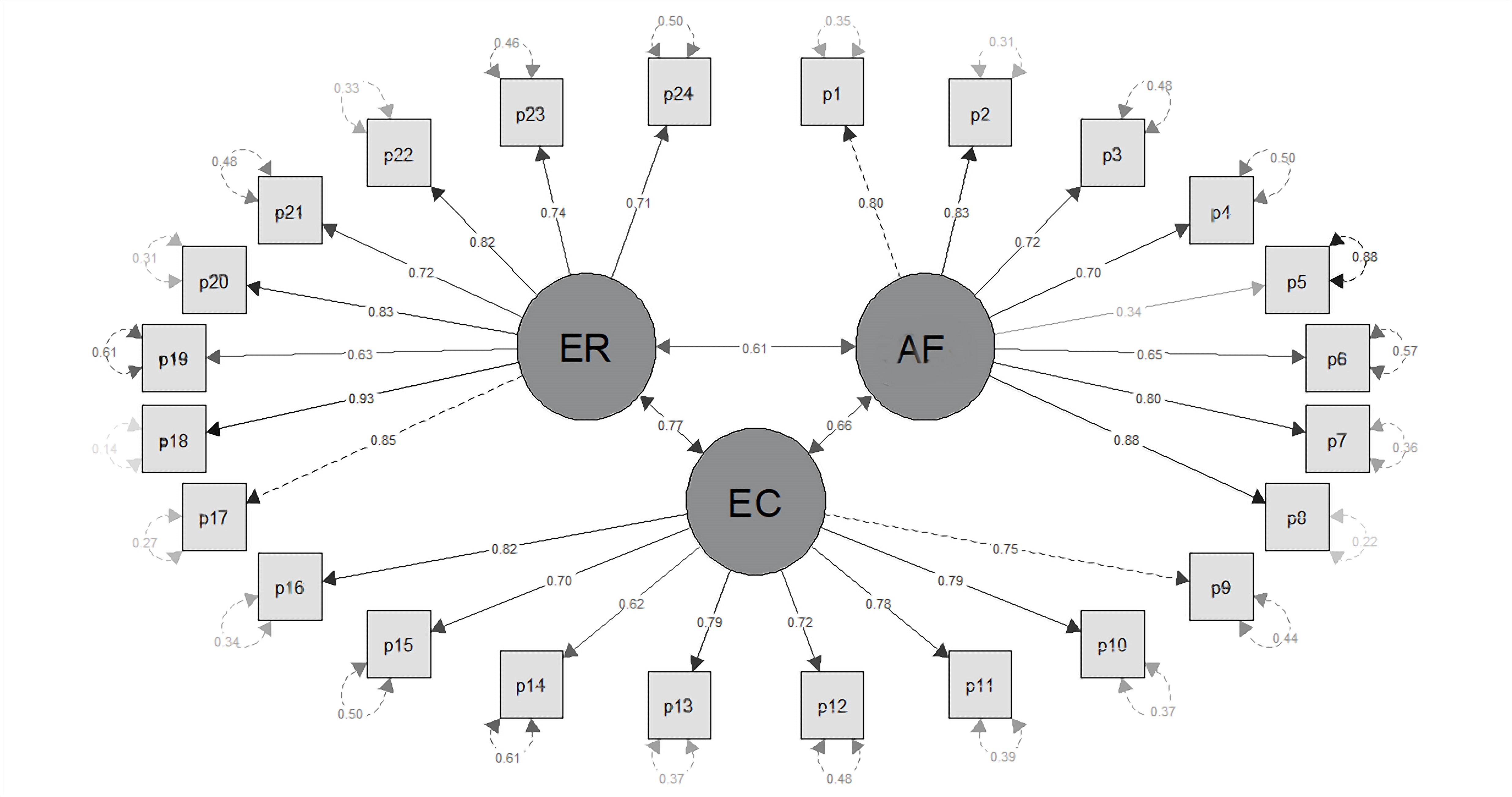
As shown in Figure
1, lthe observed factor loadings were high, particularly for the items associated with
the Emotional Repair (ER) factor (Items 17–24), suggesting that these items were well represented by
their respective factors. The observed correlations, such as 0.61 between ER and Attention to
Feelings
(AF) and 0.66 between Emotional Clarity (EC) and AF, suggest that these factors were moderately
correlated with one another, consistent with the underlying theoretical framework.
Finally, the curved arrows in the diagram represent the variance in the items that is not explained
by
the model’s latent factors. These arrows indicate the extent to which each item is not accounted for
by the model, reflecting the discrepancies between the observed and predicted scores. The values
associated with these arrows are crucial for evaluating model precision, as smaller residuals
indicate
that the model explains a greater proportion of the variability in the observed data.
Figure 1. Factor structure path diagram of the TMMS-24 by dimensions
Note. (ER) Emotional Repair; (AF) Attention to Feelings; (EC) Emotional Clarity
Reliability analysis
The reliability analysis showed that both Cronbach’s alpha and the Omega coefficient provided
valuable
information on the internal consistency of the instrument and each of its factors
Table
4.
Table 4. Cronbach's alpha coefficients by factor
X
Table 4. Cronbach's alpha coefficients by factor
|
|
Cronbach’s Alpha |
|
Attention to feelings
|
0.882
|
|
Emotional clarity
|
0.893
|
|
Emotional repair
|
0.907
|
The results presented inTable
4 indicate excellent internal consistency for each factor of the instrument,
given that a Cronbach’s alpha coefficient greater than 0.70 is considered acceptable. In
addition,
the Omega coefficient provides a more comprehensive measure of reliability because it does
not rely exclusively on the assumption of unidimensionality and takes into account the factor
structure of
the instrument, including factor loadings and correlations among factors.
The instrument yielded an overall Omega coefficient of 0.941 and an overall Cronbach’s alpha of
0.94,
indicating excellent reliability for the instrument as a whole.
Discussion
The TMMS-24 is a widely used instrument for assessing emotional intelligence
abilities across
diverse settings and professions, including nursing, where these abilities are essential to
staff’s
work
performance, as they influence the care provided to users of healthcare services, care
management,
and relationships within the interprofessional team. Recognizing and strengthening these
abilities
not only represents a crucial factor in the emotional, psychological, and social stability of
healthcare
professionals but also contributes to a healthy and efficient work environment20.
One of the most relevant findings from the literature review concerns the factor loadings of
certain
items (Items 23 and 24). In the study by Veloso-Besio et al.22,
these items exhibited factor loadings
below the recommended cutoff value (0.40). A similar finding was reported by Aradilla-Herrero et
al.2, who suggested
removing Item 23 because its factor loading on the construct was lower than that
of the other items. It is important to note that this finding warrants further investigation in
future
studies.
Another issue worthy of discussion, and one that opens avenues for future research, concerns the
factor loading of Item 5: “I let my feelings affect my thoughts”. In some studies, this
item has shown
factor loadings below the recommended cutoff value of 0.402,24,29,30,
whereas in the present study it
exhibited a low correlation with the dimension to which it belongs (AF). This finding may
suggest
inconsistencies in the item’s sensitivity across different samples. However, additional
statistical
analyses are needed to examine this item’s performance further.
For the items discussed above, the discrepancies with the findings reported by Aradilla-Herrero
et
al.2
and
Veloso-Besio et al.22
may
be attributable to certain limitations of the present study, such as crosscultural
bias or the context in which the instrument was administered. Accordingly, future research
should expand on this work by including samples with greater geographic variability and
qualitative
approaches to enable a deeper understanding of the items’ performance. In addition, the decision
to administer the instrument on-site should be carefully considered in future studies, as
completing
it in participants’ workplaces may introduce social desirability bias, thereby affecting their
responses,
particularly for items that have demonstrated sensitivity.
Another aspect worth considering is that, across all the studies reviewed, reliability was
estimated
exclusively using Cronbach’s alpha, overlooking the advantages of other methods that have
demonstrated greater precision in estimating measurement error. In the present study, internal
consistency was assessed using both Cronbach’s alpha and McDonald’s omega. The latter corrects
for the overestimation associated with the instrument and is related to the factor loadings of
the
items, thereby providing a more accurate estimate of reliability31. Although the reliability estimates
obtained with both methods were similar in the present study, this may not be the case in all
situations.
Conclusions
The evidence of validity and reliability obtained in this study confirms that
the
TMMS-24 is a valid and
reliable instrument for use with nursing personnel in Bogotá, suggesting that it may serve as an
effective
tool for assessing metaknowledge of emotional states in this specific population. Furthermore,
the
EFA showed that the TMMS-24 items were appropriately grouped into the three proposed theoretical
dimensions: Attention to Feelings, Emotional Clarity, and Emotional Repair, thereby supporting
the
instrument’s factor structure. Likewise, the CFA confirmed the factor structure proposed by the
TMMS-
24 theoretical model, demonstrating that the items clustered into three dimensions and providing
further evidence of the instrument’s construct validity.
The validation of the TMMS-24 is particularly relevant for nursing staff because their ability
to
understand and manage their own emotions may influence both professional practice and patient
care. This study validates a tool that can provide an evidence-based foundation for internal
institutional client well-being protocols. Likewise, it establishes a basis for its
incorporation
into
policies on humanization, health workforce recruitment, and quality assurance in higher
education.
As a recommendation for future research, additional analyses are warranted to examine the
sensitivity
of specific items and their performance across different samples, which may contribute to a
better
understanding of the TMMS-24’s construct validity.
Conflict of Interest: The authors declare that they have no
personal, professional, or financial
relationships that could have influenced the interpretation or presentation of the results.
Funding: This research was funded by the Fundación Universitaria del Área Andina,
Bogotá Campus,
under grant number CV2023-M3-12739.
Acknowledgments: The authors thank the Fundación Universitaria del Área Andina for
its
support of
this research through the National Directorate for Research, the Faculty of Health and Sport
Sciences,
the Nursing Program at the Bogotá Campus, and the Virtual Psychology Program, which provided the
resources necessary to carry out this project. The authors also express their gratitude to the
healthcare
professionals, students, and healthcare institutions that actively participated in its
implementation.
Authors Contribution: NCGR: Conceptualization; Data Curation; Funding Acquisition;
Investigation;
Project Management; Resources; Supervision; ; Writing-Original Draft Preparation; Writing-Review
&
Editing. LRL: Conceptualization; Data Curation; Funding Acquisition; Investigation; Resources;
Writing-
Original Draft Preparation; Writing-Review & Editing. JAEC: Methodology; Validation;
Writing-Original
Draft Preparation; Writing-Review & Editing. SBL: Data Curation; Formal Analysis; Methodology;
Software; Validation; Visualization; Writing-Original Draft Preparation; Writing-Review &
Editing.
References
-
Fernández-Berrocal P, Alcaide R, Domínguez E, Fernández-McNally C, Ramos NS,
Ravira
M.
Adaptación al castellano de la Escala rasgo de metaconocimiento sobre estados
emocionales de
Salovey et al.: datos preliminares. 1998 libro de Actas Del V Congreso de Evaluación
Psicológica,
1, 83-84. Consulta: noviembre, 14, 2024.
-
Aradilla-Herrero A, Tomás-Sábado J, Gómez-Benito J.
Perceived emotional intelligence in
nursing: psychometric properties of the Trait Meta-Mood Scale. J Clin Nurs.
2014;23(7-8):955-966.
https://doi.org/10.1111/jocn.12259
-
Morales Castillejos L, Gracia Verónica Y, Landeros Olvera
E.
The Relationship Between
Nurses’ Emotional Competence and Evidence-Based Nursing: A Scoping Review. Revista
Cuidarte.
2020;11(3). https://doi.org/10.15649/cuidarte.989
-
Machado DR, Brás MM, Almeida ALd, Vilela C.
La relación entre la competencia emocional de
las enfermeras y la enfermería basada en la evidencia: una revisión exploratoria.
Nursing
Reports.
2025;15(4):124.
https://doi.org/10.3390/nursrep15040124
-
Salovey P, Mayer JD.
Emotional Intelligence. Imagination, Cognition and Personality.
1990;9(3):185–211. https://doi.org/10.2190/DUGG-P24E-52WK-6CDG
-
Gardner H.
Estructuras de la Mente. La teoría de las inteligencias multiples. [internet]
1993 [cited 2024 Nov 01]. Available from:
https://drive.google.com/file/d/1-NprSGMH9g7ecElhgCs8MRVRgQvLY8yz/view
-
Mayer JD, Salovey P. What is emotional intelligence?
En:
Salovey P, Sluyter D, eds. Emotional
Development and Emotional Intelligence: Implications for Educators. New York: Basic
Books;
1997. p. 3-31.
-
Salovey P, Mayer JD, Goldman SL, Turvey C, Palfai TP.
Emotional attention, clarity, and repair:
Exploring emotional intelligence using the Trait Meta-Mood Scale. In J.W, Pennebaker
(Ed),
Emotion, disclosure, & health. 1995 p. 125-54. https://psycnet.apa.org/record/1995-98769-006
-
Extremera N, Fernández-Berrocal P.
¿Es la inteligencia emocional un adecuado predictor del rendimiento académico en
estudiantes.
III Jornadas de Innovación Pedagógica. Consulta: noviembre 14, 2024.
Disponible en:
https://www.academia.edu/30728564/_Es_la_inteligencia_emocional_un_adecuado_predictor_del_rendimiento_acad%C3%A9mico_en_estudiantes
-
Galvez Arcila FM, Rivera Tarrillo JA.
Validez y confiabilidad del TMMS-24 en estudiantes de
cuarto y quinto año de secundaria IE San José, Chiclayo. 2021[Internet] [tesis de
grado].
Universidad
Nacional Pedro Ruiz, Perú; 2023. Disponible en:
https://www.scribd.com/document/708316346/Galvez-Arcila-Francks-Marving-y-Rivera-Tarrillo-Jose-Abraham
-
Garay Queved O, Ortiz A.
Análisis de la equivalencia transcultural y evidencias de validez de la
versión en castellano de la Trait Meta-Mood Scale (TMMS-24) en población colombiana.
Proyectos
de Investigación Docente 2021. Consulta: Diciembre, 2025. Disponible en:
https://repositorio.ibero.edu.co/handle/001/5319
-
Cardona-Isaza AJ, González-Barrón R, Montoya-Castilla I.
La inteligencia emocional percibida
en adolescentes colombianos: propiedades psicométricas de la Escala Rasgo de
Metaconocimiento
Emocional (TMMS-24). Psicol Conductual. 2025;33(1):26-40. Disponible en:
https://dialnet.unirioja.es/servlet/articulo?codigo=10207205
-
Millán Ríos P.
La Inteligencia Emocional y su relación con el Estrés Laboral en el Personal de
Enfermería del Hospital Departamental San Antonio del Municipio de Roldanillo, Valle.
[Tesis
de
Pregrado Enfermería]. Universidad Católica de Pereira; 2021.
http://hdl.handle.net/10785/8291
-
Maureira Cid F, Flores Ferro E, Sepúlveda González S, Lagos
Urzúa B,
Contreras Contreras
S, Maureira Roldán G, et al.
Inteligencia emocional en estudiantes de Educación Física. Revista
Ciencias De La Actividad Física UCM. 2023;24(1):1-12.
https://doi.org/10.29035/rcaf.24.1.7
-
Zúñiga JO, Lara GAG, Pérez OC.
Propiedades Psicométricas del Trait Meta-Mood Scale (TMMS-
24) en adolescentes de Chiapas, México. European Scientific Journal.
2019;15(16):280.
https://eujournal.org/index.php/esj/article/view/12140
-
Ruiz Mamani PG, Cunza-Aranzábal DF, White M, Quinteros-Zuñiga D,
Jaimes-Soncco JE,
Morales-García WC.
Propiedades psicométricas de la "Escala rasgo de metaconocimiento de
los estados emocionales" para medir inteligencia emocional en estudiantes peruanos.
Behav.
Psychol. 2022;30(2):447-463. https://doi.org/10.51668/bp.8322207s
-
Villanueva Sanchez AA.
Análisis psicométrico del TMMS - 24 en adolescentes de Trujillo en
tiempos de Covid-19. [Tesis Pregrado en Psicología] Trujillo-Perú: Facultad Ciencias de
la
Salud,
Universidad César Vallejo; 2022. https://hdl.handle.net/20.500.12692/104324
-
Cari Chambi LF.
Propiedades psicométricas de la escala del metaconocimiento de los estados
emocionales (TMMS-24) en estudiantes universitarios peruanos [internet] [Tesis de
Pregrado
en
Psicología] Lima-Perú: Universidad César Vallejo; 2021. https://hdl.handle.net/20.500.12692/61283
-
Górriz AB, Etchezahar E, Pinilla-Rodríguez DE, Giménez-Espert
MdC,
Soto-Rubio A.
Validation of TMMS-24 in three Spanish-speaking countries: Argentina, Ecuador, and
Spain.
Int. J.
Environ. Res. Public Health. 2021;18(18):9753. https://doi.org/10.3390/ijerph18189753
-
Huamán Sanabria GS. Propiedades psicométricas del Cuestionario de
Inteligencia Emocional
TMMS-24 en adolescentes de Villa El Salvador [Tesis de Pregrado en Psicología].
Lima-Perú:
Facultad de Ciencias Humanas, Universidad Autónoma del Perú; 2021.
https://hdl.handle.net/20.500.13067/1306
-
Huamán Atarama DE.
Propiedades psicométricas de la escala de Inteligencia Emocional
TMMS – 24 en estudiantes de la escuela técnica superior – PNP [Tesis de Pregrado en
Psicología]
Piura-Perú: Facultad de Ciencias de la salud, Universidad César Vallejo; 2020.
https://hdl.handle.net/20.500.12692/56390
-
Veloso-Besio C, Peñaloza-Diaz G, Gallardo-Peralta L,
Cuadra-Peralta
A, Roa MC,
Santis CC, et al.
Estudio psicométrico de validación del instrumento de Inteligencia
Emocional, TMMS-24: comparación del modelo bifactorial y modelo de segundo
orden. Interciencia; Caracas. 2023;48(4):204-211.
https://www.proquest.com/docview/2817790479?sourcetype=Scholarly%20Journals
-
Espinoza-Venegas M, Sanhueza-Alvarado O, Ramírez-Elizondo N,
Sáez-Carrillo K.
Avalidation
of the construct and reliability of an emotional intelligence scale applied to nursing
students. Rev
Lat Am Enfermagem. 2015;23(1):139-47.
https://doi.org/10.1590/0104-1169.3498.2535
-
Angulo Rincón R, Albarracín Rodríguez ÁP.
Validez y confiabilidad de la escala rasgo de
metaconocimiento emocional (TMMS-24) en profesores universitarios. Revista
Lebret.
2019;(10):61-
72.
https://doi.org/10.15332/rl.v0i10.2197
-
Orozco LC.
Medición en salud: diagnóstico y evaluación de resultados: un manual crítico más allá
de lo básico. Bucaramanga: Universidad Industrial de Santander; 2010.
-
Campo-Arias A, Oviedo HC.
Propiedades Psicométricas de una Escala: la Consistencia Interna.
Rev. salud pública. 2008;10(5):831-839.
https://www.redalyc.org/articulo.oa?id=42210515
-
Pedrosa I, Suárez-Álvarez J, García-Cueto E.
Evidencias sobre la validez de contenido: avances
teóricos y métodos para su estimación. Acción Psicológica. 2013;10(2):3-18. https://dx.doi.org/10.5944/ap.10.2.11820
-
Guavita Rozo NC, Estevez Ceballos JA, Romero León L, Boyacá Leal
S.
Base de datos
validación TMMS-24 del personal de enfermería en Colombia. Papyrus V1 2025. https://doi.org/10.57924/7LCHS1
-
Martín-Albo J, Núñtez JL, León J.
Analysis of the psychometric properties of the Spanish version
of the Trait Meta-Mood Scale in a sports context. Psychological Reports.
2010;106(2):477-489.
https://journals.sagepub.com/doi/abs/10.2466/PR0.106.2.477-489.
-
Pedrosa I, Suárez-Álvarez J, Lozano LM, Muñiz J, García-Cueto E.
Assessing perceived
emotional intelligence in adolescents: New validity evidence of Trait Meta-Mood
Scale-24. Journal of Psychoeducational Assessment. 2014;32(8):737-746. http://dx.doi.org/10.1177/0734282914539238
-
Lara L, Martínez-Molina A.
Validación de la Escala de Identidad Étnica Multigrupo-Revisada
en adolescentes inmigrantes y autóctonos residentes en España. Revista
Latinoamericana
De
Ciencias Sociales, Niñez Y Juventud. 2016;14(1). https://doi.org/10.11600/1692715x.14140110515