Table 1. Distribution of reported cases of violence against pregnant women, according to
race/
color, age, and education level. Brazil, 2023.
X
Table 1. Distribution of reported cases of violence against pregnant women,
according to race/
color, age, and education level. Brazil, 2023.
|
|
Violence
% (n)
|
Live Births
(n)
|
Rate per 1,000 LB
|
|
Brazil
|
100.00 (19851)
|
2 537,511
|
7.82
|
Race/color
|
|
|
|
White
|
29.30 (5816)
|
840,041
|
6.92
|
Black
|
11.91 (2365)
|
196,323
|
12.05
|
Yellow
|
0.95 (189)
|
11,956
|
15.81
|
Brown
|
52.61 (10444)
|
1 413,597
|
7.39
|
Indigenous
|
2.70 (536)
|
29,622
|
18.09
|
Ignored
|
2.52 (501)
|
45,972
|
10.90
|
Age
|
|
|
|
Under 20 years old
|
41.02 (8142)
|
303,266
|
26.85
|
20 to 34 years old
|
26.96 (9323)
|
1 778,936
|
5.24
|
35 or more
|
12.02 (2386)
|
455,278
|
5.24
|
Education
|
|
|
|
< 8 years |
28.46 (5649)
|
290,246
|
19.46
|
8 years or older
|
47.99 (9526)
|
2 230,168
|
4.27
|
Ignored
|
23.56 (4676)
|
16,855
|
277.4
|
LB = live births; n = absolute number of cases; % =
percentage.
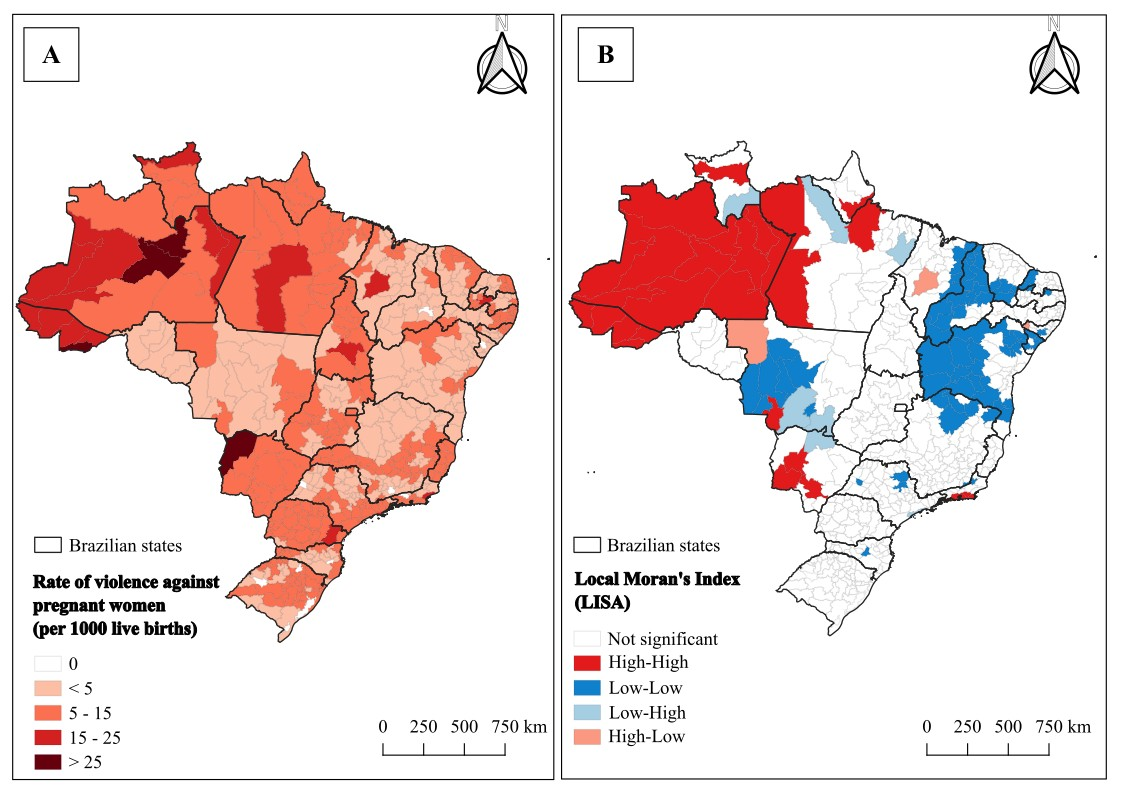
In the spatial analysis, the results obtained through the Global Moran's I indicated
a positive spatial
autocorrelation of rates of violence against pregnant women, with Moran's I = 0.374 and z-score =
14,5871, evidencing a non-random spatial pattern. The spatial distribution also showed that the
highest
rates are heterogeneously spread across the country. Among the federative units, it is noted that
the
states in the North Region, especially Acre, Amazonas, and Roraima, have the highest occurrence of
violence against pregnant women. However, the states of Mato Grosso do Sul and Paraná also showed
high rates. In contrast, states such as Rondônia, Sergipe, Piauí, Bahia, and Rio Grande do Sul
showed a
predominance of regions with lower or zero rates Figure 2A.
In the immediate regions, Corumbá-MS, Manacapuru-AM, Coari-AM, and Brasiléia-AC stand out
with high rates (53.52; 27.88; 26.25 and 25.76 per 1,000 live births, respectively). The lowest
rates
corresponded to the immediate regions of Simplício-PI, Caxambu-MG, Dracena-SP, Ituporanga-SC,
Santiago-RS, Tapejara-RS, Sananduva-RS, Itabaiana-SE, and Valença-BA, with a zero rate Figure 2A.
The analysis of spatial autocorrelation revealed immediate regions that formed
significant spatial
clusters. 29 immediate regions with direct or positive spatial correlation were identified,
classified as
high-high clusters (5.69% of the total immediate regions in Brazil). Indicating immediate regions
with
a high rate of reported violence against pregnant women, neighboring other equally high regions.
These clusters can be visualized on the map by the dark red areas, corresponding to six distinct
clusters, the most significant of which is in the Northern Region of the country, encompassing the
states of Acre, Amazonas, and Pará Figure 2B.
The PR analysis showed that adolescents with sufficient
HL were
44.80% more likely to have adequate
knowledge of HIV and STIs than those with inadequate HL (95% CI:
1.119–1.874).
In the analysis adjusted
for the covariates of sex, age, and grade level, this statistically
significant
association was confirmed with
On the other hand, 70 immediate regions formed 8 clusters with classification.
Low-low (13.73% of
the total immediate regions), that is, immediate regions with a low rate of reported violence
against
pregnant women surrounded by others that also have low rates. These regions were shown in dark
blue, with the largest group encompassing Maranhão, Piauí, Bahia, Ceará, Rio Grande do Norte,
Sergipe, Alagoas, and northern Minas Gerais Figure 2B.
Furthermore, patterns of negative or inverse spatial correlation are observed,
characterized by
contrasts between local values and those of neighboring regions. Three immediate regions presented
the high-low pattern (0.59%), and seven were classified as low-high (1.37%) Figure 2B.
Figure 2. Distribution of reported rates of violence against pregnant women and their
clusters,
Brazil 2023.
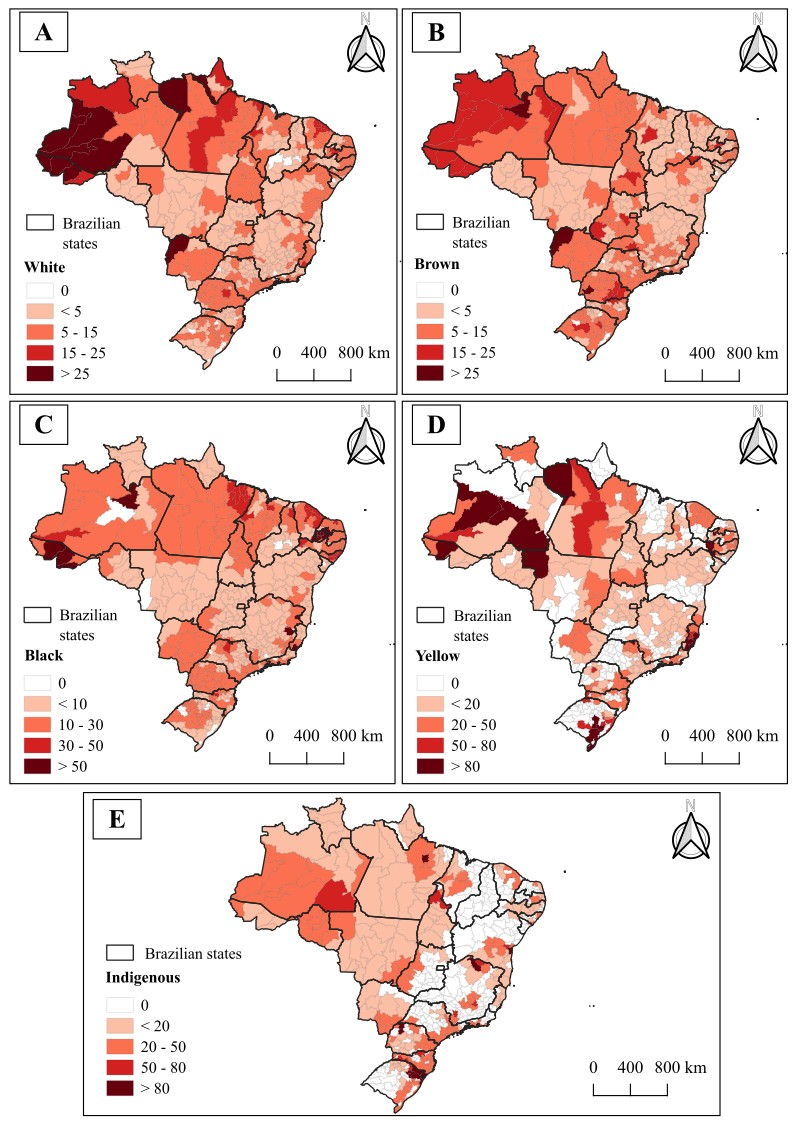
Regarding the distribution by race/color, it was found that reports of violence
against pregnant
women occur with distinct patterns among the different groups. The occurrence among brownskinned
pregnant women stood out for its scope, widely dispersed across various regions Figure 3B. While the occurrence among yellow and indigenous races/colors
stands out for its magnitude,
presenting rates higher than 80 reports per 1,000 live births Figures 3D and
3E.
It is evident that violence against pregnant women of Asian descent occurs
predominantly in the
North of the country, especially in the states of Amazonas, Acre, and Pará. However, rates exceeding
80 are also found in other regions (Northeast, Central-West, and South) Figure
3D. Similarly, rates
among Indigenous people generally predominate in the North of Brazil, extending to the western
portion of the Central-West (Mato Grosso and Mato Grosso do Sul) and the Southern states Figure 3E.
Figure 3. Spatial distribution of violence against pregnant women in Brazil, according to
the
victim's race/color. Brazil, 2023.
White. (B) Brown. (C) Black. (D) Yellow. (E) Indigenous.
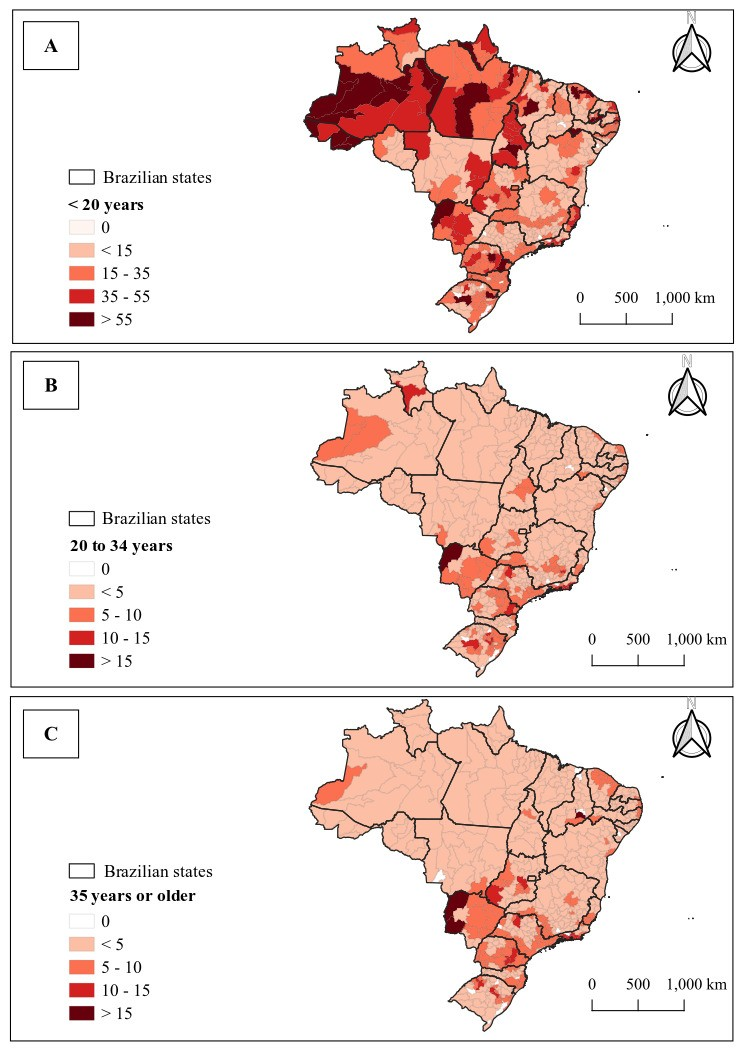
Regarding the distribution of violence against pregnant women according to age group
Figure 4, a
significant disparity in violence rates is evident across the different age groups studied. Young
women
under 20 years of age were the most affected, especially in the North and Central-West regions of
the
country, particularly in the states of Amazonas, Acre, Amapá, Rondônia, and Mato Grosso do Sul
Figure 4A. Among pregnant women aged 35 or older, the rates were the lowest
in terms of intensity, with a
predominance of rates below 5 notifications, except for some immediate regions in the states of Mato
Grosso do Sul, Paraná, and Rio Grande do Sul, where rates above 10 were identified Figure 4C.
Figure 4. Spatial distribution of violence against pregnant women in Brazil, according to
the
victim's age group. Brazil 2023.
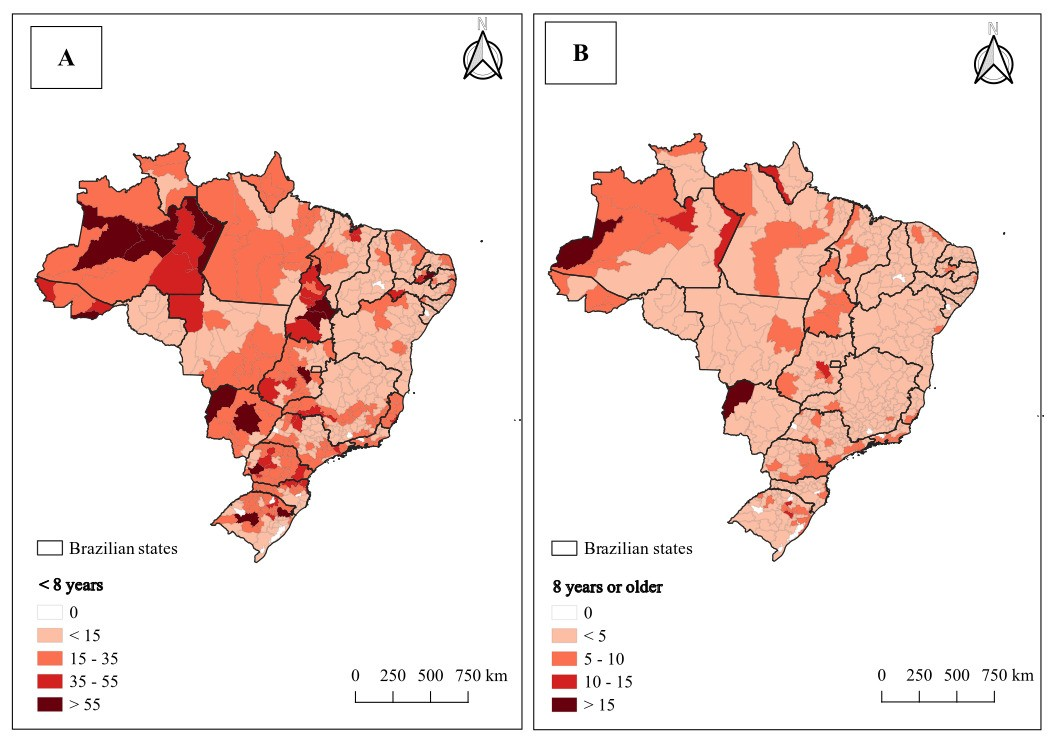
Regarding the education level of pregnant women, it is evident that women with less
than 8 years
of schooling were the main victims, reaching rates exceeding 55 notifications per 1,000 live births
in some immediate regions, mainly in the North and Central-West regions of the country Figure 5A.
However, it is observed that violence also affects pregnant women with 8 or more years of schooling,
although in most cases, the rates remain below 5 notifications per 1,000 live births. The main
exceptions occur in localized hotspots in the states of Amazonas, Pará, Tocantins, and Mato Grosso
do
Sul, where immediate regions with punctual increases were identified Figure
5B. However, it should
be noted that there were notifications in which the field was ignored or not filled in (23.56%).
Figure 5. Spatial distribution of violence against pregnant women in Brazil, according to
the
victim's education level. Brazil, 2023.
Discussion
This study sought to identify the spatial distribution of rates of violence against
pregnant women
in Brazil in 2023. During the research, no studies were found that explored this topic from a
spatial
perspective, making this one of the first at the national level. This allows for important
contributions,
such as identifying areas with a higher concentration of cases, helping to understand the
territorial
dynamics of violence against pregnant women and to highlight potentially more vulnerable regions.
The national rate was 7.82 cases per 1,000 live births, indicating a worrying
scenario, especially
because it involves the so-called double vulnerability of the woman and the fetus, which highlights
the need for specific and qualified care from health services. This context demands sensitive
support
and comprehensive interventions from the care networks, focusing on the protection of the pregnant
woman and the guarantee of her rights4.
Additionally, the study conducted by Soares and colleagues in 2023 characterized the
main causes
of death among women with reported interpersonal violence during pregnancy, observing that in
the period from 2011 to 2017, 45.20% of pregnant women with reported violence during pregnancy
died. This observation is concerning and amplifies the need for immediate interventions to prevent
violence and consequently femicide during pregnancy3.
Beyond the Brazilian context, violence against pregnant women is not an isolated
phenomenon,
being widely recognized in different international scenarios. In the Latin American context, a
worrying
situation is observed, as in Peru, where the prevalence of violence against pregnant women reached
29.44%16. In high-income
countries, such as the United States of America, evidence indicates that
homicides occurring during pregnancy or in the 42 days following its termination more than doubled
the main traditional causes of maternal mortality17.
In this study, using the spatial scanning method, it was possible to identify the
area’s most vulnerable
to violence against pregnant women, with high-high clusters concentrated predominantly in the
North region of the country, particularly in the states of Acre, Amazonas, and Pará. Previous
studies
had already indicated this region as one of those with the fastest-growing rates of violence in
Brazil18.
Furthermore, data show that Amazonas and Acre register the highest proportions of women who
reported having suffered or witnessed domestic violence (57% and 54%, respectively), with rates
higher than the national average, which is 48%19.
The concentration of these cases in this region may suggest geographical
peculiarities. Geographical
obstacles hinder access to support services and the perception of the severity of the cases20. Rural
women are more prone to violence, since they require greater dependence on their partner and do
not know who or what to turn to, facing difficulties in asking for help21.
Furthermore, Brazil is marked by profound regional disparities, which are reflected
in social, economic
and health indicators. The North and Northeast regions concentrate the worst results in these
indicators, evidencing a scenario of historical and structural inequality in relation to the other
regions
of the country22,23.
Although the states of Rondônia, Sergipe, Piauí, and Bahia present lower rates of
violence against
pregnant women, it is worth highlighting that, according to the Atlas of Violence in Brazil (2025),
these states have high rates of female homicide. According to this document, Bahia is considered
the most violent state for women, and the states of Rondônia and Piauí have the highest incidence of
femicide in Brazil in the years 2018 to 2023. As for the states of Mato Grosso do Sul and Paraná,
which
presented high rates of violence against pregnant women in this study, Mato Grosso do Sul appears
as a state with a low proportion of femicide in the Atlas of Violence, even showing a decrease in
the
period from 2018 to 2023, and Paraná follows the proportion presented for Bahia24.
The discrepancies between the data on violence against pregnant women and femicide
may indicate
difficulties on the part of some states in reporting the data, since it is expected that regions
more
vulnerable to femicide are also vulnerable to violence against women, including pregnant women.
Regarding the race/color variable, the data reveal a predominance of cases among
brown women,
as well as a higher magnitude of rates among those of yellow and indigenous race/color. This
finding corroborates evidence that black, brown, and ethnic minority women are the main victims of
violence25.
Furthermore, IBGE data reveals profound inequalities in access to work and
education. Approximately
69% of managerial positions are held by white people, demonstrating the underrepresentation of
racialized groups in leadership positions26. In education, the illiteracy rate among
mixed-race people
is 8.8%, more than double that observed among white people (4.3%). Among the indigenous
population, this rate is even more alarming, reaching 16.1%27.
The high rates observed among self-declared Asian pregnant women, especially in the
Northern
Region, should be interpreted with caution due to the instability effect of rates in small
populations. In this region, which is home to only 0.20% of the country's Asian population, a small
absolute number of cases can result in very high proportional rates28.
Regarding indigenous women, it is observed that, despite the transformations that
have occurred
since the colonial period, many are still victims of sexual exploitation. Stereotypes persist that
reduce
them to hypersexualization and fetishization, perpetuating violence. In addition, contact with white
men and the introduction of alcohol and other drugs into indigenous communities have intensified
the violence perpetrated by indigenous men against their partners and other women in the
group29.
The prevalence of violence against pregnant women of Asian and Indigenous descent in the Northern
Region, especially in Amazonas, Acre, and Pará, is also linked to the phenomenon of plant or mineral
extraction. In these areas, one observes the so-called "corrutelas," support points that operate
as kitchens, bars, supply stores, lodging, leisure, and socialization spaces. In these "corrutelas,"
prostitution and sexual exploitation of girls and women are common, including alcohol and drug
abuse, where gender is a fundamental marker. There are reports of assaults and even murders when
the men's wishes are thwarted24.
Regarding age range, violence was observed in all cycles and phases of a woman's life, indicating
that it is a phenomenon that transcends the age25. However, the highest rates were among those
under 20 years of age, possibly due to socioeconomic and emotional dependence. This dependence,
frequently associated with low education and lack of insertion in the labor market, contributes to
the
vulnerability of young women30. In this context, violence can emerge as an
expression of structural
limitations and, in some cases, be naturalized or tolerated as a survival strategy.
Among young women in this age group, jealousy on the part of intimate partners remains a
relevant factor. Controlling behaviors are often accepted and interpreted as demonstrations of care,
contributing to the trivialization and invisibility of abusive dynamics31. On the other hand, it
is also
observed that increased access to information and public services, such as security, education, and
health, has the potential to strengthen strategies for breaking the cycle of violence and
encouraging
the reporting of aggressors, representing progress in confronting these situations of oppression. In
this context, the role of epidemiological surveillance stands out, acting decisively in identifying
a
pregnant woman aged 14 or younger, carrying out the mandatory notification of rape of a vulnerable
person, as provided for in current Brazilian legislation, which may result in a greater number of
notifications in the under-20 age group25,32.
Among pregnant women of advanced age, the numbers of perpetrated violence tend to be lower,
which may indicate greater family and personal life planning. Many women in this age group generally
have greater independence, emotional stability, better access to contraceptive methods, and a
desire to prioritize their professional careers to achieve financial stability before starting a
family33.
Furthermore, this greater preparation for pregnancy results in greater assertiveness in choosing a
partner and more stable relationships, contributing to a better experience during the postpartum
period and less exposure to violence.
Regarding the educational level of the victims, previous studies corroborate that there is a higher
prevalence of violence cases among pregnant women with low levels of education, highlighting
mainly that the majority of women in situations of violence had less than 8 years of
schooling13,
suggesting an inverse correlation between the level of education and tolerance of violence; the
greater the access to education, the lower the acceptance of abusive situations. Furthermore, the
literacy deficit constitutes a factor that makes the pregnant woman financially dependent on others,
since education is related to the expansion of opportunities in the job market and, consequently, to
better living conditions34.
This study has some limitations. One of them is the use of secondary data, which is subject to
incomplete information, the possibility of underestimation due to underreporting of cases, and the
impossibility of establishing direct causal inferences. However, the data show promise as they are
original information, offering valuable and essential insights for understanding the
phenomenon
under study, and contributing to guiding future research.
Conclusion
Violence against pregnant women is present throughout the country, highlighting its
multifactorial
and complex nature, affecting women of different races/colors, age groups, and educational levels.
However, regional variations were identified, with higher rates in the states of Amazonas, Roraima,
Acre, Mato Grosso do Sul, and Paraná, indicating significant disparities between regions. Greater
vulnerability was observed among pregnant women under 20 years of age, those who self-identified
as mixed-race, Asian, or Indigenous, and those with low levels of education, indicating greater
exposure of these groups to violence.
It is important to highlight that the ethno-racial characteristics of violence
against pregnant women
can be imprecise. Notifications of violence against Indigenous and Asian women, for example, tend
to be lost in the "mixed-race" category, since they are not always based on self-declaration. In
other
words, it is possible that violence against Indigenous and Asian pregnant women is underreported in
some areas and is even more representative than observed in this study.
Protective measures, information, and support for victims are essential to ensure
that this cycle is
broken. It is also necessary to implement more effective public policies, especially strengthening
primary healthcare, where prenatal care is the gateway for pregnant women into the public health
system and allows for the creation of bonds, opening space for debate and actively listening to
women, identifying and addressing their vulnerabilities.
Conflicts of interest: There are no conflicts of interest.
Funding:This work was carried out with support from the Scientific
Initiation Program with PIBICUNINGÁ
Scholarship and the Coordination for the Improvement of Higher Education Personnel -
Brazil (CAPES) - Funding Code 001.
Author contributions: RMPS: Conceptualization; Data Curation;
Investigation; Visualization; Writing
– Original Draft Preparation; Writing – Review & Editing. MLMdS: Data Curation; Investigation;
Methodology; Validation; Visualization; Writing – Original Draft Preparation; Writing – Review &
Editing.
LSdA: Formal Analysis; Visualization; Writing – Review & Editing. EMC: Validation; Writing – Review
&
Editing. RRdO: Conceptualization; Data Curation; Investigation; Methodology; Project Administration;
Supervision; Validation; Writing – Original Draft Preparation; Writing – Review & Editing.
References
-
United Nations Office on Drugs and Crime.
Gender-related killings of women and girls
(femicide/feminicide): Global estimates of female intimate partner/family related homicides
in 2022. [Internet] 2023. [cited 2024 November 22]. Available from:
https://www.unwomen.org/sites/default/files/2023-11/gender-related-killings-of-women-and-girls-femicide-feminicide-global-estimates-2022-en.pdf
-
Defilipo EC, Chagas OS de C, Ribeiro LC.
Violência contra gestante e fatores associados no
município de Governador Valadares. Rev Saúde Pública. 020;54:135.
https://doi.org/10.11606/s1518-8787.2020054002491
-
Soares MQ, Melo CM de, Pinto IV, Bevilacqua PD.
Mortalidade de mulheres com notificação
de violência durante a gravidez no Brasil: um estudo caso-controle. Cadernos de Saúde
Pública.
2023;39(10):e00012823.
https://doi.org/10.1590/0102-311XPT012823
-
Colonese CF, Pinto LW.
Análise das notificações de violência contra gestante no Brasil no
período de 2011 até 2018. Texto & Contexto-Enfermagem. 2022;31:e20210180.
https://doi.org/10.1590/1980-265X-TCE-2021-0180
-
Pinto IV, Bernal RTI, Souza, M de FM de, Malta DC. Fatores
associados ao óbito de
mulheres com notificação de violência por parceiro íntimo no Brasil. Ciênc. saúde
coletiva.
2021;26(3):975-985. https://doi.org/10.1590/1413-81232021263.00132021
-
Leite TH, Marques ES, Corrêa RG, Leal M do C, Olegário B da CD,
Costa RM da, et al.
Epidemiologia da violência obstétrica: uma revisão narrativa do contexto brasileiro.
Ciênc.
saúde
coletiva. 2024;29(09):e12222023.
https://doi.org/10.1590/1413-81232024299.12222023
-
Román-Gálvez RM, Martín-Peláez S, Fernández-Félix BM, Zamora J, Khan
KS, Bueno-
Cavanillas A. Worldwide Prevalence of Intimate Partner Violence in Pregnancy. A
Systematic
Review and Meta-Analysis. Frontiers in public health. 2021;9:738459.
https://doi.org/10.3389/fpubh.2021.738459
-
Miranda VIA, Meller F de O, Schãfer AA, Soratto J, Tomasi CD, Coll C
de VN, et al.
Violência por parceiro íntimo durante a gestação e qualidade de vida no Sul do Brasil:
estudo
transversal, 2022. Epidemiol. Serv. Saúde. 2022;33:e2023993.
https://doi.org/10.1590/S2237-96222024v33e2023993.pt
-
Gava FDM.
Violência contra gestante no Brasil e regiões em 2019: estudo ecológico.
[Dissertação Mestrado Profissional]. Criciúma (SC): Universidade do Extremo Sul Catarinense;
2023.
http://repositorio.unesc.net/handle/1/10764
-
Silva R de P, Leite FMC.
Violências por parceiro íntimo na gestação: prevalências e
fatores associados. Rev. Saúde Pública. 2020;54:97.
22024;6:1444111. https://doi.org/10.11606/s1518-8787.2020054002103
-
Instituto Brasileiro de Geografia e Estatística (IBGE).
Cidades e Estados. Consulta: Maio 17,
2025.
-
Moroskoski M, Brito FAM de, Oliveira RR de.
Tendência temporal e distribuição espacial dos
casos de violência letal contra mulheres no Brasil. Rev. Latino-Am.
Enfermagem. 2022;30:e3609.
https://doi.org/10.1590/1518-8345.5613.3609
-
Moreira KFA, Bicalho BO, Moreira TL.
Violência sexual contra mulheres em idade fértil
na região norte do Brasil. Revista Eletrônica Acervo Saúde. 2020;12(3):e2826.
https://doi.org/10.25248/reas.e2826.2020
-
Instituto Brasileiro de Geografia e Estatística (IBGE).
IBGE divulga nova divisão territorial
com foco nas articulações regionais. Consulta: Abril 30, 2025. Disponível em:
https://agenciadenoticias.ibge.gov.br/agencia-sala-de-imprensa/2013-agencia-de-noticias/releases/10515-ibge-divulga-nova-divisao-territorial-com-foco-nas-articulacoes-regionais
-
Silva LA de, Silva MLM da, Semezatto RMP; Oliveira RR de.
Banco de dados: violência
contra gestantes. Mendeley Data. 2025.
2021;21(4):804–10. https://doi.org/10.17632/kx5pcgszx3.1
-
Barzola Mancha MK, Moquillaza Alcántara VH, Diaz Tinoco CM.
Violencia doméstica
durante el embarazo en un hospital especializado del Perú: Prevalencia y factores asociados.
Rev. chil. obstet. ginecol. [online]. 2020, vol.85, n.6, pp.641-653. ISSN
0048-766X. https://www.scielo.cl/pdf/rchog/v85n6/0717-7526-rchog-85-06-0641.pdf
-
Wallace M, Gillispie-Bell V, Cruz K, Davis K, Vilda D.
Homicide during pregnancy and the
postpartum period in the United States, 2018-2019. Obstet Gynecol.
2021;138(5):762-769.
https://doi.org/10.1097/AOG.0000000000004567
-
Instituto de Pesquisa Econômica Aplicada -Ipea.
Dinâmicas da violência e da criminalidade
na Região Norte do Brasil. Brasília: Ipea; 2024. Consulta: Abril 30, 2025. Disponível em: https://repositorio.ipea.gov.br/entities/book/23fbdcd5-e870-48b9-8da4-34d735712d2a
-
Senado Federal.
Comparativo Nacional de Violência contra a Mulher. Brasília: Senado
Federal, 2024. Consulta: Abril 30, 2025. Disponível em: https://www.senado.leg.br/institucional/datasenado/relatorio_online/pesquisa_violencia_domestica/2024/interativo.html#comparativo-nacional-de-viol%C3%AAncia-contra-a-mulher
-
Lacerda DF, Azevedo MN de. Violência por parceiros íntimos em pessoas
transgênero no
Brasil: estudo transversal, 2015-2021. Epidemiol Serv Saúde. 2024;33(1):e2024386.
https://www.scielosp.org/article/ress/2024.v33nspe1/e2024386/pt/
-
Stochero L, Wernersbach-Pinto L.
Eu sofria calada e certamente toda mulher é assim -
Silenciamentos: reproduções e rupturas da violência contra as mulheres que vivem em
contextos rurais. Ciênc saúde coletiva. 2024;29(7):e025222024.
https://cienciaesaudecoletiva.com.br/artigos/eu-sofria-calada-e-certamente-toda-mulher-e-assim-silenciamentosreproducoes-e-rupturas-da-violencia-contra-as-mulheres-que-vivem-em-contextos-rurais/19077
-
Instituto de Estudos para Políticas de Saúde (IEPS).
Norte e Nordeste apresentam os piores
índices do sistema de saúde, segundo pesquisa do IEPS. 2022. Atualizado em: 2 maio 2024.
Consulta: Junho 14, 2025. Disponível em:
https://ieps.org.br/norte-e-nordeste-apresentampiores-indices-do-sistema-de-saude-segundo-pesquisa-do-ieps
-
Pitombeira DF, Oliveira LC de.
Pobreza e desigualdades sociais: tensões entre direitos,
austeridade e suas implicações na atenção primária. Ciênc. saúde coletiva.
2020;25(5):1699-708.
https://doi.org/10.1590/1413-81232020255.33972019
-
Cerqueira DRC, Bueno S, coordenadores.
Atlas da violência 2025. Brasília: Instituto de
Pesquisa Econômica Aplicada (Ipea); Fórum Brasileiro de Segurança Pública (FBSP);2025.
Consulta: Junho 13, 2025. Disponível em:
https://repositorio.ipea.gov.br/handle/11058/17165
-
Moroskoski M, Brito FAM de, Queiroz RO, Higarashi IH, Oliveira RR
de.
Aumento da violência
física contra a mulher perpetrada pelo parceiro íntimo: uma análise de tendência. Ciênc.
saúde coletiva. 2021;26:4993-5002. https://doi.org/10.1590/1413-812320212611.3.02602020
-
Instituto Brasileiro de Geografia e Estatística (IBGE).
Desigualdades sociais por cor ou raça
no Brasil. 2021. Consulta: Maio 6, 2025. Disponível em:
https://www.ibge.gov.br/estatisticas/sociais/populacao/25844-desigualdades-sociais-por-cor-ou-raca.html
-
Instituto Brasileiro de Geografia e Estatística (IBGE).
Censo 2022: taxa de analfabetismo
cai de 9,6% para 7,0% em 12 anos, mas as desigualdades persistem. 2024. Consulta: Maio
6, 2025. Disponível em: https://educa.ibge.gov.br/criancas/brasil/2848-nosso-povo/22320-alfabetizacao.html
-
Instituto Brasileiro de Geografia e Estatística (IBGE).
Cor ou raça. Educa Jovens.
Consulta: Maio 6, 2025. Disponível em:
https://educa.ibge.gov.br/jovens/conheca-o-brasil/populacao/18319-cor-ou-raca.html
-
Kristiensen I, Caetano SO de.
Violência sexual contra a mulher indígena brasileira: a história
construída na dor infringida aos seus corpos do passado colonial à contemporaneidade.
Lampiar. 2024;3(1).
https://periodicos.apps.uern.br/index.php/LAMP/article/view/5875/4154
-
Soares LSA, Teixeira EC.
Dependência econômica e violência doméstica conjugal no Brasil.
Planejamento e políticas públicas. 2022:61.
https://doi.org/10.38116/ppp61art9
-
Oliveira APF, Silva SMC, Campeiz AB, Oliveira WA de, Silva MAI,
Carlos DM.
Violência nas
relações íntimas entre adolescentes de região de alta vulnerabilidade social. Rev.
Latino-Am.
Enfermagem. 2021;29:e3499.
https://doi.org/10.1590/1518-8345.5353.3499
-
Cargnin JSS, Luna JS, Aguiar DM de, Rodrigues BTC, Filho AA de A,
Silveira RP.
Violência
sexual em mulheres na Amazônia Ocidental. Rev. Saúde Pública. 2021;55:92.
https://doi.org/10.11606/s1518-8787.2021055003069
-
Prates LF de L, Silva MLM, Moroskoski M, de Oliveira NN, Silva M de
AP, Melo EC, et al.
Tendência temporal e distribuição espacial das taxas de vias de parto, segundo
características
maternas no Brasil, entre 2011 e 2020. Rev. Contexto & Saúde. 2024;24:48.
https://doi.org/10.21527/2176-7114.2024.48.13873
-
Silva WKO, Brandão BML da S, Araújo-Monteiro GKN de, Pereira FA,
Dantas AMN, Souto
RQ, et al.
Violência doméstica e gestação: estudo descritivo em unidade pré-natal. As Várias
Faces de Eva: o feminino na contemporaneidade. Editora Científica Digital.
2022;195-209.
https://www.editoracientifica.com.br/books/chapter/220509005