



Table 1. Mapping of Health Promotion actions for older adults in Primary Health Care Units in a municipality in Santa Catarina, Brazil. Navegantes, Santa Catarina, 2025
Table 1. Mapping of Health Promotion actions for older adults in Primary Health
Care Units in a
municipality
in Santa Catarina, Brazil. Navegantes, Santa Catarina, 2025
| PHCU | Team
Composition |
Health Promotion Actions |
Frequency | Mean Number of Participants |
Professionals nvolved |
Resources Used |
|---|---|---|---|---|---|---|
| PHCU 2 | 3 FHT 1 PCT |
Health education group for individuals with arterial hypertension and diabetes mellitus. |
Monthlyl | 5 | Nurse |
Materials provided by the Municipal Health Department (SVF foam sheets, cardboard, A4 paper) |
| PHCU 3 | 2 FHT |
Health education
group for individuals with arterial hypertension and diabetes mellitus. |
Monthly | 16 |
Nursing technician, community health worker and dentist |
Refreshments and gifts (selffunded); office supplies and projector provided by the Municipal Health Department |
| PHCU 4 | 1 FHT |
Health education group for individuals with arterial hypertension and diabetes mellitus. |
Bimonthly | 15 |
Community health worker, physician, dentist and nursing technician |
Refreshments and gifts (selffunded); office supplies, WhatsApp and projector provided by the Municipal Health Department |
| PHCU 5 | 2 FHT | Walking group. | Weekly | 3 |
Community health worker, physician, nutritionist, dentis and nursing technician |
Meeting room, gifts, seedlings, and refreshments (self-funded); office supplies and projector provided by the Municipal Health Department |
| PHCU 6 | 2 FHT | Walking group. | Semiannual | 5 |
Community health worker |
CComputer and sphygmomanometers |
| PHCU 12 | 1 FHT | Community garden. | Monthly | 2 | Nursing technician | Seedlings (self-funded) |
| PHCU 15 | 2 FHT | Walking group. | Weekly | 10 |
Community health worker |
CRAS facilities; materials provided by the Municipal Health Department (cardboard, SVF foam sheets and A4 paper) |
| PHCU 16 | 3 FHT | Walking group. | Weekly | 10 |
Nurses and community health workers |
Scale, measuring tape, projector and microphone |
| PHCU 17 | 1 FHT | EHealth education
group for individuals with arterial hypertension and diabetes mellitus. |
Annual | 4 |
Nurses, dentist, physician and nursing technician |
Projector, materials provided by the Municipal Health Department, measuring tape and scale |
| PHCU 18 | 3 FHT | Walking group; health education group for individuals with arterial hypertension and diabetes mellitus; community garden. |
Weekly (walking group); biweekly (health education group); community garden under implementation |
15 (walking group); 10 (health education group); community garden under implementation |
Nurses, dentist, community health worker and nursing technician |
Glucometer, sphygmomanometers and materials provided by the Municipal Health Department (cardboard, SVF foam sheets and A4 paper) |
Note: PHCU: Primary Health
Care Units; FHT: Family Health Team; PCT: Primary Care Team;
CRAS: the Brazilian Social Assistance
Reference Center; SVF: Satin
Vinyl
Foam;
A4 paper: ISO 216 A4 paper
format (210 × 297
mm).
The mapping of Health Promotion (HP) actions targeting older adults identified their distribution, frequency, professionals involved, and resources mobilized across the Primary Health Care Units (PHCUs). Subsequently, a qualitative analysis of the accounts provided by professionals from the selected unit was undertaken to further explore the challenges related to the implementation of HP actions in the Primary Health Care setting Table 2.
Table 2. Characteristics of the professionals participating in the Hermeneutic-Dialectic Circle at a Primary Health Care Unit. Navegantes, Santa Catarina, Brazil, 2025
Table 2. Characteristics of the professionals participating in the
Hermeneutic-Dialectic Circle
at a
Primary Health Care Unit. Navegantes, Santa Catarina, Brazil, 2025
| Codename | Professional Category |
Age (years) | Sex | Length of Experience in PHC (months) |
Length of Service in the Territory (months) |
|---|---|---|---|---|---|
| Aphrodite | Nursing technician | 51 | Female | 73 | 36 |
| Apollo | Community health worker | 46 | Female | 9 | 9 |
| Artemis | Nurse | 39 | Male | 156 | 36 |
| Athena | Nurse | 29 | Female | 7 | 7 |
| Ivy | Physician | 34 | Female | 48 | 48 |
| Minotaur | Community health worker | 52 | Female | 9 | 9 |
| Persephone | Receptionist | 47 | Female | 6 | 6 |
| Zeus | Community health worker | 54 | Female | 252 | 252 |
Note: PHC: Primary Health Care
These challenges emerged in the form of claims, concerns, and issues (CCIs), which were grouped into provisional constructions and subsequently validated during the negotiation session. The challenges were organized into four main constructions—team, community, resources and management—and systematized using an Ishikawa diagram12, as presented in Figure 1.
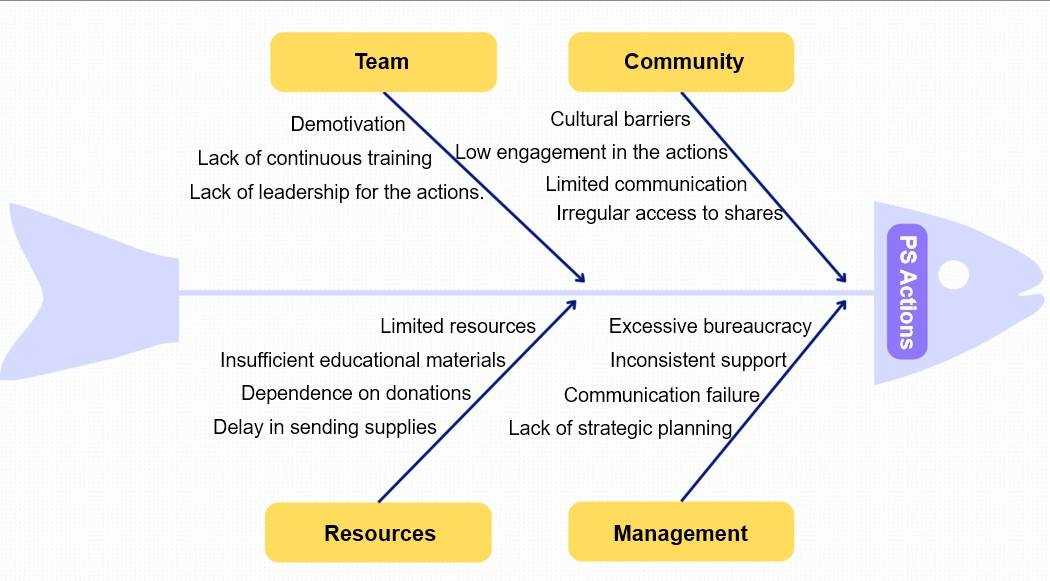
Figure 1. Ishikawa diagram
Note: Illustrating the main challenges associated with the implementation of Health Promotion actions for older adults in Primary Health Care, organized into four categories: team, community, resources, and management. Navegantes, Santa Catarina, Brazil, 2025.
To illustrate the four main constructions identified through the analysis and systematized in the Ishikawa diagram, illustrative excerpts from the participants' statements are presented below.
“I have the desire, but I would also need the knowledge”: in healthcare teams’
planning
and implementation of Health Promotion actions.
The actions developed by the
healthcare teams were predominantly focused on preventing
complications, particularly those associated with the most prevalent chronic conditions among older
adults. The incorporation of broader Health Promotion approaches remained limited, restricting the
scope and potential impact of these practices within the routine activities of the services.
“The actions we carry out are intended to prevent further harm to patients’ health. [...] In
this way, we
avoid having more cases of chronic conditions such as hypertension, diabetes, and obesity
[...] and help
keep the population healthier [...]” (Hera)
Furthermore, the participants’ reports highlighted operational difficulties that
affect the work
of healthcare teams. Staff shortages and professional demotivation limit the planning,
implementation, and continuity of collective Health Promotion actions.
“[...] there are professionals who are demotivated [...] there is a lack of incentive, we
need incentive [...]”.
(Apollo)
“[...] there are few of us and so sometimes we fail to do certain things due to lack of time
[...]”. (Aphrodite)
“[...]this is hampered by the demand for acute problems, which we end up having to solve
[...].” (Hera)
Nevertheless, leadership emerged as a fundamental element in the organization and
motivation of
healthcare teams. Participants highlighted the absence of technical leadership and qualified support
to guide the planning and implementation of Health Promotion actions, particularly those aimed at
promoting active and healthy aging.
“Trying to convince patients to adhere”: Low adherence as a barrier imposed
by the community Professionals also attributed low participation to weak bonds between older
adults and the health
unit. The lack of collective spaces for interaction and the difficulty in establishing
lasting relationships were identified as factors that limit engagement over time.
Furthermore, socioeconomic conditions
were reported as additional barriers affecting access to services and participation in
Health Promotion
activities.
“[...] there’s that issue of the
groups [...] when we manage to rescue them [...] it will be more effective [...] to
create stronger bonds [...]”. (Athena)
“[...] what’s missing is someone who [...] has
leadership skills [...] who will pull the team along and make
things happen. Because the team is very cohesive, but without someone to organize, the
actions don’t
hold up.”
(Minotaur)
“[...] We will perhaps need people who already have experience to pass it on to us [...] We
want to do things
differently, but often we don't know where to start. [...] we even try, but without this
support it's difficult to
continue.” (Apollo)
“[...] The biggest challenge is this, [to] make [...] it happens.” (Minotaur)
Low participation among older adults emerged as one of the main challenges faced by
healthcare teams.
This recurring issue compromises both the continuity and effectiveness of Health Promotion
actions.
In many cases, the challenge manifests as difficulties in engaging and mobilizing the
community to
participate in the proposed activities.
“[...] the most difficult thing is trying
to convince patients to adhere [...]”. (Minotaur)
There’s no way we can carry out Health
Promotion actions if we don’t have community support [...]”.
(Hera)
“[…] currently, participation is low […]
not [...] because of the users […] but because of the few activities
they are carrying out at this moment […]”. (Hera)
“We have to pay for everything out of our own pockets”: constraints as a barrier to
Health
Promotion actions Within the daily routine of the service, insufficient structural support
permeates work processes and
directly affects the implementation of Health Promotion actions. Limited access to basic
materials shifts
responsibility for enabling these initiatives to healthcare teams, even though such actions
should be
supported institutionally.
“We need to be heard first”: Communication barriers and the
bureaucratization of management Participants’ accounts also revealed the absence of systematic
opportunities for dialogue and meaningful
engagement with management. This limitation reduces team autonomy and hinders the
implementation
of actions within the territory, particularly those that require planning,
coordination, and continuity.
“I want to form my group [...],
but I need my superior to say: 'go ahead, form your group' [...] so we need
that, we need to be heard first [...]”. (Apollo)
“[...] there's a lack of feedback [...] of knowing if what we ask for will
be granted [...]”. (Athena)
“[...] we speak, but many times it seems like it doesn't get us anywhere
[...]”. (Apollo)
Discussion The Health Promotion actions implemented in Primary Health Care Units
(PHCUs) revealed
considerable heterogeneity in the activities offered, reflecting conceptual and
policy-related
challenges in defining and operationalizing Health Promotion6.
A predominance of practices focused
on specific conditions, particularly Noncommunicable Chronic Diseases (NCDs), was
identified. These
practices remain largely anchored in a biomedical model that prioritizes the
complaint–conduct
approach. Such a perspective limits the incorporation of actions addressing the
social determinants
of health and maintains Health Promotion as primarily associated with the prevention
of health
problems, which is inconsistent with the principles of the National Health Promotion
Policy (NHPP)15.
This pattern has also been described in other studies, which report
the widespread implementation of
actions linked to the School Health Program (SHP), groups for pregnant women and
health education
groups for individuals with hypertension and diabetes within Primary Health Care
(PHC)16,17. In the
present study, this configuration reinforces the relative invisibility of older
adults, as the few initiatives
identified as promoting active and healthy aging were limited to incipient actions
such as walking
groups, community gardens, and health education activities. Although relevant, these
practices still
lack strategic planning, institutional support, and a broader conceptual foundation,
thereby limiting
their potential to promote autonomy, functional capacity, and quality of life in
later life18,19.
Although the Brazilian Unified Health System (SUS) has a specific
policy to guide Health Promotion
actions6,
these practices remain largely focused on the prevention of complications and the
control
of noncommunicable chronic diseases (NCDs) in the daily routine of health
services20. In the present
study, actions targeting older adults were predominantly directed toward the
management of chronic
conditions, with limited incorporation of strategies aimed at promoting autonomy,
functional
capacity, and active aging3.
Working conditions emerged as a structuring factor in this context.
Professional demotivation
and the lack of institutional support hinder the organization, implementation, and
continuity of
collective actions, particularly those targeting older adults21. These
challenges are compounded
by weaknesses in professional training, as participants reported feeling
insufficiently prepared
despite their willingness to adopt different approaches. This finding reinforces the
need for greater
technical support, continuing education opportunities, and spaces for professional
exchange and
critical reflection. As a result, many actions remain confined to traditional
formats focused on the
transmission of information, with limited opportunities for dialogue and the
co-construction of
knowledge and practices with the community22.
National guidelines emphasize that Health Promotion actions should be
developed with the
community rather than for the community4, erequiring the overcoming of
top-down approaches
that are insensitive to the experiences, needs, and realities of the territory.
Furthermore, community
participation, particularly among older adults, contributes to empowerment,
self-care, and
improvements in quality-of-life23.
In this context, leadership emerged as a critical issue. Although
participants reported positive
teamwork and collaborative relationships, they also expressed the need for leaders
capable of driving,
coordinating, and sustaining initiatives over time. In the absence of such
leadership, actions become
excessively dependent on individual motivation and are therefore more vulnerable to
the challenges
and fluctuations of daily practice9.
Regarding the community, low participation in Health Promotion
activities emerged as one of
the main challenges faced by healthcare teams. Reduced participation among older
adults has
already been identified in the literature as an obstacle to the continuity and
effectiveness of such
activities, highlighting limitations in the ways these actions are integrated into
and appropriated
by the community24. These findings reinforce that
participation should not be understood solely
as an individual decision, but rather as an expression of broader social, cultural
and organizational
conditions. Although participants did not explicitly use the term “cultural
barrier,” their accounts
revealed difficulties related to how Health Promotion actions interact—or fail to
interact—with the
lifestyles, expectations, values, and reference frameworks of the community.
Previous studies indicate that low participation is also associated
with concrete everyday factors,
such as geographic barriers, transportation difficulties, and limited access to
services, particularly
in contexts of greater social vulnerability5-7. Furthermore, participation tends
to be lower when
individuals do not perceive clear benefits from the activities offered or have
limited confidence in
their effectiveness. These aspects are closely associated with levels of
satisfaction and the bonds
established between users and healthcare teams1-4.
The methodology adopted in Health Promotion actions is also known to
directly influence this
scenario. In the context of the present study, isolated and traditional practices
demonstrated limited
potential for community engagement, as they tend to reinforce vertical relationships
and the passive
role of users in the educational process23. In contrast, interventions
oriented toward autonomy,
empowerment, and active participation promoted greater engagement, fostering
dialogue between
scientific and popular knowledge while strengthening the bonds between healthcare
teams and the
communities they serve25.
For older adults, this perspective is particularly relevant. By
recognizing individual trajectories, lived
experiences, and social contexts, such approaches contribute to individuals
perceiving themselves
as active participants in their own care. This perspective is consistent with the
principles of Health
Promotion, which recognize social participation as a fundamental component of
health-promoting
practices25.
Resources—whether material, financial, or structural—are fundamental for the
implementation of
Health Promotion (HP) actions within Primary Health Care (PHC)26.
However, participants’ accounts
highlighted that the scarcity of these resources constitutes a recurring barrier,
compromising both
the continuity and quality of the initiatives developed. Resource limitations not
only affect the
implementation of actions but also restrict opportunities for innovation and the
adaptation of
initiatives to local needs27.
Insufficient resources also influence professionals’ perceptions of the value and
feasibility of their
work. The lack of adequate materials and infrastructure tends to generate feelings
of devaluation
and frustration, negatively affecting team motivation and the quality of the
practices developed
desenvolvidas15-28.
This scenario highlights the need for stronger coordination between management
and healthcare teams to identify gaps and develop solutions that are responsive to
local realities15.
To address these challenges, adequate planning is essential, with priority given to
strengthening
infrastructure and providing support for healthcare teams. Furthermore, the
implementation of
participatory strategies may broaden the impact of Health Promotion (HP) initiatives
and enhance
their sustainability23.
Regarding older adults, the lack of managerial support and organized
strategies has directly affected
the continuity of actions aimed at promoting active and healthy aging. The absence
of institutional
responsiveness and support has hindered initiatives that could foster social
participation, autonomy,
and functional capacity in later life—fundamental pillars of healthy aging and
quality of life. In this
sense, Health Promotion actions targeting older adults require strategic planning
and institutional
coordination that consider their specific needs and recognize the territory as a
space for the collective
construction of health.
Management plays a central role in defining priorities, allocating resources, and
sustaining actions
developed within Primary Health Care (PHC)19. When active aging is not
established as a strategic
priority within institutional agendas, Health Promotion actions targeting older
adults tend to
assume a sporadic and fragmented character. In such situations, these initiatives
become excessively
dependent on the individual efforts of healthcare professionals15,
compromising their continuity
and reach. This scenario weakens PHC practices and reinforces the invisibility of
older adults in the
planning and implementation of collective actions17.
The bureaucratization of decision-making processes and delays in
institutional responses discourage
Health Promotion initiatives within Primary Health Care, particularly those that
require intersectoral
coordination and sustained support24. Strengthening participatory
management through greater
interaction between decision-making levels and local teams may foster more
consistent actions that
are better aligned with the needs of healthy aging within PHC25.
Although this study allowed for an in-depth analysis of Health
Promotion practices within Primary
Health Care, some limitations should be acknowledged. The sample consisted of
healthcare
professionals from a single municipality and a single Primary Health Care Unit
(PHCU), which may
limit the transferability of the findings to other contexts. Furthermore, data
collection was restricted
to healthcare professionals and did not include the perspectives of service users.
Future studies
should incorporate the views of older adults and other community members, as well as
explore
different regional contexts, to provide a more comprehensive understanding of the
challenges and
opportunities associated with Health Promotion in Primary Health Care. Conclusions The study findings demonstrated that, although initiatives aimed at
promoting active and healthy
aging exist within Primary Health Care (PHC), they remain sporadic, poorly
systematized, and
frequently constrained by structural, organizational, and managerial barriers. A
biomedical model
continues to predominate, with practices focused primarily on chronic conditions,
while actions
aimed at promoting functional capacity, quality of life, autonomy, and empowerment
among older
adults remain limited. The findings highlight the need to strengthen the role of older
adults in their own care through
improved institutional coordination and greater responsiveness and dialogue between
healthcare
teams and management. Such efforts may facilitate the planning and implementation of
Health Promotion actions, create conditions for greater empowerment and active
participation among older
adults, and consolidate practices that value autonomy, self-care and community
participation.
Conflicts of Interest: The authors declare no conflicts of
interest.
Funding: This study is part of the doctoral research
project entitled “Challenges and Opportunities
for Health Promotion Among Older Adults in Primary Health Care: A
Fourth-Generation Evaluation.” The
study received no specific grant from any funding agency in the public, commercial,
or not-for-profit
sectors. Author contributions: FSTdS: Conceptualization; Data
Curation; Formal Analysis; Investigation;
Methodology; Supervision; Validation; Writing – Original Draft Preparation; Writing
– Review &
Editing. JGdS: Validation; Writing – Review & Editing. LEW: Writing – Original Draft
Preparation; Writing
– Review & Editing. RdSM: Writing – Review & Editing. BPdA: Data Curation;
Visualization; Writing –
Review & Editing. AdLS: Conceptualization; Investigation; Supervision;
Visualization; Writing – Review
& Editing.
References
Heidemann ITSB, Alonso da Costa MFBN, Hermida PMV, Marçal CCB,
Antonini FO,
Cypriano CC.
Health promotion practices in primary care groups. Glob Health
Promot.
2019;26(1):25-32.
https://doi.org/10.1177/1757975918763142
Carvalho FFBD, Akerman M, Cohen SC.
Promoção da Saúde na Atenção Básica: o
papel do setor Saúde, a mudança comportamental e a abordagem individual.
Estud. Av.
2023;37(109):89–104.
https://doi.org/10.1590/s0103-4014.2023.37109.007
Ministério da Saúde-Brasil.
Recomendações para operacionalização da Política Nacional
de Promoção da Saúde na Atenção Primária à Saúde. Secretaria de Atenção
Primária à
Saúde. Departamento de Promoção da Saúde. Brasília; 2022. 49 p. Consulta:
Março 01, 2025.
Disponível em:
https://www.conass.org.br/recomendacoes-para-operacionalizacao-da-politica-nacional-de-promocao-da-saude-na-atencao-primaria-a-saude/
Silva LP, Sousa NCB de, Muniz TR, Silva OS da.
Estratégias coletivas de cuidar promovidas
por equipes da unidade básica de saúde a idosos: Estratégias promotoras de
saúde a
idosos. Revista Brasileira Em Promoção Da Saúde. 2024;36.
https://ojs.unifor.br/RBPS/article/view/13618
Mrejen M, Nunes L, Giacomin K.
Envelhecimento populacional e saúde dos idosos: o Brasil
está preparado? São Paulo: Instituto de Estudos para Políticas de Saúde.
2023; 39 p. (Estudo
Institucional IEPS, n. 10). Consulta: Março 01, 2025. Disponível em:
https://ieps.org.br/wp-content/uploads/2023/01/Estudo_Institucional_IEPS_10.pdf
Ministério da Saúde-Brasil.
Portaria nº 2.446, de 11 de novembro de 2014. Redefine a
Política Nacional de Promoção da Saúde. Diário Oficial da União. 12 Nov
2014.
Ceccon RF, Soares KG, Vieira LJE de S, Garcia Júnior
CAS, Matos CC de SA, Pascoal MD de
HA. Atenção Primária em Saúde no cuidado ao idoso dependente e
ao seu cuidador. Ciênc.
Saúde Colet. 2021;26(1):99–108.
https://doi.org/10.1590/1413-81232020261.30382020
Wangler J, Jansky M.
Promotion of exercise and health for older people in primary care:
a qualitative study on the potential, experiences and strategies of general
practitioners in
Germany. J Prev. 2023;44:477–490.
https://doi.org/10.1007/s10935-023-00730-6
Franco CM, Giovanella L, de Almeida PF, Fausto
MCR.
Working practices and integration
of primary health care doctors in remote rural areas in Brazil: a
qualitative study. BMC Prim.
Care. 2024;25:319.
https://doi.org/10.1186/s12875-024-02553-8
Guba EG, Lincoln YS.
Avaliação de quarta geração. 2. ed. Campinas: Unicamp; 2011. 272 p.
Instituto Brasileiro de Geografia e
Estatística-IBGE.
Navegantes (SC): panorama Rio de
Janeiro: IBGE; 2022 Consulta: Dezembro 18, 2025. Disponível em:
https://cidades.ibge.gov.br/brasil/sc/navegantes/panorama
Ishikawa K.
Controle de qualidade total: à maneira japonesa. Rio de Janeiro: Campus;
1993.221 p.
Hosseini M, Resnik DB, Holmes K.
The ethics of disclosing the use of artificial intelligence
tools in writing scholarly manuscripts. Res Ethics.
2023;19(4):449–465.
https://pmc.ncbi.nlm.nih.gov/articles/PMC11694804/
Silva FST da, Souza JG de, Weimer LE, Macuch R da S,
Assis BP de, Santos A de L.
Transcrições anonimizadas de entrevistas sobre Promoção da Saúde da pessoa
idosa na
Atenção Primária-Dataset. Mendeley Data; 2026.
https://doi.org/10.17632/v9ph8282mn.2
Santos JS, Santos Neto PM dos.
Formação para o Sistema Único de Saúde (SUS) na residência
em área profissional da saúde: análise dos efeitos da política em um
contexto estadual.
Interface (Botucatu). 2023;28:e230587.
https://doi.org/10.1590/interface.230587
Becker RM, Heidemann ITSB.
Health promotion in care for people with chronic nontransmitable
disease: integrative review. Texto Contexto Enferm.
2020;29:e20180250. https://doi.org/10.1590/1980-265X-TCE-2018-0250
Kessler M, Thumé E, Duro SMS, Tomasi E, Siqueira FCV, Silveira DS,
et al.
Ações
educativas e de promoção da saúde em equipes do Programa Nacional de
Melhoria do
Acesso e da Qualidade da Atenção Básica, Rio Grande do Sul, Brasil.
Epidemiol Serv Saúde.
2018;27(2):e2017389.
http://dx.doi.org/10.5123/s1679-49742018000200019
Placideli N, Castanheira ERL.
Atenção à saúde da pessoa idosa e ao envelhecimento em
uma Rede de Serviços de Atenção Primária. Rev Kairós Gerontol.
2017;20(2):247-269. https://revistas.pucsp.br/index.php/kairos/article/view/2176-901X.2017v20i2p247-269
Almeida PF de, Medina MG, Fausto MCR, Giovanella L,
Bousquat A, Mendonça MHM
de.
Coordenação do cuidado e Atenção Primária à Saúde no Sistema Único de Saúde.
Saúde
Debate. 2018;42(1):244–60. https://doi.org/10.1590/0103-11042018S116
Bisak A, Stafström M. Unleashing the potential of Health
Promotion in primary care - a
scoping literature review. Health Promot Int. 2024;39(3):daae044.
https://doi.org/10.1093/heapro/daae044
Silva BG, Silva LA, Silva RM, Leal AS, Filgueiras
TF, Carício MR, et al.
Trabalho interdisciplinar
e condições de trabalho de enfermeiros que atuam na Atenção Primária à
Saúde. Enferm Foco.
2024;15(1):e-202413SUPL1.
https://enfermfoco.org/wp-content/uploads/articles_xml/2357-707X-enfoco-15-s01-e-202413SUPL1/2357-707X-enfoco-15-s01-e-202413SUPL1.pdf
Iglesias A, Garcia DC, Pralon JA, Badaró-Moreira
MI.
Educação permanente no sistema
único de saúde: concepções de profissionais da gestão e dos serviços.
Psicol
Ciênc Prof.
2023;43:e255126.
https://doi.org/10.1590/1982-3703003255126
Ministério da Saúde-Brasil.
Autocuidado em saúde e a literacia para a saúde no contexto da
promoção, prevenção e cuidado das pessoas em condições crônicas: guia para
profissionais
da saúde. Secretaria de Atenção Primária à Saúde. Departamento de Prevenção
e Promoção
da Saúde. Brasília; 2023. 51 p. Consulta: abril 10, 2025. Disponível em:
https://biblioteca.cofen.gov.br/autocuidado-em-saude-e-a-literacia-para-a-saude-no-contexto-da-promocao-prevencao-e-cuidado-das-pessoas-em-condicoes-cronicas/
Prado GAS, Caetano MVA.
Apontamentos sobre a noção de território no campo da saúde
coletiva: determinação, identidades e territorialidades. Saúde
Debate.
2024;48(spe2):e8730.
https://doi.org/10.1590/2358-28982024E28730P
Souza EM de, Silva DPP, Barros AS de.
Educação popular, promoção da saúde
e envelhecimento ativo: uma revisão bibliográfica integrativa. Cienc
Saude
Colet.
2021;26(4):1355–1368. https://doi.org/10.1590/1413-81232021264.09642019
Marchetti JR, Santana SK.
Gestão dos recursos na atenção primária à saúde. Anu Pesqui
Extens Unoesc Xanxerê. 2020;5:e24258.
https://periodicos.unoesc.edu.br/apeux/article/view/24258
Souza LEPF de, Paim JS, Teixeira CF, Bahia L, Guimarães R, Almeida-Filho
N de, et
al.
Os desafios atuais da luta pelo direito universal à saúde no Brasil.
Cienc
Saude Colet.
2019;24(8):2783–92. https://doi.org/10.1590/1413-81232018248.34462018
Figueiredo IDT, Torres GMC, Cândido JAB, Morais APP,
Pinto AGA, Almeida MI de.
Planejamento estratégico como ferramenta de gestão local na atenção primária
à saúde.
Rev. Fam. Ciclos Vida Saúde Contexto Soc. 2020;8(1):27-38.
https://www.redalyc.org/journal/4979/497962779006/html/
The scarcity of supplies, materials, and structural support was identified as a recurring obstacle
to the
implementation of Health Promotion actions, directly affecting the work of healthcare teams.
“[...]here, sometimes, we don’t have many
resources[...]”. (Aphrodite)
“[...] difficulty [...] of materials and
equipment for some activities that we might want to develop [...]”. (Artemis)
In addition to operational limitations, participants highlighted the lack of consistent
institutional and
structural support. In some cases, this shortcoming required healthcare professionals to cover basic
expenses using their own resources to enable the implementation of Health Promotion actions,
contributing to professional exhaustion and feelings of institutional neglect.
“[...] what we lack is the collaboration of
management for materials [...] offering coffee, souvenirs [...]
because we have to pay for everything out of our own pockets [...]”. (Zeus)
“[...] if I need to print material [...]
it will all be black and white [...] a folder like that doesn't attract attention
[...] we would need support [...] of material [...]”.
(Apollo)
“[...] I think that improving things
would be having free access to materials [...] scheduling appointments
and not lacking anything [...] because sometimes there is a lack of material [...]”
(Zeus)
Within the management context, participants’ accounts revealed that weak
institutional communication
and bureaucratic decision-making processes constitute important barriers to the
implementation
of Health Promotion actions. Management was perceived as being distant from the
daily realities of
healthcare teams, particularly regarding actions aimed at promoting active and
healthy aging among
older adults.
“[...] sometimes what doesn't
depend on our primary health care unit, what depends on outside, on the
management of the Secretariat, takes time”
(Zeus)
“[...] there’s no way we can carry out Health Promotion actions if we don’t
have support from the city hall
[...]”.
(Hera)
