Artificial intelligence: An opportunity amid structural gaps
Artificial intelligence (AI) is rapidly transforming multiple fields,
particularly medicine and the health sciences, not only as a
technological innovation but also as a potential shift in how clinical
decisions are made, healthcare services are organized, and health
systems are structured1. From
diagnostic algorithms and predictive
models to the recent emergence of generative models and
generative AI tools, AI has evolved from isolated applications into
technologies capable of reshaping clinical care processes as well
as operational and administrative functions related to healthcare
delivery2-5. The exponential advancement
of
this technology has
generated considerable expectations regarding its potential to
improve quality, efficiency, and access to healthcare, while also
raising important concerns about safety, equity, governance, and
accountability6.
As health systems begin to adopt and explore the use of AI, it is
becoming increasingly clear that the analysis of these technologies
can no longer focus solely on the technical capabilities of algorithms.
The more critical question is whether AI can be effectively integrated
to strengthen health systems and how this can be achieved, given
its potential to help reduce structural gaps. However, inappropriate
implementation carries the risk of reproducing and even amplifying
pre-existing inequalities, particularly in settings such as Latin
American countries, where structural barriers remain pervasive,
including those observed in Colombia7,8.
This question is particularly important in Latin America, where health systems face
institutional
fragmentation, health workforce shortages, financial constraints, and persistent gaps in access to
care9,10. In this context, AI
represents not only a frontier technological innovation but also a potential
tool for expanding capacity in areas where structural limitations currently exist10.
Several studies have demonstrated the utility of machine learning–based tools for
specific diagnostic
tasks, clinical risk prediction, and support for repetitive processes8,11,12.
More recently, the expansion
of generative AI models has created new opportunities in clinical documentation, medical education,
conversational support, and the analysis of complex information. These applications are enabled by
advanced deep learning capabilities, the processing of large volumes of data, and the development
of models capable of generating content and supporting decision-making processes in complex
environments13,14.
However, technological potential alone does not guarantee improvements in health
outcomes.
The implementation of AI in healthcare is, fundamentally, a sociotechnical challenge3,10,15. The
performance of AI models is important, but so are data quality, regulatory frameworks, institutional
trust, and the readiness of health systems and their stakeholders to adopt these technologies4,10-12,16. Indeed, the healthcare sector is being reshaped by
one of the driving forces of the Fourth Industrial
Revolution, and whether this transformation unfolds successfully way will depend on those responsible
for implementing it: governments and health systems.
Artificial intelligence at a crossroads: closing or widening gaps
In Latin America, AI has the potential to become a tool for reducing long-standing
inequities or, if
implemented without appropriate safeguards, a mechanism capable of deepening them1,17. This
tension reflects one of the major challenges currently facing the integration of these technologies
into healthcare. Limitations related to interoperability, digital maturity, data representativeness,
and institutional capacity persist and are closely shaped by the heterogeneity of the region’s health
systems. In addition, a large proportion of technological developments originate outside Latin
America, raising important questions about their external validity, technological sovereignty, and the
appropriateness of their application in local contexts10,12,15.
The risks are well recognized: algorithmic bias, opacity in decision-making, digital
exclusion, systematic
errors affecting underrepresented populations, and new forms of technological dependence.
However, the opportunities are equally evident: improving access to care, optimizing resource
allocation, strengthening continuity of care, and supporting complex clinical decision-making10,15. In
this context, particularly in Latin America, AI could help improve the quality of care, expand access
(one of the region’s most persistent challenges), and mitigate the impact of shortages of specialized
healthcare personnel, thereby promoting more timely care delivery. These effects could, in turn,
reduce the burden on health systems and associated costs, while also influencing social determinants
relevant to health across the region10,15.
At present, Latin America lacks the computing capacity required to manage large volumes
of data,
as well as the information technology needed to integrate, adopt, and use AI effectively in the
healthcare sector. Across the region, supercomputing infrastructure remains limited compared with
that of more technologically advanced regions, restricting the analytical capacity and scalability of
these tools. Consequently, without investment in infrastructure, and in policies designed to support
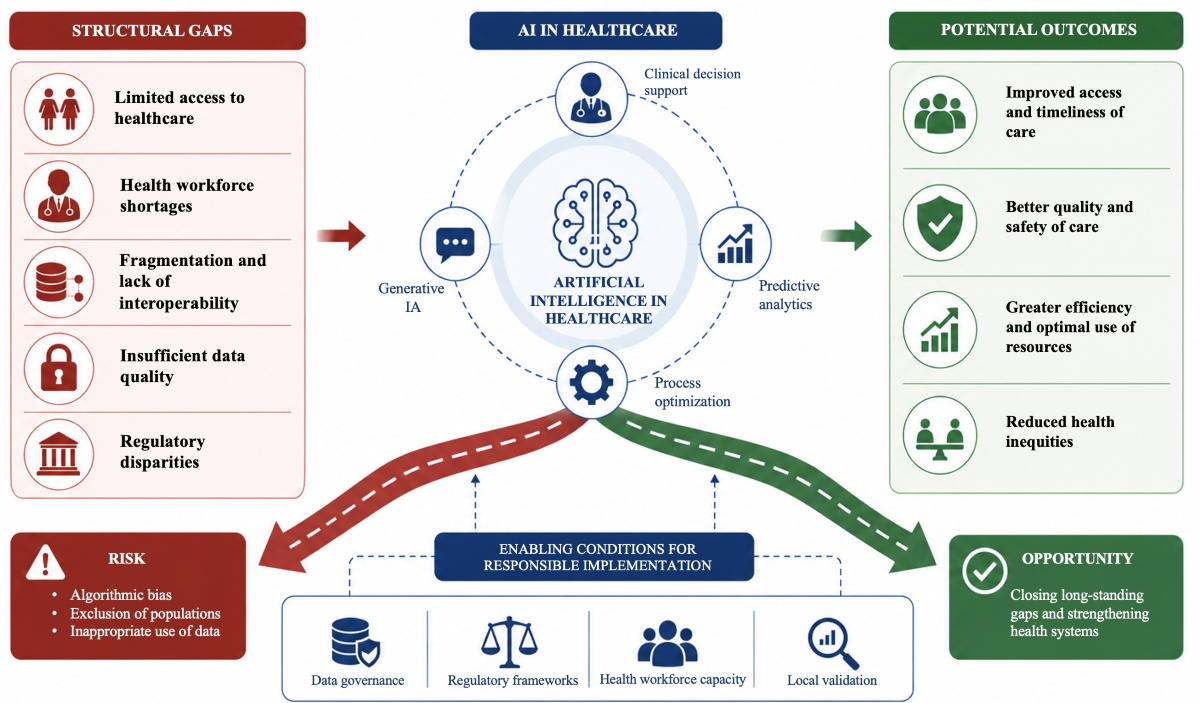
its implementation, the potential of AI to transform health systems will remain constrained10,11,14,15 Figure
1.
Figure 1. Artificial intelligence as a crossroads for health systems in Latin
America
Artificial intelligence (AI) can either amplify structural gaps or help close them, depending on
enabling conditions such as
data governance, regulation, ethical frameworks, human resources for health, and local validation.
(Figure created with the
assistance of generative artificial intelligence [ChatGPT, OpenAI] for visual design and composition).
Data governance, ethics, and trust as foundational pillars
One of the most important debates surrounding the adoption of AI in healthcare concerns data
governance. These technologies rely on robust, longitudinal, and representative clinical data, but
they also raise critical questions regarding privacy, informed consent, secondary use of data, and
digital sovereignty14,15.
In middle-income countries, these discussions are particularly relevant. It is not only
about protecting
data but also about determining who controls it, how the value it generates is distributed, and how to
avoid new forms of technological dependence18,19. Equally important is the need to address ethical
dimensions such as bias, transparency and accountability. In healthcare, these issues are not ancillary
considerations but essential requirements for safe implementation19,20.
The emergence of generative AI models has made this discussion even more urgent. Although
these technologies offer significant opportunities for clinical and administrative support, they also
introduce risks related to plausible errors, unsupervised automation, and cognitive dependence
15. This reinforces the need
for innovation and caution to advance hand in hand.
Colombia as an opportunity for responsible innovation
Colombia reflects many of these regional tensions. Although the country has made progress
in
digitalization and innovation, barriers related to interoperability, fragmentation of clinical
information,
nascent regulatory frameworks, and heterogeneous institutional capacities remain16.
Recent evidence from Colombian institutions indicates that patients, healthcare
administrators,
and engineers simultaneously recognize both the transformative potential of AI and the challenges
nstitutional trust14,16,20.
This finding suggests that
the discussion is not merely technological but also organizational and
political. For this very reason, Colombia could make a significant contribution to developing regional
models for the responsible implementation of AI in healthcare.
Colombia is making progress toward the integration of AI within the public sector, where
initiatives
have been put forward to explore its applications across different sectors, including healthcare.
However, these initiatives, promoted by the institutions responsible for health regulation, remain
limited and lack a clear roadmap for implementation. In this context, the main challenges can be
grouped into several key dimensions: data quality, contextual understanding, regulatory frameworks,
education and resistance to change, research and development, financial resources, infrastructure
and connectivity, as well as scalability16.
Five priorities for a regional agenda
In light of this landscape, a regional agenda for AI in healthcare should prioritize at
least five key
areas10,14,15.
- Strengthen digital infrastructure and interoperability as prerequisites for scalability.
- Promote local clinical validation and regional evidence generation, while avoiding the
uncritical adoption of externally developed solutions.
- Develop risk-based regulatory frameworks capable of balancing innovation with safety and
ethical oversight.
- Invest in health workforce capacity and artificial intelligence literacy as prerequisites for safe
adoption.
- Make equity and public value creation the guiding principles for impact assessment.
These priorities do not represent an exclusively technological agenda but rather a
strategy for
directing innovation toward strengthening health systems.
From technological adoption to value creation
Perhaps one of the most important contributions of AI will not be to automate medicine
but to help
humanize it. Reducing administrative burden, strengthening continuity of care, and freeing up clinical
time for the physician-patient relationship may be among its most valuable applications14.
For Latin America, this opportunity carries important strategic implications. The region
can either
limit itself to adopting technologies designed around external priorities or develop its own models of
responsible innovation aimed at addressing local structural challenges7,10,15.
Artificial intelligence will not, by itself, resolve the region’s structural challenges.
However, if
implemented appropriately, it can become a powerful tool for addressing them. The real challenge is
not technological but political, ethical, and institutional14,19.
Ultimately, the question is not whether artificial intelligence will reach Latin American
health systems,
but whether it will be used to close long-standing gaps or to deepen them. Its impact will depend
not only on its technical capabilities but also on the conditions under which it is implemented: data
governance, the robustness of regulatory frameworks, validation in local contexts, and the capacity
of health systems to integrate it effectively.
In a region marked by structural limitations in access, financing, and institutional
capacity, artificial
intelligence represents both an opportunity and a risk. Its implementation can contribute to improving
the quality of care, optimizing resource use, and expanding access to healthcare; however, it can
also reproduce inequities if it is not guided by a framework grounded in equity and public value. In
this regard, advancing toward the responsible adoption of AI requires strengthening institutional
capacities, investing in infrastructure and health workforce development, and aligning public policies
to ensure that these technologies respond to the region’s actual needs.
Conflict of interest: The authors declare that they have no conflicts of
interest related to this article.
Funding: The authors received no funding for the conduct of this study.
Use of Artificial Intelligence: Generative artificial intelligence tools
(ChatGPT, OpenAI; the latest
version available at the time of manuscript preparation) were used exclusively to assist with the
design and visual composition of graphical elements. The conceptualization, scientific interpretation,
and final review of the content were performed entirely by the authors.
Author contributions: SS-C: Conceptualization; Data Curation; Formal
Analysis; Investigation;
Methodology; Project Administration; Validation; Visualization; Writing – Original Draft Preparation;
Writing – Review & Editing. DA-C: Conceptualization; Investigation; Validation; Supervision; Writing –
Review & Editing. MER-S: Conceptualization; Methodology; Supervision; Validation; Writing – Review
& Editing.
References
-
García-Subirats I, Vargas I, Mogollón-Pérez AS, De Paepe P, da Silva MRF,
Unger JP,
et al. Barriers in access to healthcare in countries with different health systems.
A crosssectional
study in municipalities of central Colombia and north-eastern Brazil. Soc Sci Med.
2014;106:204-13.
https://doi.org/10.1016/j.socscimed.2014.01.054
-
Rajkomar A, Dean J, Kohane I. Machine learning in medicine.
N
Engl J Med.
2019;380(14):1347-58.
https://doi.org/10.1056/NEJMra1814259
-
Davenport T, Kalakota R.
The potential for artificial intelligence in healthcare. Future Healthc
J. 2019;6(2):94-98.
https://doi.org/10.7861/futurehosp.6-2-94
-
Topol EJ.
High-performance medicine: the convergence of human and artificial intelligence.
Nat Med. 2019;25:44-56.
https://doi.org/10.1038/s41591-018-0300-7
-
Takita H, Kabata D, Walston SL, Tatekawa H, Saito K, Tsujimoto Y, et
al. A systematic
review and meta-analysis of diagnostic performance comparison between generative AI and
physicians. npj Digit. Med. 2025;8:175. https://doi.org/10.1038/s41746-025-01543-z
-
Bajwa J, Munir U, Nori A, Williams B.
Artificial intelligence in healthcare: transforming
the practice of medicine. Future Healthcare Journal. 2021;8(2):e188-e194.
https://doi.org/10.7861/fhj.2021-0095
-
Peters DH, Garg A, Bloom G, Walker DG, Brieger WR, Rahman MH.
Poverty and access to
health care in developing countries. Annals New York Academy of Sciences.
2008;1136:161-71.
https://doi.org/10.1196/annals.1425.011
-
Younis HA, Eisa TAE, Nasser M, Sahib TM, Noor AA, Alyasiri OM, et
al.
A systematic review
and meta-analysis of artificial intelligence tools in medicine and healthcare: applications,
considerations, limitations, motivation and challenges. Diagnostics. 2024;14:109. https://doi.org/10.3390/diagnostics14010109
-
Gutiérrez JD, Muñoz-Cadena S. 25: Artificial intelligence in
Latin America’s public
policy cycles. En: Secchi L, Cruz-Rubio CN, editores. Handbook of Public Policy in Latin
America. Cheltenham (UK): Edward Elgar Publishing. 2025 p. 405-422.
https://doi.org/10.4337/9781035310197.00034
-
Bakker B, Chen S, Vasilyev D, Bespalova O, Chin M, Kolpakova D, et
al.
What can artificial
intelligence do for stagnant productivity in Latin America and the Caribbean?. Latin
American
Journal of Central Banking. 2025;100192. https://doi.org/10.1016/j.latcb.2025.100192
-
Fahim YA, Hasani IW, Kabba S, Ragab WM.
Artificial intelligence in healthcare and
medicine: clinical applications, therapeutic advances, and future perspectives. Eur J Med
Res.
2025;30:848.
https://doi.org/10.1186/s40001-025-03196-w
-
Rios-Garcia W, Sofía F, Silva-Jiménez, Banegas-Báez D, Rios-Garcia
AA.
Artificial
intelligence for chronic disease screening in Latin America and the Caribbean: the diagnostic
potential of digital health. J. Med. Syst. 2025;49:82. https://doi.org/10.1007/s10916-025-02218-8
-
Al-Nafjan A, Aljuhani A, Alshebel A, Alharbi A, Alshehri A.
Artificial intelligence in predictive
healthcare: a systematic review. J. Clin. Med. 2025;14(19):6752. https://doi.org/10.3390/jcm14196752
-
Angus DC, Khera R, Lieu T, Liu V, Ahmad FS, Anderson B, et al.
AI, health, and health
care today and tomorrow: The JAMA Summit Report on Artificial Intelligence. JAMA.
2025;334(18):1650-64.
https://doi.org/10.1001/jama.2025.18490
-
González-Argote J, Alonso-Galbán P, Vitón-Castillo AA, Lepez CO,
Castillo-Gonzalez W,
Bonardi MC, et al. Trends in scientific output on artificial intelligence and
health in Latin
America in Scopus. EAI Endorsed Scal Inf Syst. 2023;10(4):e5.
vi.3231 https://doi.org/10.4108/eetsis.vi.3231
-
López DM, Osorio JS.
Inteligencia artificial y salud digital en Colombia: panorama de los
avances más recientes y retos futuros. Biomédica. 2025;45(3):5-9. https://doi.org/10.7705/biomedica.8248
-
Roski J, Hamilton BA, Chapman W, Heffner J, Trivedi R, Del Fiol G, et al.
How artificial
intelligence is changing health and health care. In: National Academy of Medicine, The
learning Health System Series, Whicher D, Ahmed M, Israni ST, et al. Artificial intelligence in
health care: the hope, the hype, the promise, the peril. National Academies Press (US); 2023.
https://www.ncbi.nlm.nih.gov/books/NBK605950/
-
Feng M, Mishra S, Ma J, Flaxman S, Bhatt S, Car J, et al.
Artificial intelligence for public
health can harness data for healthier populations. Nat. Health. 2026;1:167-70. https://doi.org/10.1038/s44360-025-00005-w
-
Castaño Castaño S.
La inteligencia artificial en salud pública: oportunidades, retos éticos y
perspectivas futuras. Rev Esp Salud Pública. 2025;99(1):12. https://ojs.sanidad.gob.es/index.php/resp/article/view/1006
-
Garcia A, Girón-Luque F, Roselli D. La integración de la
inteligencia artificial en la
atención médica: desafíos éticos y de implementación. Univ. Med. 2023;64(3).
https://doi.org/10.11144/Javeriana.umed64-3.inte